
Senso-ji in Tokio: an ancient temple at the heart of Asakusa
Published on 08/30/2026 at 10:30 | Editorial responsibility: Rafael Müller, Editor-in-Chief AD HOC NEWS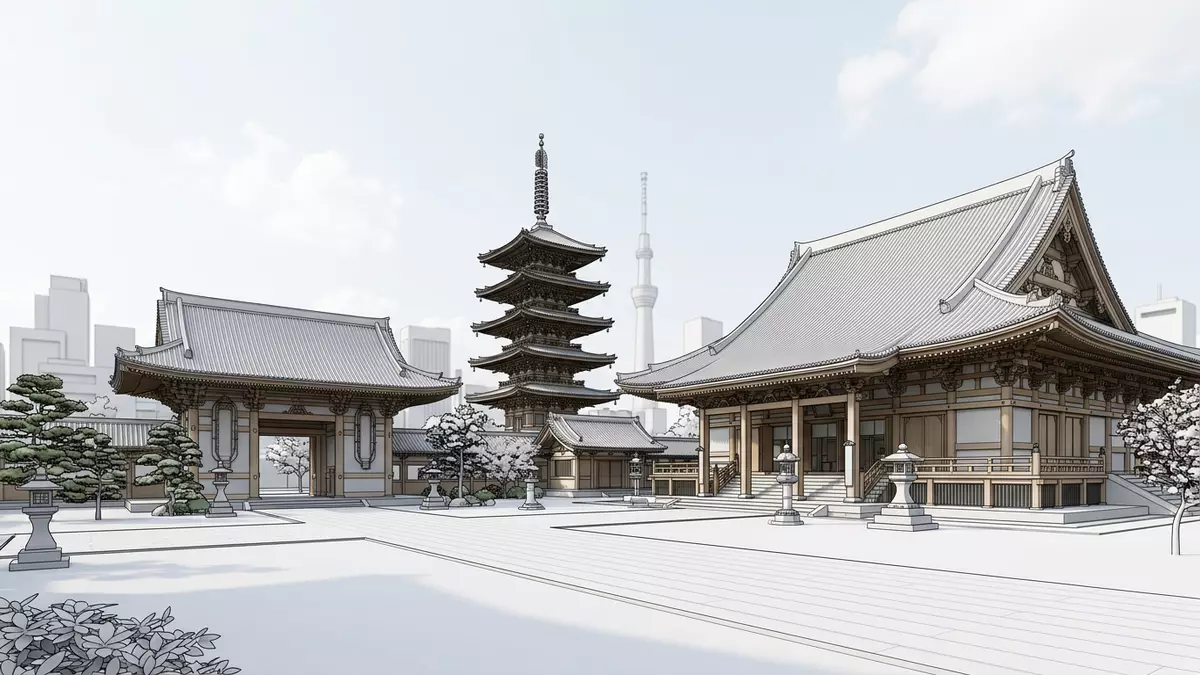
Senso-ji is an ancient Buddhist temple in the Asakusa district of Tokio, dedicated to the bodhisattva Kannon and known for its vivid wooden gates and bustling approach.
The oldest temple in Tokyo’s old riverside quarter
Senso-ji stands in Asakusa, a historic neighbourhood on the eastern side of Tokio near the Sumida River, and is recognised as the city’s oldest temple.Tokyo’s oldest temple The temple’s formal name Kinry?zan Sens?-ji links it to an earlier period when Edo grew around nearby waterways and trading routes.Kinry?zan Sens?-ji The complex gathers its main hall, a five-storey pagoda, smaller halls and gates around a central courtyard laid out in a way that still reflects its emergence as a place of worship along a river settlement.
The origins of Senso-ji are traditionally dated to 628 in the Asuka period, when two fisherman brothers are said to have found a small statue of Kannon in a river and brought it to their village chief.legend of the Kannon statue In 645 the monk Shokai built a hall to house the image, concealing the statue itself as a hidden icon and setting the pattern for a temple that would be rebuilt, expanded and guarded by figures such as Tokugawa Ieyasu and later shoguns.Shokai’s hall in 645 Fires, earthquakes and air raids destroyed earlier buildings, and the present main hall was completed in the twentieth century in reinforced concrete with a traditional timber form.
Kaminarimon, Nakamise-dori and the temple’s wooden axis
The route into Senso-ji begins at Kaminarimon, the Thunder Gate, whose deep red timber frame and suspended lantern mark the outer entrance to the temple grounds from the surrounding district.Kaminarimon gate The gate known formally as Furaijinmon carries statues of wind and thunder gods, a reconstruction completed in 1960 after earlier structures on the site were lost to fire.1960 reconstruction of Kaminarimon Passing beneath its beams leads directly onto Nakamise-dori, a straight shopping street lined with small stalls and shopfronts that runs towards the inner gate Hozomon and the temple’s main courtyard.
Nakamise-dori is paved and flanked by low, continuous buildings, creating a compressed wooden corridor between Kaminarimon and the temple buildings. The facades along the street mix traditional details such as tiled roofs and sliding shutters with brightly coloured shop signs, drawing the eye forward to Hozomon, the Treasure House Gate. Hozomon itself is a towering timber gate facing the main hall, with large lanterns and guardian statues, and serves as the hinge between the commercial approach and the more formal religious precinct beyond. Seen together, the three elements – Kaminarimon, Nakamise-dori and Hozomon – form a clear axis that visitors follow towards the main hall and pagoda.
Main hall, pagoda and the hidden image of Kannon
Beyond Hozomon the main hall, or hondo, stands on a raised platform with wide steps, a sweeping roof and deep eaves sheltering an interior dedicated to Kannon as the principal image.hall dedicated to Kannon Inside, the concealed statue derived from the Asuka-period legend remains enshrined as a hidden Buddha, a presence that has drawn worshippers for centuries.hidden image tradition The hall combines traditional wooden detailing and bright vermilion elements with structural materials designed to withstand seismic forces, giving the building a layered character in which older forms sit on newer foundations.
Beside the main hall stands a five-storey pagoda, its stacked roofs and central spire rising above surrounding buildings and forming a vertical counterpoint to the broad spread of the hondo. Smaller ancillary halls, statues and a stone basin for incense complete the ensemble around the courtyard. From the central space, views extend back along Nakamise-dori towards Kaminarimon and outward to the Sumida River area, underlining how closely the temple remains tied to its riverside setting and its role within the wider fabric of Asakusa.
Visiting Senso-ji: what travellers from Western Europe should know
- Senso-ji stands in the Asakusa district in the north-eastern part of central Tokio, reached by urban rail lines that serve Asakusa Station on several networks.Asakusa Station connections
- The approach from Kaminarimon through Nakamise-dori to the main hall is paved and level, with the only significant climb being the staircase up to the hondo’s platform.
- The temple grounds lie close to the Sumida River, with riverside walks and views of modern towers providing a marked contrast to the low traditional buildings of Asakusa.
- The official language is Japanese and the currency is the yen; English-language signage is present on major approaches and at key points around the complex.
- Entry requirements depend on your nationality; UK travellers can check the FCDO travel advice at gov.uk/foreign-travel-advice, Irish travellers the Department of Foreign Affairs at ireland.ie.
Searching for Senso-ji on social platforms
These links open searches for Senso-ji on each platform.
Frequently asked questions about Senso-ji
Where is Senso-ji located in Tokio?
Senso-ji is in the Asakusa district of Tokio, on the eastern side of the city near the Sumida River and served by Asakusa Station on several rail lines.
What should visitors expect when entering Senso-ji?
Visitors pass through the red Kaminarimon gate and walk along Nakamise-dori, a straight shopping street leading to Hozomon, before reaching the main hall and pagoda around a central courtyard.
What makes Senso-ji distinctive among temples in Tokyo?
Senso-ji combines its status as Tokyo’s oldest temple with a striking sequence of wooden gates, a busy market street and a main hall housing a hidden Kannon image linked to a seventh-century river legend.


