
Senso-ji in Tokio, a wooden gateway to old Buddhist Tokyo
Published on 09/15/2026 at 10:03 | Editorial responsibility: Rafael Müller, Editor-in-Chief AD HOC NEWS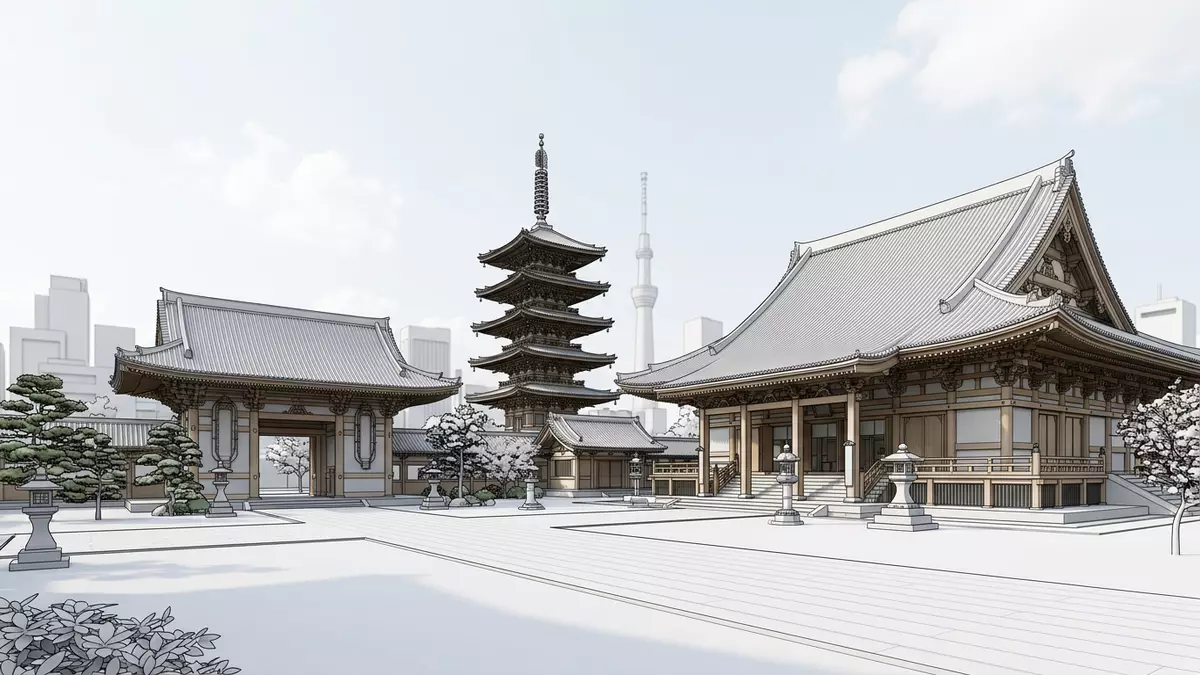
Senso-ji is a Buddhist temple in Asakusa in eastern Tokio, a spacious wooden complex rebuilt after wartime destruction yet still recognised as Tokyo’s oldest temple and a landmark of the city’s religious life. Its story reaches back to the seventh century, when devotion to the bodhisattva Kannon took physical form on the banks of the Sumida River, and its present layout of gates, main hall, pagoda and side shrine turns that long history into a sequence of spaces.
From river legend to early temple in Asuka Japan
The origins of Senso-ji are rooted in the Asuka period, the era when Buddhism was taking hold in Japan and court power was centred around Nara rather than Edo or Tokio. The temple narrative begins in 628, when two brothers named Hinokuma Hamanari and Hinokuma Takenari were fishing in what is now the Sumida River and drew up a small statue of Kannon, the bodhisattva of compassion.discovery of Kannon in 628 The village headman Haji no Nakatomo is recorded as having remodelled his own house into a small sanctuary to enshrine the image, an act that turned a private dwelling into the nucleus of a temple community.remodelled his home into a temple
Senso-ji is traditionally dated to 645, when construction is said to have created a formal temple complex dedicated to Kannon on the Asakusa site.temple completed in 645 That makes it the oldest Buddhist temple in Tokyo and an early focus of worship long before the Tokugawa shogunate turned Edo into a political centre.oldest Buddhist temple in Tokyo Over the centuries it became closely linked with the city’s fortunes, including a period when Tokugawa Ieyasu designated it as a tutelary temple for the ruling clan during the Edo period.association with the Tokugawa clan
Kaminarimon, Nakamise and Hozomon: an approach built as sequence
The approach to Senso-ji from the city side leads first to Kaminarimon, the outer gate whose official name, Furaijinmon, refers to the gods of wind and thunder enshrined on either side. Its centre is dominated by a large hanging lantern painted in deep red, suspended below a beam so that visitors pass under it on their way into the temple grounds.Kaminarimon outer gate with large lantern Beyond Kaminarimon runs Nakamise-dori, the straight shopping street lined with small stalls and shops that leads directly towards the inner gate and gives travellers a compressed cross-section of traditional snacks and souvenir culture between the outer city and the sacred precinct.
At the far end of Nakamise stands Hozomon, the inner gate that guards the main hall and pagoda. Hozomon is a two-storey structure whose present form dates from a reconstruction in 1964 and incorporates fire-resistant materials, because it doubles as a storehouse for Buddhist scriptures and temple treasures.Hozomon rebuilt in 1964 as treasure gate Large Nio guardian statues stand at its front, carved in muscular poses that contrast with the flowing lines of its roof and eaves.Nio guardians at Hozomon Passing through Hozomon brings visitors onto the broad plaza from which the main hall rises ahead and the pagoda stands to one side, framing the temple’s core in vermilion timber and tiled roofs.
Main hall, five-storey pagoda and Asakusa Shrine
The main hall of Senso-ji, known as the Hondo, is the focus of worship for Kannon and the visual anchor of the complex. The original hall was destroyed in bombing raids during the Second World War, and the present building is a post-war reconstruction raised in the 1950s using traditional Japanese timber techniques and tiled roofing.main hall destroyed in 1945 and rebuilt in 1950s Its interior centres on the inner sanctuary housing the image of Kannon, while an outer space admits the flow of devotees and travellers offering incense, following established patterns of Buddhist temple practice in Japan.wood construction and tiled roofs
To one side of the main hall stands a five-storey pagoda, a slender vertical counterpoint to the broad volume of the Hondo. The current pagoda dates from 1973 and is built on a foundation building known as the Toin, with the uppermost storey housing relics of the Buddha received from Sri Lanka’s Isurumuniya Temple.five-storey pagoda rebuilt in 1973 with relics Immediately adjacent to the main hall lies Asakusa Shrine, founded in 1649 under the patronage of Tokugawa Iemitsu to honour the two fishermen brothers and the village headman associated with the temple’s origin story.Asakusa Shrine founded in 1649 The proximity of shrine and temple reflects the historical coexistence of Shinto and Buddhist devotion on this plot of land.
Visiting Senso-ji: what travellers from Western Europe should know
- Senso-ji stands in Asakusa in Taito City in north-eastern Tokio, across the Sumida River from the modern high-rise districts, and is reached by urban rail lines serving Asakusa Station.
- The temple grounds are level in their central areas, but the approaches to Kaminarimon, Hozomon and the main hall involve broad flights of steps and stone paving that call for steady footing.
- Asakusa Shrine is integrated into the Senso-ji precinct on the north side of the main hall, so a single walk through the complex brings visitors past both Buddhist and Shinto structures.
- The official language is Japanese and the currency is the yen; English-language signage is present on the main approaches and around the central buildings.
- Entry requirements depend on your nationality; UK travellers can check the FCDO travel advice at gov.uk/foreign-travel-advice, Irish travellers the Department of Foreign Affairs at ireland.ie.
Searching for Senso-ji on social platforms
These links open searches for Senso-ji on each platform.
Frequently asked questions about Senso-ji
Where is Senso-ji located in Tokio?
Senso-ji stands in the Asakusa district of Taito City in north-eastern Tokio, close to the Sumida River and served by Asakusa Station on urban rail lines.
What can visitors expect during a visit to Senso-ji?
A visit leads through Kaminarimon and the Nakamise shopping street to Hozomon, the main hall and five-storey pagoda, with incense, timber structures and stone paving shaping the experience.
What makes Senso-ji distinctive among Tokyo’s temples?
Senso-ji combines a seventh-century founding legend and status as Tokyo’s oldest temple with a post-war wooden reconstruction, an intact pagoda and the neighbouring Asakusa Shrine on the same grounds.


