

Senso-ji in Tokio: a crimson gateway to old Edo
Published on 08/28/2026 at 21:18 | Editorial responsibility: Rafael Müller, Editor-in-Chief AD HOC NEWS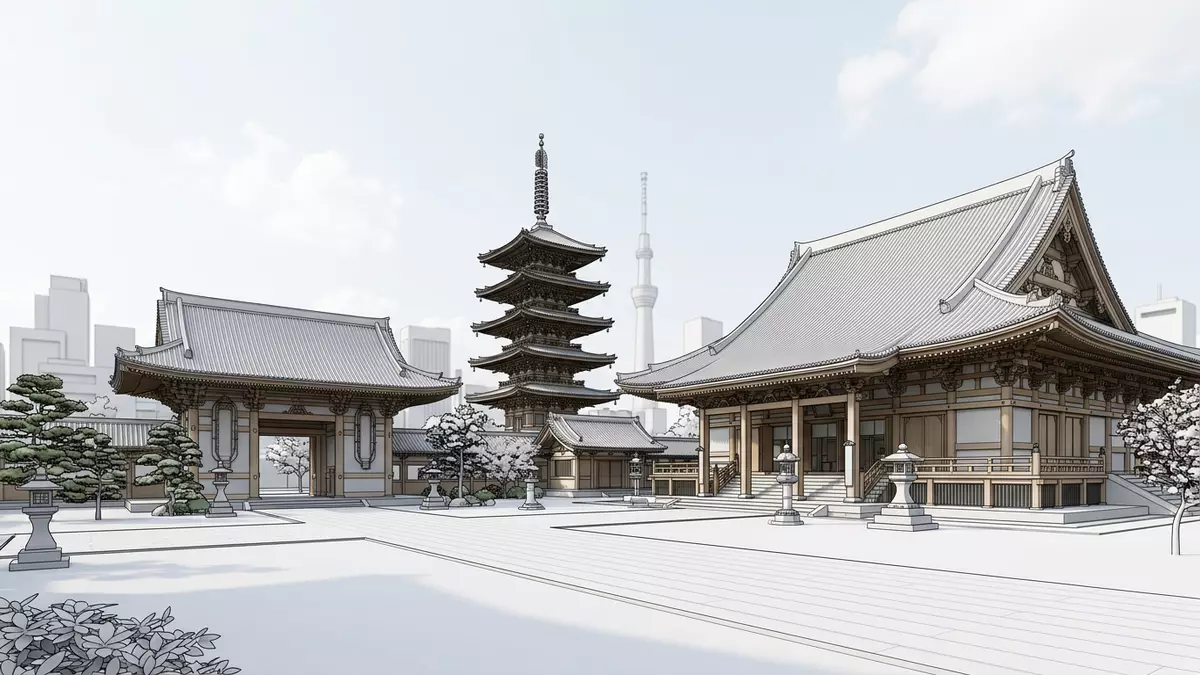
Senso-ji in Tokio’s Asakusa district is a Buddhist temple complex where vivid crimson gates, a towering pagoda and dense incense smoke evoke the city’s Edo-era past. Founded in the seventh century and rebuilt after wartime destruction, it remains a major focus of devotion to Kannon, the bodhisattva of compassion, and an enduring landmark of eastern Tokyo.
The story behind Tokyo’s oldest temple
Senso-ji is rooted in a legend that places its origins in 628, when two brothers fishing on the Sumida River found a small golden statue of Kannon in their nets and began to venerate it. The village headman, Haji no Nakatomo, turned his own house into a shrine, and by 645 a dedicated temple had been founded on the site, making Senso-ji Tokyo’s oldest established Buddhist templecompleted in 645. Over the centuries the complex grew, supported by powerful patrons including Tokugawa Ieyasu, the first Tokugawa shogun, who designated Senso-ji as one of the temples where prayers would be offered for the shogunateprayers of the shogunate.
The temple’s buildings have been destroyed and rebuilt multiple times by fire, earthquake and bombing. During the Edo period, structures such as the main hall and the five-storey pagoda were reconstructed under Tokugawa Iemitsu in the mid-seventeenth century, consolidating Senso-ji’s role at the heart of the shogunal capitaloldest Buddhist temple in Tokyo. The complex suffered heavy damage in 1945, and the current main hall is a post-war reconstruction completed in the late 1950s, built in reinforced concrete but finished to preserve the traditional wooden temple profile and deep eavesreconstruction of the main hall.
Kaminarimon, Nakamise and Hozomon: the temple’s ceremonial approach
The route into Senso-ji from the south runs through Kaminarimon, the Thunder Gate, an outer entrance with massive supporting pillars and a gabled roof that marks the symbolic threshold between city streets and sacred precinct. The gate carries an enormous red lantern and statues of the gods of wind and thunder, Fujin and Raijin, flanking the passageway, along with carved details including a dragon beneath the lanternKaminarimon Thunder Gate. Kaminarimon has existed in various forms since the tenth century and has been relocated and rebuilt several times; the structure visitors pass through dates from the twentieth century and uses modern materials to sustain its traditional silhouette.
Beyond Kaminarimon, a straight, gently rising shopping street known as Nakamise links the outer gate with the inner Hozomon gate. The stalls along Nakamise sell religious items and everyday goods, echoing the long-standing connection between pilgrimage and commerce in Asakusa. Hozomon, whose name means Treasure House Gate, forms the main entrance to the inner temple compound and houses important ritual objects and scriptures on its upper levelTreasure House Gate. The gate carries statues of Nio guardian deities, large lanterns and immense straw sandals that underline its protective role. The existing Hozomon is a concrete reconstruction dating from the 1960s, echoing earlier wooden incarnations but engineered to resist fire.
Main hall, incense and the five-storey pagoda
Passing Hozomon leads directly to the main hall, or hondo, dedicated to Kannon. The hall follows classical Japanese Buddhist temple planning, raised above the surrounding plaza, with broad steps and a dramatic roofline built in traditional timber style even though the underlying structure uses modern materialsJapanese Buddhist architecture. Pilgrims and visitors approach to offer prayers before the altar, while in front of the building a large incense brazier sends smoke drifting across the forecourt. Devotional practices around the incense and the inner hall have continued across many centuries, tying present-day worship to the temple’s seventh-century foundation.
To one side of Hozomon stands Senso-ji’s five-storey pagoda, rising to around 53 m (174 ft) from its foundation to the tip of its finial and ranked among the taller pagodas in Japanfive-storey pagoda. The pagoda’s current form is a twentieth-century reconstruction that preserves the tiered roof profiles and ornamental details of earlier wooden structures, and it is associated with the enshrinement of relics of the Buddha. Immediately adjacent to the main hall stands Asakusa Shrine, founded in 1649 under Tokugawa Iemitsu, which honours the two fisherman brothers and the village headman linked to the temple’s origin storyAsakusa Shrine founded in 1649. Together, the hall, pagoda and shrine form a dense cluster of buildings that express Senso-ji’s layered religious and historical significance.
Visiting Senso-ji: what travellers from Western Europe should know
- Senso-ji stands in the Asakusa district of eastern Tokio, close to the Sumida River, and is reached on foot from Asakusa Station on local rail and subway lines.
- The main approach from Kaminarimon through Nakamise to Hozomon is level but busy, with a short flight of steps leading up to the hondo and additional stairways around the inner precinct.
- Asakusa Shrine and the five-storey pagoda are within the same temple grounds, so moving between the hall, gates and shrine involves short walks across paved surfaces and plazas.
- The official language is Japanese and the currency is the yen.
Searching for Senso-ji on social platforms
These links open searches for Senso-ji on each platform.
Frequently asked questions about Senso-ji
Where is Senso-ji located in Tokio?
Senso-ji stands in Asakusa in Taito ward, on the eastern side of Tokio near the Sumida River, a short walk from Asakusa Station.
What can visitors expect when they enter the temple grounds?
Visitors pass through Kaminarimon and walk along Nakamise towards Hozomon, then reach the incense-filled forecourt and main hall, with the pagoda and Asakusa Shrine close by.
What makes Senso-ji distinctive among Tokio’s temples?
Its seventh-century foundation, association with Kannon, sequence of grand gates and the prominent five-storey pagoda together make Senso-ji a defining historic temple complex of the city.


