
Senso-ji and the layered templescape of Asakusa
Published on 08/31/2026 at 10:09 | Editorial responsibility: Rafael Müller, Editor-in-Chief AD HOC NEWS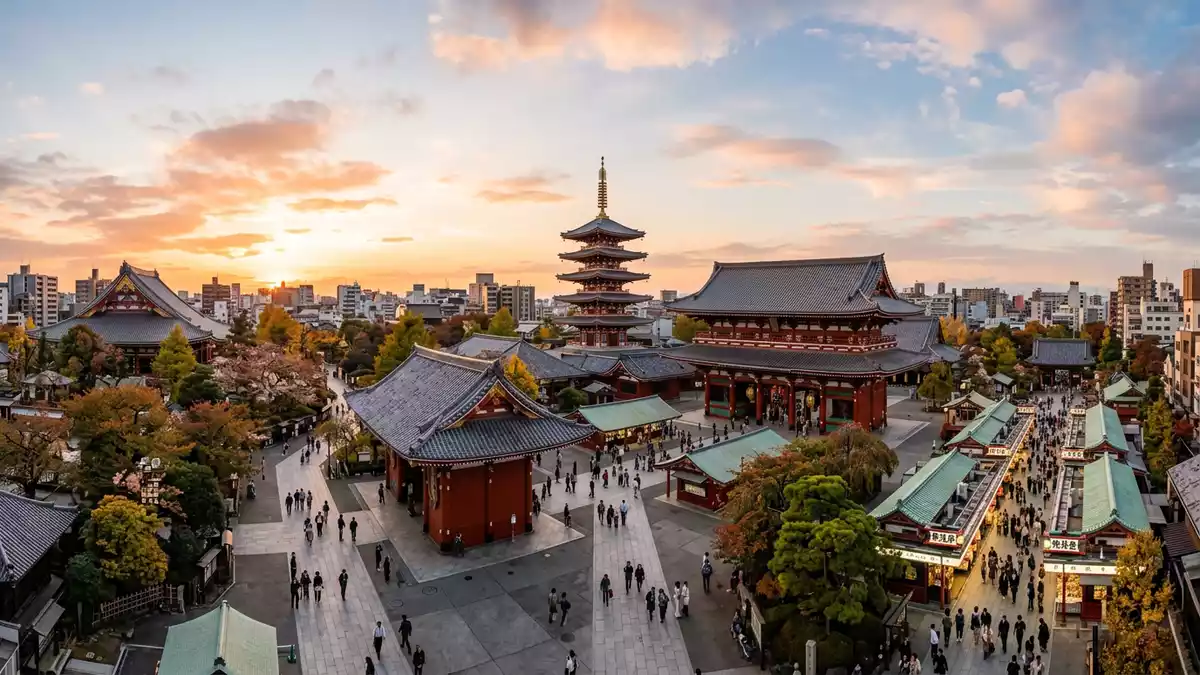
Senso-ji in Asakusa is Tokyo’s oldest temple, and its precincts unfold as a sequence of gates, halls and a pagoda in the middle of the city. The temple is linked to Tokugawa Ieyasu and the early Edo period, yet its most striking quality is the visible layering of wood, concrete and ritual space.
Senso-ji and the Asakusa temple precinct
The temple’s origin is traditionally dated to 628, when two fishermen brothers found a statue of Kannon in the Sumida River. In 645, Shokai built a hall for it, and the figure has remained hidden from public view since then. oldest temple in Tokyo
The temple grew with Asakusa, a district on the western side of the Sumida River in Taito, Tokyo. By the Kamakura period, shoguns were supporting the site, and in 1590 Tokugawa Ieyasu designated it as a place of prayer for the shogunate. Tokugawa Ieyasu
Gates, halls and the five-storied pagoda
The approach through Senso-ji is a clearly staged temple sequence. Kaminarimon stands at the outer edge, followed by Nakamise, Hozo-mon, the main hall and the five-storied pagoda beside it.
The current main hall was rebuilt in 1958 after wartime destruction, using reinforced concrete in a traditional form. The five-storied pagoda is part of the same rebuilt precinct, and Rokkaku-do survives as one of the older buildings in the grounds. rebuilt in 1958
Kaminarimon and Hozo-mon are among the names most closely associated with Senso-ji. The first is the famous outer gate of the temple, while Hozo-mon stands deeper in the complex and marks the transition towards the inner sacred core. Kaminarimon
Kannon worship and temple practice
Senso-ji is dedicated to Avalokitesvara Bodhisattva, called Kannon in Japan, and that identity shapes the whole site. The hidden principal image, the prayer halls and the subordinate buildings all belong to a long Buddhist setting rather than a single monument.
Ennin, known as Jikaku Daishi, appears in the temple’s history through the replica image he created in the ninth century. The site later became closely associated with Edo culture, and the Asakusa district developed around its religious presence. Ennin
The temple complex includes smaller halls and subsidiary structures, among them Denbo-in and Awashima-do. Their presence gives the precinct a deeper historical texture than the main hall alone, with older devotional buildings placed beside reconstructed ones. Denbo-in
Visiting Senso-ji: what travellers from Western Europe should know
- The temple stands in Asakusa, Taito, Tokyo, close to the Sumida River. It is reached through the district streets and the temple approach leads straight into the main precinct.
- The route through the grounds includes gates, a shopping street and the main hall area. The sequence is compact, and the precinct combines open courtyards with enclosed temple buildings.
- The main hall, pagoda and gate structures present a mix of rebuilt and older elements. Rokkaku-do is among the older buildings in the complex.
- The official language is Japanese and the currency is the Japanese yen.
- Entry requirements depend on your nationality; UK travellers can check the FCDO travel advice at gov.uk/foreign-travel-advice, Irish travellers the Department of Foreign Affairs at ireland.ie.
Searching for Senso-ji on social platforms
These links open searches for Senso-ji on each platform.
Frequently asked questions about Senso-ji
Where is Senso-ji?
Senso-ji is in Asakusa, in Tokyo’s Taito ward, close to the Sumida River. The temple address is 2-3-1 Asakusa, Taito-ku, Tokyo 111-0032, Japan.
What does Senso-ji contain?
It contains a gate sequence, Nakamise shopping street, the main hall, a five-storied pagoda and several subsidiary halls. The precinct combines rebuilt structures with older buildings such as Rokkaku-do.
What makes Senso-ji distinctive?
Its identity rests on the Kannon cult, the hidden principal image and the layered temple landscape in Asakusa. The combination of Kaminarimon, Hozo-mon and the main hall gives the site its recognisable form.


