
Senso-ji and the layered heart of Asakusa
Published on 09/19/2026 at 08:32 | Editorial responsibility: Rafael Müller, Editor-in-Chief AD HOC NEWS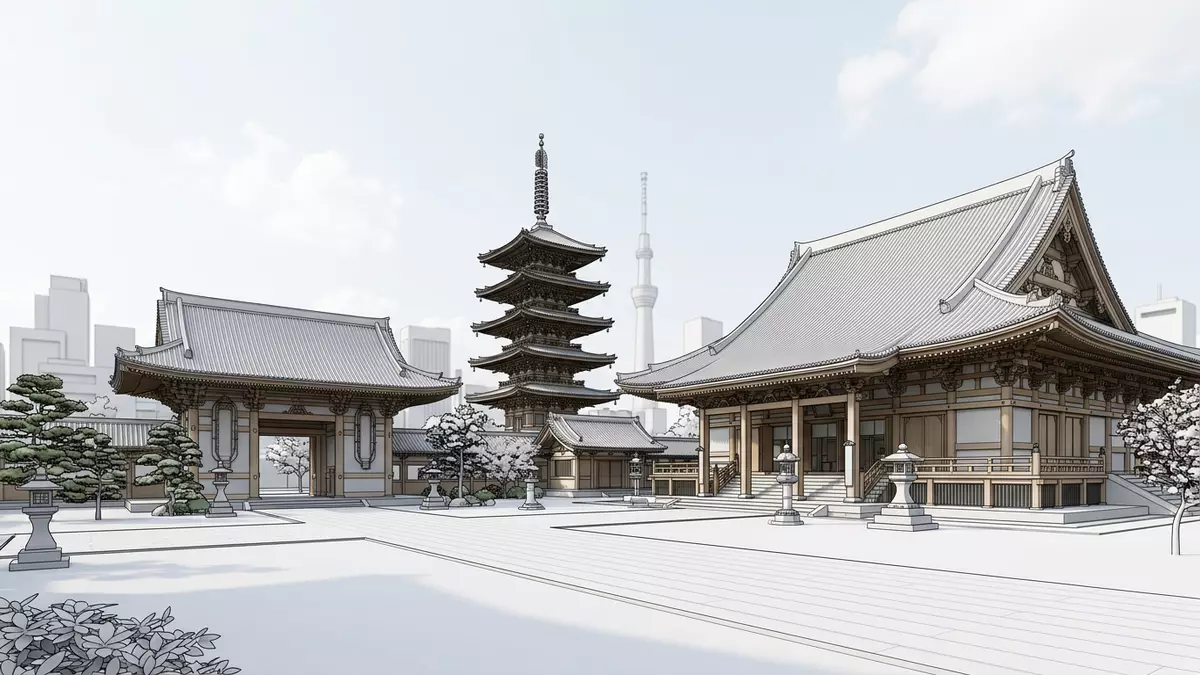
Senso-ji in Asakusa is Tokyo’s oldest established temple, and its precinct is organised around gates, halls and a five-storey pagoda. The place centres on a Buddhist sanctuary associated with Kannon and the Asakusa district’s layered temple landscape.
Senso-ji’s layered temple precinct
The temple complex brings together the Kaminarimon, the shopping approach of Nakamise, the Hozomon, the main hall and the pagoda. That sequence gives the precinct a clear rhythm of street, gate and sanctuary, with red-painted structures set against darker roofs and stone paving.temple precinct Asakusa district
The Five-Storied Pagoda was first built in 942 and is one of the temple’s most distinctive vertical elements. The main hall stands as the central devotional building, while the surrounding ensemble keeps the focus on movement through enclosed urban space rather than a single isolated monument.Five-Storied Pagoda
From legend to temple in the tenth century
Temple tradition places the origin story in 628, when two brothers fishing in the Sumida River found a statue of Kannon. The formal establishment of Senso-ji is associated with 645, giving the site a very early place in the religious history of Tokio.628 645
The temple later became closely tied to the development of Edo, the former name of Tokio, and its position in Asakusa gave the district a strong religious centre. The surviving ensemble reflects repeated rebuilding, with older forms preserved in the layout and later fabric visible in the standing structures.Tokugawa Ieyasu
Kannon, rebuilding and the temple’s present form
Senso-ji is dedicated to Kannon, the bodhisattva of compassion, and the main hall is the spiritual centre of the precinct. The temple became independent in 1950 after a long period of association with the Tendai tradition, and the complex today combines devotional use with a strongly historic urban setting.dedicated to Kannon independent in 1950
The five-storey pagoda and the main hall belong to different layers of the temple’s history, but both are integral to the present ensemble. Together with the gates and Nakamise, they give Senso-ji a dense architectural sequence that remains easy to read on foot through the precinct.
Visiting Senso-ji: what travellers from Western Europe should know
- The temple is in Asakusa, Taito-ku, Tokio, and the closest transport hub is Asakusa Station. The address is 2-3-1 Asakusa, Tokyo 111-0032, Japan.
- The precinct includes gates, open forecourts and paved passages, so the route through it is straightforward. The pagoda and the main hall are separate buildings within the same ensemble.
- The approach through Nakamise is lined with small shops and stalls. That streetlike sequence is part of the site’s identity rather than a separate district.
- The official language is Japanese and the currency is the Japanese yen.
Searching for Senso-ji on social platforms
These links open searches for Senso-ji on each platform.
Frequently asked questions about Senso-ji
Where is Senso-ji?
Senso-ji stands in Asakusa, in Taito-ku, Tokio. Its setting is close to the Sumida River and the older commercial streets of the district.
What does a visit involve?
The precinct combines gates, a main hall, a pagoda and Nakamise, so a visit moves through several distinct parts of the temple complex. The layout is compact and urban rather than spread across open grounds.
What makes Senso-ji distinctive?
The temple combines an early foundation story, a long history of rebuilding and a strongly layered approach sequence. The Five-Storied Pagoda and the main hall give the site a clear visual identity.


