
Senso-ji and the gates that frame Asakusa
Published on 09/23/2026 at 18:25 | Editorial responsibility: Rafael Müller, Editor-in-Chief AD HOC NEWS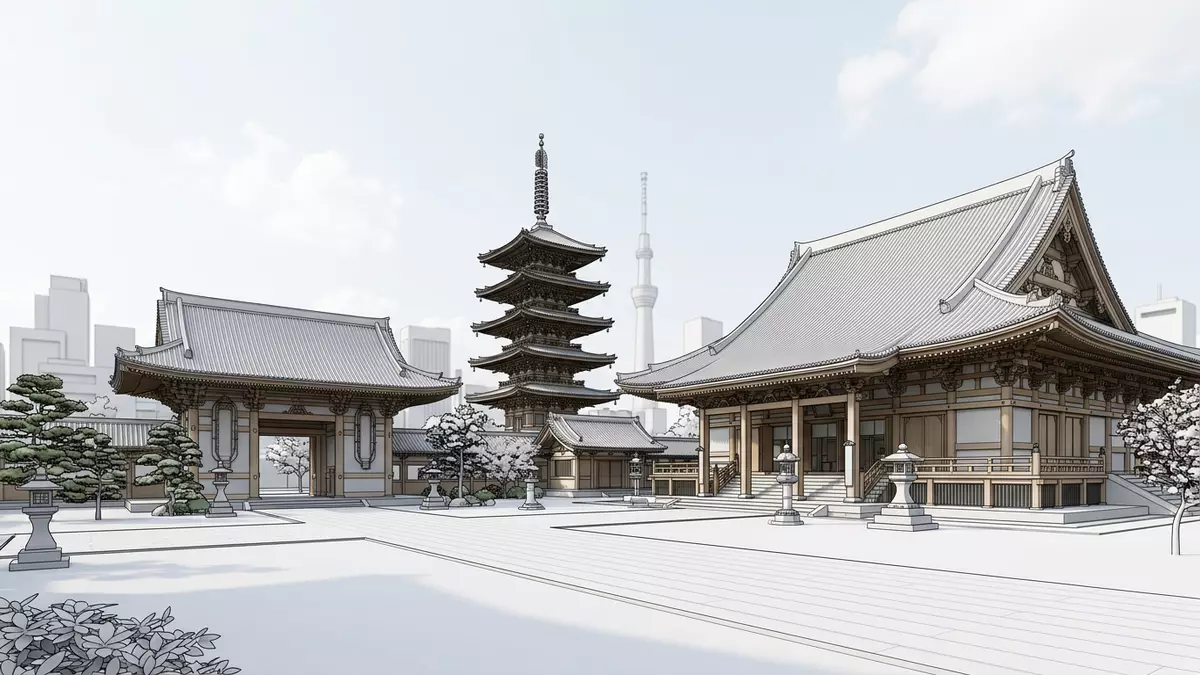
Senso-ji in Tokio is a Buddhist temple arranged as a sequence of gates, shops, halls and a pagoda. Its visible architecture surrounds an image of Kannon, the Bodhisattva of compassion, whose story begins with a fishing discovery in the Sumida River in 628.
Senso-ji begins with Kannon and the Sumida River
Senso-ji is dedicated to Avalokitesvara Bodhisattva, known in Japan as Kannon. The temple’s principal image remains concealed, a practice associated with the priest Shokai and the year 645.
The foundation story names the fishermen Hinokuma Hamanari and Hinokuma Takenari. On 18 March 628, they found a statue in their net while fishing in the Sumida River. Haji no Nakatomo, the village headman of Asakusa, recognised the figure as Kannon and converted his home into a place of worship. Senso-ji’s founding story preserves these names and dates.
Kaminarimon, Nakamise and the inner gate
The approach begins at Kaminarimon, the Thunder Gate, with its large red lantern and guardian figures representing wind and thunder. The gate forms the public face of Senso-ji in Asakusa.
Beyond it, Nakamise-dori leads towards the temple precinct. The shopping street is lined with stalls and small shops selling traditional sweets, toys and souvenirs. At its far end stands Hozomon, the Treasure House Gate, a two-storey structure rebuilt in 1964. Nakamise-dori and Kaminarimon define the approach before the main hall comes into view.
The main hall and the five-storied pagoda
The main hall, known as Kannondo, contains the concealed principal image of Kannon. Its interior is divided into an outer area and an inner sanctum, with the miniature shrine containing the image at the centre of the latter.
The present hall was rebuilt in 1958 after wartime destruction. Nearby, the five-storied pagoda rises above the surrounding roofs. Its history reaches back to 942, while the present pagoda was rebuilt in 1973. The complex also includes Niten-mon, an eastern gate associated with protective Buddhist deities. Senso-ji’s historical setting connects the temple’s buildings with the religious history of Asakusa.
Visiting Senso-ji: what travellers from Western Europe should know
- Senso-ji is at 2-3-1 Asakusa in Taito City, Tokio. The Tokyo Metro Ginza Line, Toei Asakusa Line, Tobu Skytree Line and Tsukuba Express serve nearby stations.
- The approach crosses Kaminarimon and Nakamise-dori before reaching Hozomon and the main hall. The precinct contains paved paths, gates, halls and temple buildings.
- The official language is Japanese and the currency is the Japanese yen.
- The Sumida River lies beside Asakusa, linking the temple’s foundation story with the district’s riverside setting.
Searching for Senso-ji on social platforms
These links open searches for Senso-ji on each platform.
Frequently asked questions about Senso-ji
Where is Senso-ji?
Senso-ji is in Asakusa, within Taito City, Tokio. The temple stands near the Sumida River and is reached through Kaminarimon.
What can visitors see at Senso-ji?
The complex includes Kaminarimon, Nakamise-dori, Hozomon, the main hall, a five-storied pagoda and additional Buddhist halls.
What makes Senso-ji distinctive?
Senso-ji combines a seventh-century foundation story with a concealed Kannon image and a clearly staged approach through gates, shops and temple buildings.


