
Se de Evora and its granite mass over the city
Published on 09/14/2026 at 19:22 | Editorial responsibility: Rafael Müller, Editor-in-Chief AD HOC NEWS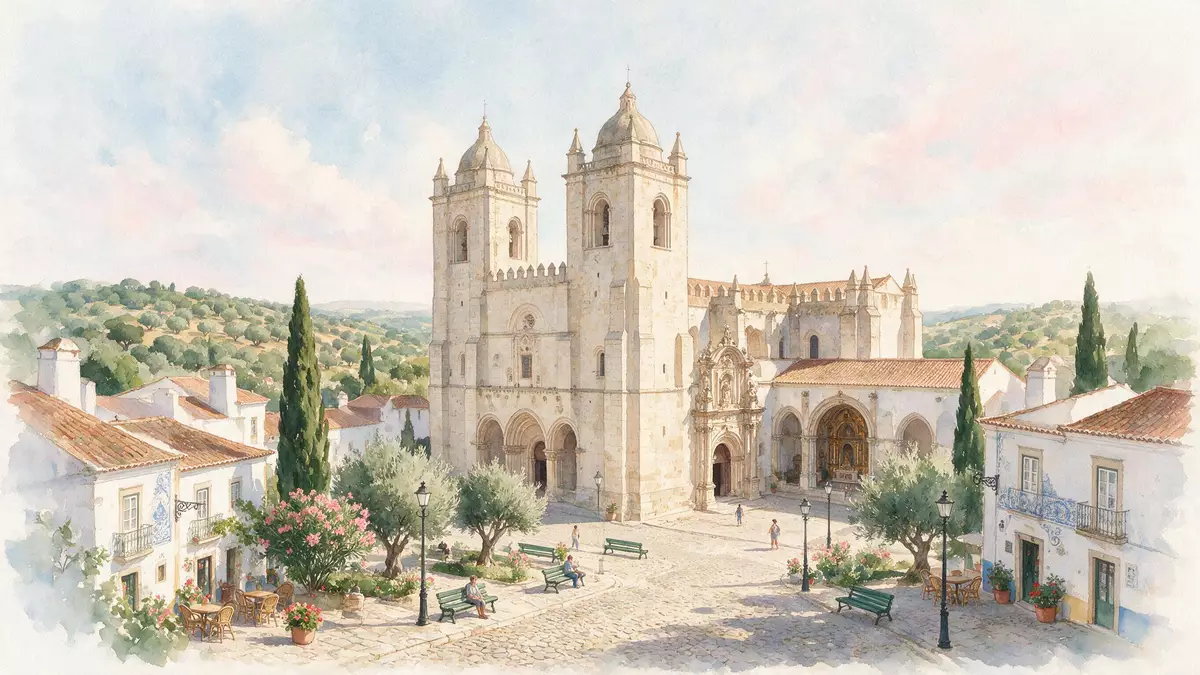
Se de Evora rises above Evora in heavy granite, with a Romanesque core and later Gothic detail. Begun in 1186 and finished in the thirteenth century, it gives the city a stern medieval profile linked to the Cathedral of Évora.
Granite, towers and a medieval outline
The cathedral’s mass is the first thing most visitors see. Its façade carries two towers, and the building is formed from stone that gives it a blunt, fortress-like presence.
That combination of Romanesque solidity and Gothic movement is the cathedral’s defining visual contrast. The main body belongs to the late twelfth and thirteenth centuries, while later additions bring in Renaissance and Baroque layers without erasing the older shell Romanesque to Gothic.
Inside the nave and cloister
Inside, the nave runs beneath stone vaulting and past a sequence of chapels and carved details. The church keeps a strong linear character, with the interior organised around the long central space rather than elaborate side rooms.
The cloister is one of the clearest Gothic parts of the complex. Built in the fourteenth century, it brings pointed arches and a calmer, enclosed rhythm to the cathedral’s denser main body Gothic cloisters.
Se de Evora in the city’s historic centre
Se de Evora stands in the historic centre of Evora, a city whose core was listed as a UNESCO World Heritage Site in 1986. From the upper parts of the cathedral, the old urban fabric spreads out below in low roofs and pale walls historic centre.
The building is closely tied to the city’s Christian medieval history, especially the period after the reconquest of Évora in 1166. Its long development under Bishop D. Paio and later patrons left a layered monument rather than a single campaign building Bishop D. Paio.
Visiting Se de Evora: what travellers from Western Europe should know
- Se de Evora stands in central Evora, and the approach is on foot through the old town streets. The cathedral sits on high ground within the historic core.
- The building includes steps and stairways, especially towards the upper parts and the cloister levels. The stone interior also leaves narrow passages in places.
- The cathedral is a Roman Catholic church and a museum setting for sacred art. Its fabric combines medieval structure with later chapels, fittings and altar work.
- The site belongs to the UNESCO-listed historic centre of Evora. That setting places the cathedral among narrow streets, whitewashed walls and compact urban blocks.
Searching for Se de Evora on social platforms
These links open searches for Se de Evora on each platform.
Frequently asked questions about Se de Evora
Where is Se de Evora?
Se de Evora is in the city of Evora in southern Portugal. It stands within the historic centre, on the high point of the old city.
What does a visit involve?
The visit centres on the stone cathedral, its nave, cloister and upper levels. Steps and narrow passages are part of the building’s fabric.
What makes Se de Evora distinctive?
Its granite mass, Romanesque base and Gothic additions give it a layered medieval character. The cloister and the city views add a second, quieter reading of the same monument.


