
Se de Evora and its granite mass over the Alentejo city
Published on 09/19/2026 at 11:12 | Editorial responsibility: Rafael Müller, Editor-in-Chief AD HOC NEWS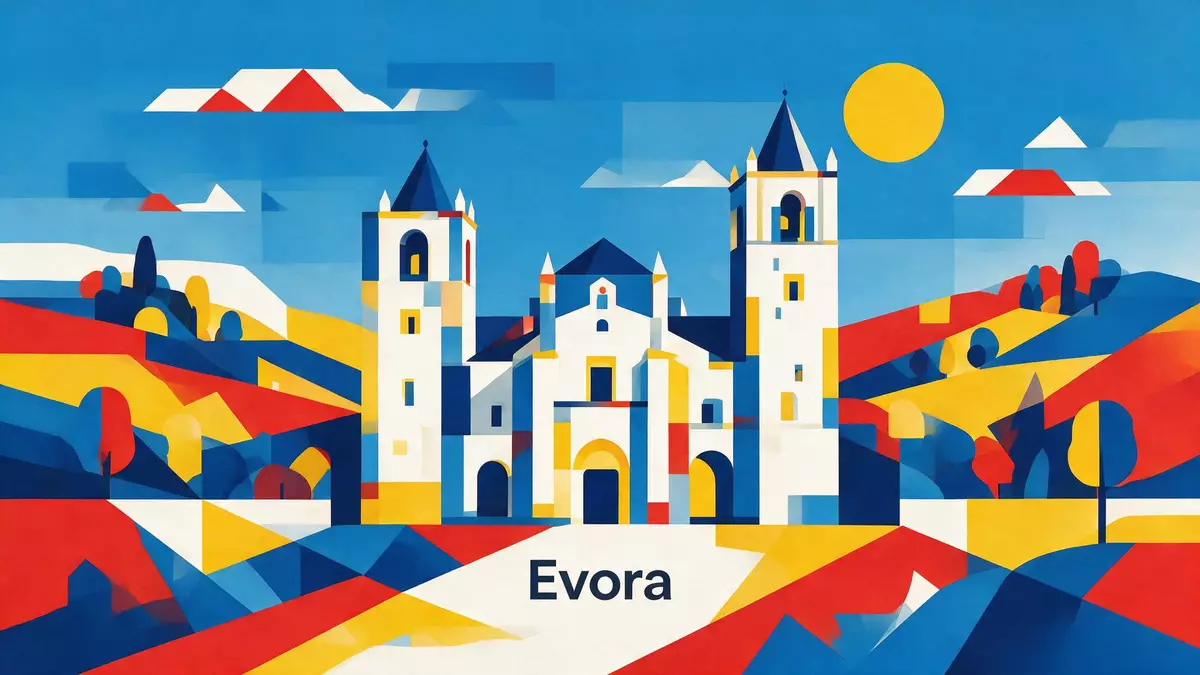
Se de Evora, the Cathedral of Évora in southern Portugal, is a granite Roman Catholic basilica whose medieval mass and towers rise above the whitewashed roofs of the old city. Built between the late twelfth and thirteenth centuries, it anchors the UNESCO-listed historic centre and stands as one of Portugal’s major medieval churches.
A fortress-like granite cathedral on the hill
The official name of Se de Evora is Basílica Sé Catedral de Nossa Senhora da Assunção, a title that reflects both its dedication to Our Lady of the Assumption and its status as a basilica and cathedral.Basílica Sé Catedral de Nossa Senhora da Assunção The building serves as the seat of the Archdiocese of Évora, tying the church into a wider ecclesiastical network across Portugal and reinforcing its role as a religious and administrative centre.seat of the Archdiocese of Évora
Constructed mainly from local granite, Se de Evora has a compact, fortress-like outline, with solid walls and towers rising above the surrounding streets.granite Roman Catholic church Construction of the present cathedral is dated to the late twelfth and early thirteenth centuries, with work beginning in 1186, consecration in 1204 and completion around 1250.begun in 1186 and completed in 1250 It belongs to the transitional moment between Romanesque and Gothic architecture, combining heavy masonry and rounded structural forms with pointed arches and taller vaults inside.
Romanesque, Gothic and later additions in stone
Se de Evora is frequently described as the largest medieval cathedral in Portugal, with sources giving a length of about 80 m (262 ft), high vaults and a central spire rising more than 30 m (98 ft) above the crossing.maior Catedral medieval do paíslength of about 80 m Its overall plan is that of a Latin cross, legible through the long nave, transverse arm and eastern chancel typical of Western Christian churches of the period.plan is that of a Latin cross
The dominant architectural styles are Romanesque and Gothic, with three main naves marked by sturdy pillars and stone vaults.românico, gótico and three naves In the fifteenth and sixteenth centuries, the cathedral received substantial additions, including the high choir, a pulpit, the baptistry and hybrid elements such as the Capela de Nossa Senhora da Piedade, also known as Capela do Esporão, dated to 1529 and noted as an example of plateresque architecture.Capela do Esporão dated 1529 Restoration campaigns in the twentieth century further revealed medieval features, including opening up exterior faces and rosaces of the cloister.
The cathedral within Evora’s UNESCO historic centre
Se de Evora stands in the historic centre of Évora in the Alentejo region of southern Portugal, within the walled old town recognised by UNESCO for its concentration of medieval and early modern architecture.Cathedral of Évora in Évora, Portugalhistoric centre of Évora The cathedral occupies one of the higher points of the city, with its terrace described as the highest point, offering wide views over the historic quarters within the walls and the newer neighbourhoods beyond.terrace of the Cathedral is the highest point of the city
The building is classified as a National Monument and forms part of the ensemble that defines Évora as a World Heritage city.Monumento Nacional since 1907 Streets such as Rua 5 de Outubro lead up from Praça do Giraldo towards Largo do Marquês de Marialva, where the cathedral complex stands amid museums and remnants of earlier periods, including the nearby Roman temple and civic buildings.Rua 5 de outubro from Giraldo Square Within this setting, Se de Evora reads as a stone anchor point, its towers, nave and cloister forming a granite counterweight to the surrounding whitewashed houses and narrow lanes.
Visiting Se de Evora: what travellers from Western Europe should know
- Se de Evora stands in Évora’s historic centre in the Alentejo region of southern Portugal, within the walled old town on Largo do Marquês de Marialva and close to Praça do Giraldo.
- The cathedral rises on one of the city’s higher points, and the approach from Giraldo Square along Rua 5 de Outubro involves an uphill walk through paved streets and stone-lined alleys.
- Se de Evora sits beside major landmarks such as the Roman temple and the Évora Museum, so visits to the cathedral often combine with short walks between these historic sites in the compact centre.
- The official language is Portuguese and the currency is the euro.
Searching for Se de Evora on social platforms
These links open searches for Se de Evora on each platform.
Frequently asked questions about Se de Evora
Where is Se de Evora located?
Se de Evora stands in Évora, a city in the Alentejo region of southern Portugal, within the walled historic centre on Largo do Marquês de Marialva.
What can visitors expect inside Se de Evora?
Visitors encounter a granite Romanesque and Gothic interior with three naves, a Latin-cross layout and later additions such as chapels, a choir and a cloister.
What makes Se de Evora distinctive among Portuguese cathedrals?
Se de Evora is recognised as the largest medieval cathedral in Portugal, combining fortress-like granite architecture, a hilltop position and a role as seat of the Archdiocese of Évora.


