
Schloss Sanssouci, Frederick the Great’s Rococo terrace palace
Published on 09/19/2026 at 11:32 | Editorial responsibility: Rafael Müller, Editor-in-Chief AD HOC NEWS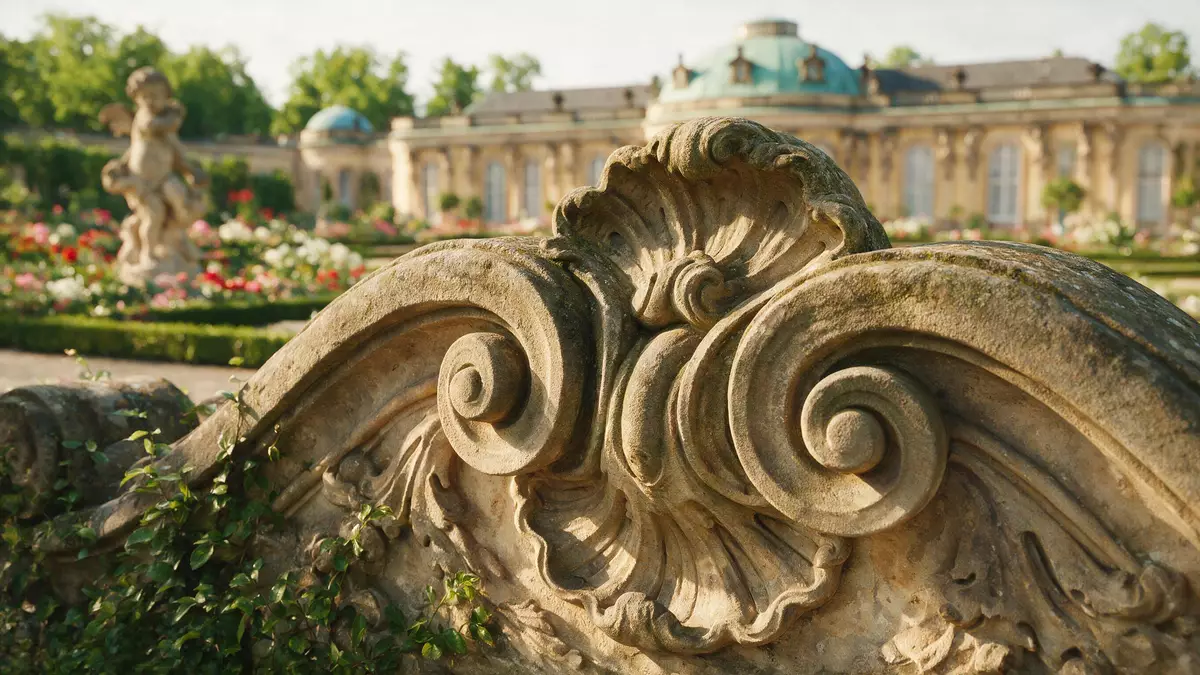
On the southern edge of Potsdam, Schloss Sanssouci stretches along vineyard terraces as an intimate Rococo summer palace commissioned by Frederick II of Prussia in the mid?eighteenth century. Built between 1745 and 1747 as a single?storey residence, it remains one of the clearest expressions of German Rococo architecture and a compact counterpoint to larger royal complexes in the surrounding landscape.
A Rococo palace drawn into the hillside
Schloss Sanssouci occupies the eastern part of Sanssouci Park, set above a terraced vineyard that was formed on a gentle slope overlooking Potsdam. The palace itself takes the form of a long, low building aligned along the crest of the hill, its façade stepping rhythmically across the top of the terraces and tying the architecture directly to the cultivated slope below.Sanssouci Palace in the park The arrangement makes the building read as part of the landscape, with ornamental steps and balustrades connecting the main level to the vineyard terraces beneath.
Frederick II of Prussia, better known as Frederick the Great, conceived Sanssouci primarily as a personal summer retreat in Potsdam rather than as a ceremonial palace. He provided sketches and ideas for a modest, horizontally stretched residence on the vineyard slope and entrusted Georg Wenzeslaus von Knobelsdorff, his court architect, with turning those drawings into a built structure.Frederick II and Knobelsdorff Construction began in 1745 and was completed in 1747, resulting in a palace that has remained closely associated with the king’s private life.
Frederick the Great’s most personal residence
The name “Sanssouci”, taken from French and meaning “without worry”, reflects the character of the palace as a place of retreat. From 1747 onwards, Frederick used Schloss Sanssouci as his summer residence in Potsdam, living here during the warmer months and withdrawing from the formal routines of the Berlin court.Sommerresidenz in Potsdam The rooms are arranged on a single level along a sequence that includes reception spaces, music rooms and more private chambers, all opening towards the park through large French windows.
Inside, Schloss Sanssouci presents Rococo decoration at a concentrated scale, with wall panelling, stucco work and ceiling ornamentation framing paintings and decorative arts from the eighteenth century. Works by artists such as Antoine Watteau, Giovanni Paolo Pannini and Antoine Pesne are integrated into the interiors, reinforcing the palace’s role as a refined setting for conversation, music and reflection.Rococo interiors and artworks The intimate proportions, combined with the continuous garden views, give the residence a domestic scale that distinguishes it from multi?storey court palaces.
Terraces, park and World Heritage setting
Below the palace, a cascade of vineyard terraces descends towards the park, edged by low walls, balustrades and planting beds. These terraces were laid out in the 1740s to cultivate figs and grapes on the south?facing slope and form a central feature of the wider Sanssouci landscape. Herms and caryatid figures support the heavy cornice of the palace roof and visually tie the architecture to the sculpted garden setting, while paths lead from the base of the hill into avenues and lawns across the park.Herms and caryatids on the façade
Schloss Sanssouci and its surrounding park form part of the ensemble of palaces and gardens in and around Potsdam and Berlin that are recognised together as a UNESCO World Heritage Site.UNESCO?listed palaces and gardens Within this broader setting, Sanssouci stands out as a comparatively small, single?storey palace integrated with the vineyard terraces, while nearby complexes such as the New Palace occupy larger footprints and present more monumental façades. The contrast between the compact hilltop residence and the extensive parkland around it is one of the defining experiences of a visit, as paths lead from the terrace steps into long views framed by trees, water features and ornamental buildings across the undulating terrain.
Visiting Schloss Sanssouci: what travellers from Western Europe should know
- Schloss Sanssouci stands in the eastern section of Sanssouci Park on the Weinbergterrassen in Potsdam, south?west of central Berlin, and is reached easily by regional rail services to Potsdam and local transport from the station.
- The approach to the palace involves a walk through the park and ascents on outdoor stairways that climb the vineyard terraces, with several flights of steps between the lower paths and the hilltop level.
- Within the palace, the historic rooms lie on a single floor, but the park itself covers varied ground with gentle gradients, long avenues and open lawns surrounding the vineyard slope.
- The official language is German and the currency is the euro.
Searching for Schloss Sanssouci on social platforms
These links open searches for Schloss Sanssouci on each platform.
Frequently asked questions about Schloss Sanssouci
Where is Schloss Sanssouci located?
Schloss Sanssouci is in Potsdam in eastern Germany, on the Weinbergterrassen in the eastern part of Sanssouci Park, within the wider region south?west of Berlin.
What should visitors expect on a visit to Schloss Sanssouci?
Visitors encounter an eighteenth?century Rococo palace on a vineyard hillside, with single?storey interiors opening onto terraces and a surrounding park landscape of paths, avenues and ornamental structures.
What makes Schloss Sanssouci distinctive among German palaces?
Schloss Sanssouci is distinctive for its combination of a long, low Rococo residence, vineyard terraces and its status as Frederick the Great’s most personal summer palace within a UNESCO?listed park ensemble.


