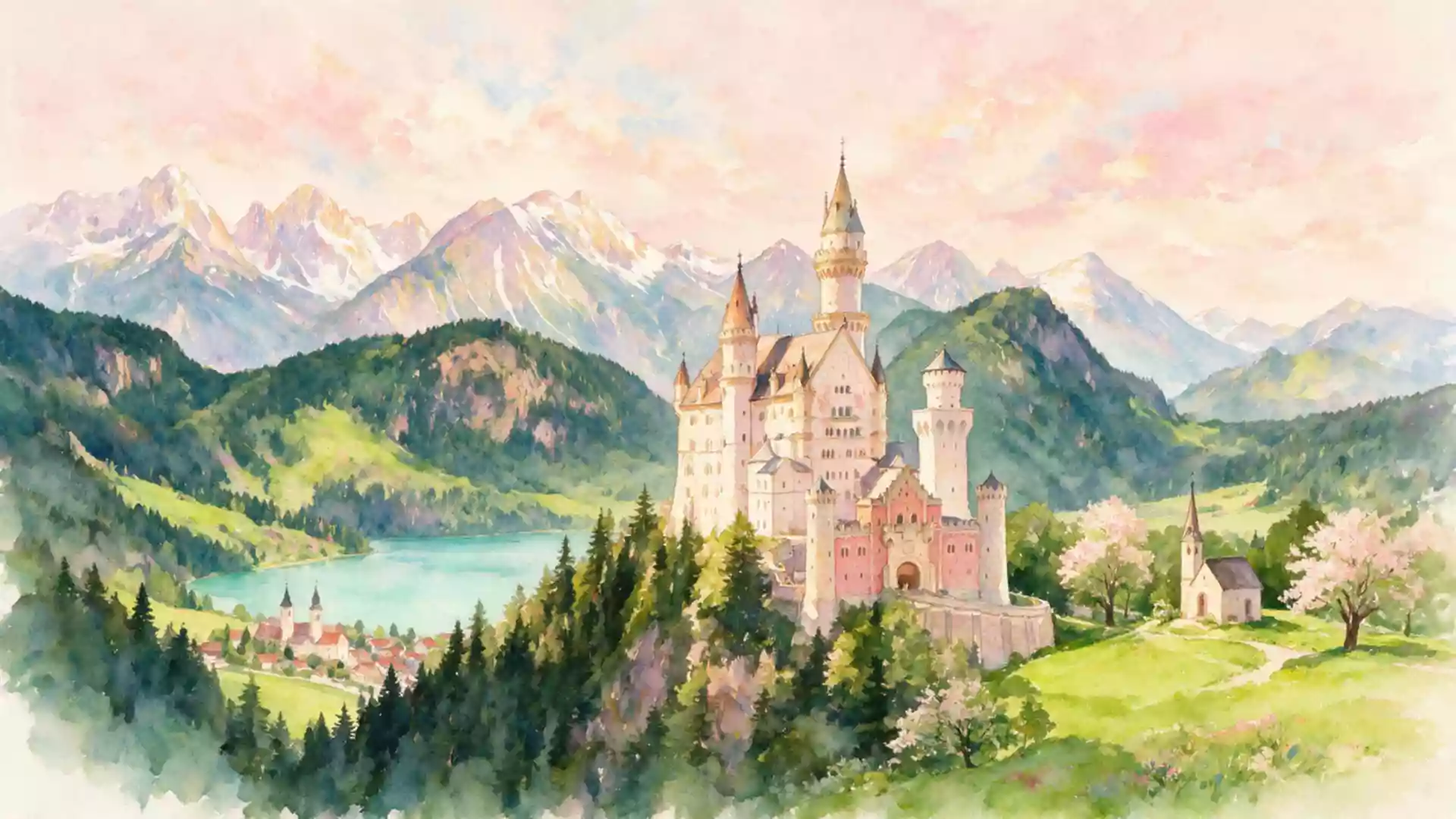
Schloss Neuschwanstein and its theatrical hilltop silhouette
Published on 09/11/2026 at 10:36 | Editorial responsibility: Rafael Müller, Editor-in-Chief AD HOC NEWS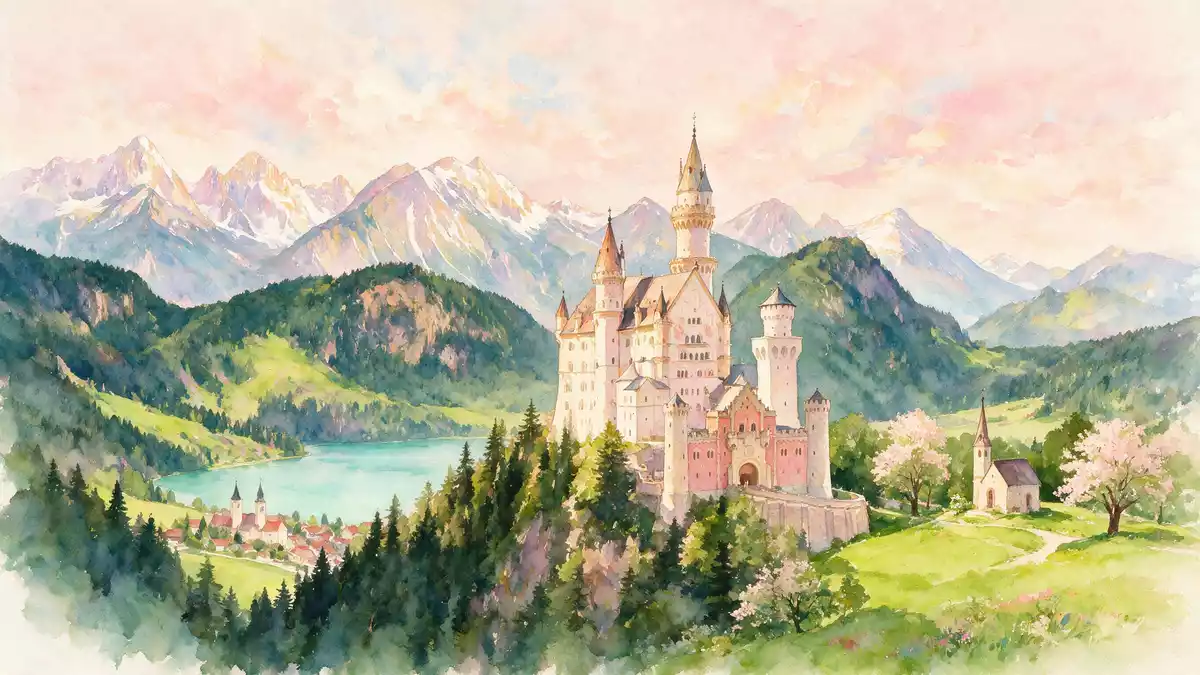
High above the village landscape of Schwangau in southern Germany, Schloss Neuschwanstein gathers its towers, walls and roofs into a theatrical silhouette on a steep Alpine foothill. Conceived by King Ludwig II of Bavaria in the late nineteenth century, the castle turns the entire hill into a kind of three-dimensional stage, with façades and courtyards arranged to be seen in sequence as visitors climb towards it.Construction began in 1869, and the building still reads as a project shaped by that era’s fascination with romanticised medieval architecture.
A nineteenth-century fantasy built into the slope
Schloss Neuschwanstein stands above the incorporated village of Hohenschwangau in the municipality of Schwangau, close to the border between Germany and Austria, with the rugged foothills of the Alps rising behind it and the lowlands of the Allgäu opening out below.The site lies in the Swabia region of Bavaria, on a hill that drops away towards the Pöllat Gorge and nearby lakes.
Work on the hill began before the palace itself, when stone outcrop on the future building site was removed to make way for foundations, and a new access road was built to connect the slope to the valley below.The foundation stone was laid on 5 September 1869, incorporating building plans and coins from Ludwig II’s reign in line with Bavarian tradition. The castle fabric uses brickwork behind light-coloured limestone cladding, so the walls read externally as pale masonry while the structure itself is carried by more conventional materials.
Romanesque Revival façades and layered interiors
The architectural style of Schloss Neuschwanstein belongs firmly to nineteenth-century historicism, combining Romanesque Revival elements with Gothic and Byzantine influences.Arcades, slim towers and upward-pointing lines give the exterior a vertical emphasis, while semi-circular arches and grouped window openings recall older European church and castle forms. Eduard Riedel, later followed by architects such as Georg von Dollmann and Julius Hofmann, translated Ludwig II’s interest in medieval imagery into a complex ensemble of wings, gateways and courtyards rather than a single compact block.Riedel was the first architect appointed in 1868, and successive designers continued the work as the project expanded.
Inside, the rooms follow the same historicist spirit. The Palas, the main residential wing, contains spaces such as the Singer’s Hall and a large Throne Hall, the latter built with an encased steel construction to support its volume within the brick fabric of the walls.Modern structural techniques were used to achieve these interior spans while keeping to the outward appearance of a medieval fortress. Decorative schemes draw heavily on religious and legendary themes associated with German-speaking Europe, including scenes from the works of Richard Wagner, whose operas were a major cultural reference for Ludwig II.The castle was conceived as a romantic medieval-style retreat, and that intention is visible in the painted walls, carved timber and theatrical staging of many chambers.
From royal retreat to UNESCO-listed landmark
Schloss Neuschwanstein was commissioned by Ludwig II of Bavaria as a private retreat, and he moved into parts of the castle in the 1880s when some key rooms became habitable.The king died in 1886, with only a fraction of the planned interiors completed, and construction of the original design was never finished.A simplified Bower and Square Tower were completed in 1892, but large parts of the castle remained unbuilt or undecorated.
Despite this incompleteness, the hilltop ensemble has taken on an enduring role in how nineteenth-century Bavaria is remembered. Since 2025 Schloss Neuschwanstein has formed part of the UNESCO World Heritage Site “The Palaces of King Ludwig II of Bavaria: Neuschwanstein, Linderhof, Schachen and Herrenchiemsee”, recognising both its architecture and its place within a group of royal residences from the same period.The UNESCO listing was made in 2025. Guiness World Records has also identified Neuschwanstein as the tallest castle in the world at an overall height of about 65 m (213 ft) from base to highest point, a figure that reflects the way the building rises above its rock platform.Its height is recorded at 65 metres.
Visiting Schloss Neuschwanstein: what travellers from Western Europe should know
- Schloss Neuschwanstein stands above Hohenschwangau in the municipality of Schwangau, in Bavaria in southern Germany, reached from the valley by mountain roads and paths.
- The approach involves a sustained uphill walk on paved surfaces, with gradients that reflect the steepness of the foothill and steps within the castle itself.
- The castle hill lies near lakes including the Alpsee, and other historic sites such as Hohenschwangau Castle sit within walking distance across varied terrain.
- The official language is German and the currency is the euro.
Searching for Schloss Neuschwanstein on social platforms
These links open searches for Schloss Neuschwanstein on each platform.
Frequently asked questions about Schloss Neuschwanstein
Where is Schloss Neuschwanstein located?
Schloss Neuschwanstein stands above Hohenschwangau in the municipality of Schwangau in Bavaria, in the very south of Germany close to the border with Austria.
What can visitors expect when approaching the castle?
The castle is reached by a steady climb along roads and paths on a steep hill, with views over lakes and the surrounding Alpine foothills as the approach rises.
What makes Schloss Neuschwanstein distinctive among European castles?
Its nineteenth-century historicist architecture, combination of Romanesque Revival exterior and richly staged interiors, and hilltop setting together give it a distinctive theatrical profile.