
Schloss Neuschwanstein and its romantic silhouette above Schwangau
Published on 09/14/2026 at 19:20 | Editorial responsibility: Rafael Müller, Editor-in-Chief AD HOC NEWS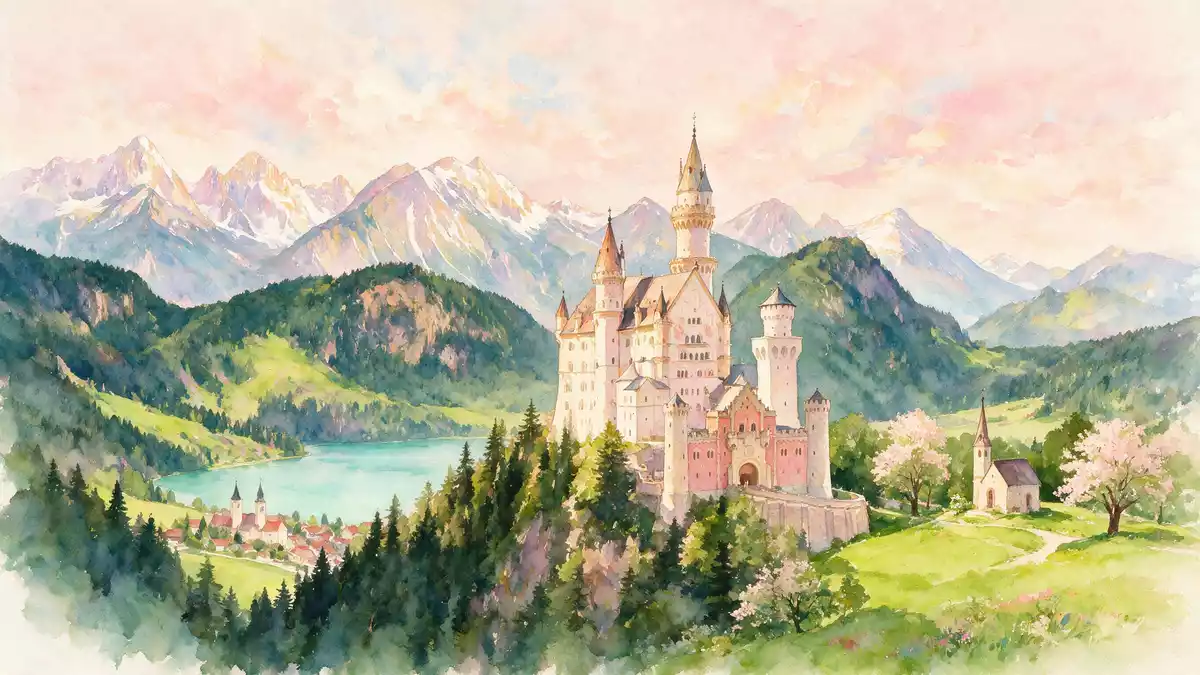
Schloss Neuschwanstein rises above Schwangau in southern Bavaria as a nineteenth century fantasy castle commissioned by King Ludwig II of Bavaria and planned by architect Eduard Riedel. Its pale walls and towers stand on a steep hillside at the edge of the Bavarian Alps, looking across valleys and lakes near the border with Austria.
A historicist castle on a Bavarian mountainside
Schloss Neuschwanstein is a historicist palace of the nineteenth century, conceived as a romanticised knight’s castle rather than a practical fortress. It occupies a rocky ledge above the Pöllat Gorge at the southern fringe of Germany, close to the village of Hohenschwangau in Schwangau and not far from Füssen in the Allgäu region.rock ledge over the Pöllat Gorge The castle’s three main wings step along the ridge, forming an irregular mass whose towers and turrets give it a theatrical silhouette against the surrounding mountains.three winged complex was built between 1869 and 1892
The building belongs to the historicist movement, in which architects combined motifs from earlier periods into new structures. At Neuschwanstein, the prevailing language is Neo Romanesque, visible in the arcaded facades, rounded arches and relatively simple wall masses, while details of the interiors draw on Gothic and Byzantine imagery.architecture and interior are shaped by Neo Romanesque forms The contrast between the steep natural terrain and the composed, historicising architecture makes the castle read almost like a theatrical set placed above the landscape.
King Ludwig II’s vision in stone and brick
The project for Schloss Neuschwanstein was initiated by King Ludwig II of Bavaria, born in 1845 and reigning from 1864, who grew up nearby at Hohenschwangau Castle and was deeply engaged with medieval imagery and the operas of Richard Wagner.constructed for Bavarian King Ludwig II In 1868 he set out plans for a “New Hohenschwangau”, and construction of Neuschwanstein began in 1869 on the site of earlier castle ruins, with Eduard Riedel translating sketches by scene painter Christian Jank into architectural drawings.construction began on 5 September 1869
Work on the foundations involved cutting back the rock and creating an access road before the foundation stone was laid in September 1869.foundation stone was laid on 5 September 1869 The castle walls are built of brick and faced with light coloured limestone, while the interiors incorporate late nineteenth century construction techniques, including an encased steel structure for the large Throne Hall within the main residential wing, or Palas.built and furnished in medieval styles but equipped with latest technology Building campaigns continued into the 1880s, and simplified versions of certain elements, such as the square tower and the bower, were completed in 1892; Ludwig II did not live to see a finished castle.
Approaching the castle and reading its silhouette
Approach to Schloss Neuschwanstein begins in the valley around Hohenschwangau, where paths and roads climb towards the hillside site. The castle’s address lies on Neuschwansteinstraße in Schwangau, and its location on a high spur means that visitors ascend from the village through woodland before reaching the outer walls.Neuschwansteinstraße, Hohenschwangau, Schwangau, Bavaria From the access route the massing of the castle becomes legible: an elongated group of wings, with a gatehouse in front and taller towers marking key corners.
The composition is asymmetrical, with differing rooflines and towers of varying height arranged along the ridge. On one side, the Palas presents a broad facade with arcaded galleries and tall gables, while other wings turn away towards the gorge and the mountains. From viewpoints around the valley, Neuschwanstein appears both as an architectural object and as part of a wider panorama, balancing its romantic, castle like outline with the steep slopes, forests and peaks of the Bavarian Alps.hilltop overlooking the Hohenschwangau valley
Visiting Schloss Neuschwanstein: what travellers from Western Europe should know
- Schloss Neuschwanstein stands on a hillside above Hohenschwangau in Schwangau, southern Germany, reached from Füssen and other Bavarian towns by road and by public transport connections.
- The ascent to the castle involves a sustained uphill walk on paved paths, together with staircases within the complex, so visitors encounter gradients and steps between the valley and the main rooms.
- The surrounding region is mountainous, with the Bavarian Alps rising nearby and the castle overlooking a gorge and lakes, so terrain and weather can affect the experience of the approach and viewpoints.
- Germany’s official language is German and the currency is the euro.
Searching for Schloss Neuschwanstein on social platforms
These links open searches for Schloss Neuschwanstein on each platform.
Frequently asked questions about Schloss Neuschwanstein
Where is Schloss Neuschwanstein located?
Schloss Neuschwanstein is in Schwangau in southern Bavaria, Germany, above the village of Hohenschwangau and near Füssen close to the border with Austria.
What should visitors expect on a visit to Schloss Neuschwanstein?
Visitors encounter an uphill approach through woodland to a hillside castle with historicist architecture, stepped wings, towers and interiors reflecting nineteenth century Neo Romanesque design.
What makes Schloss Neuschwanstein distinctive among castles in Germany?
Its combination of theatrical romantic massing, Neo Romanesque detailing, late nineteenth century construction and a setting on a rocky spur above an Alpine gorge gives Schloss Neuschwanstein a recognisable profile.


