
Schloss Heidelberg, Germany’s romantic ruin above the Neckar
Published on 09/16/2026 at 20:35 | Editorial responsibility: Rafael Müller, Editor-in-Chief AD HOC NEWS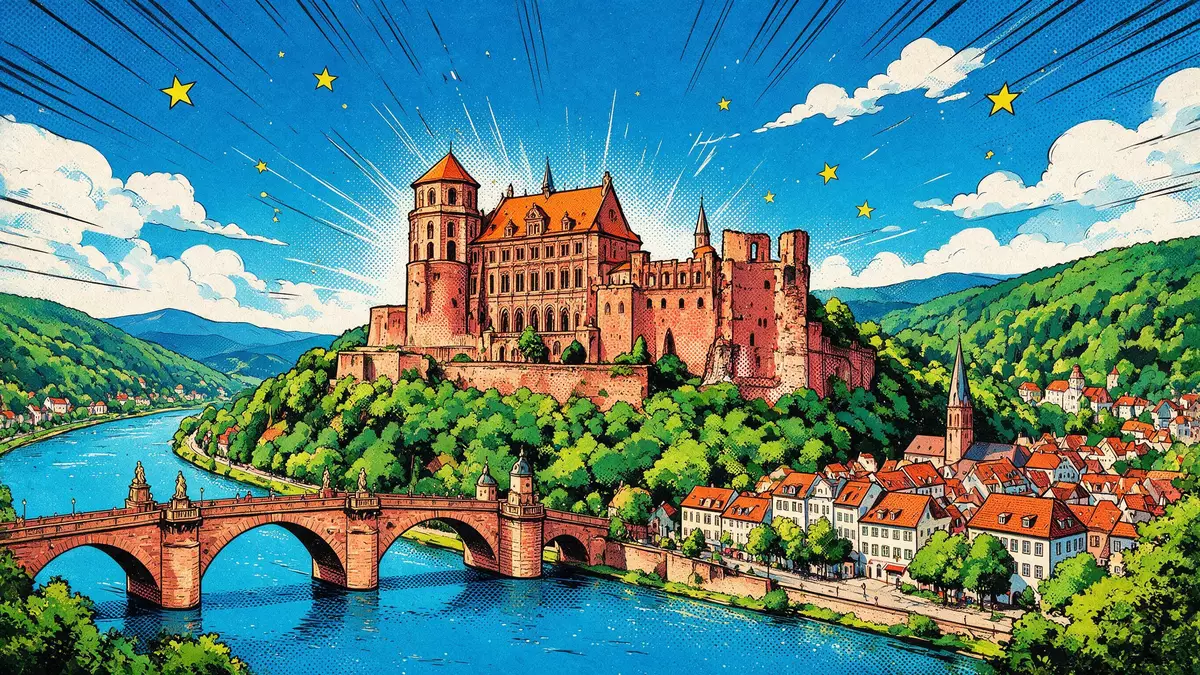
Schloss Heidelberg, the castle ruin above Heidelberg and the River Neckar, brings together centuries of power, architecture and deliberate decay in one sprawling sandstone complex. Its origins lie in the Middle Ages, and the visible remains chart a progression from fortified stronghold to Renaissance residence and later baroque additions.
From medieval fort to princely residence
A fort in Heidelberg was first mentioned in 1225, when the counts palatine of the Rhine held a defensive seat above the town and river crossing.A fort in Heidelberg was first mentioned in 1225 Over time that fort evolved into Schloss Heidelberg, the residence of the prince electors who shaped the Electorate of the Palatinate for centuries.residence of the prince electors
The castle complex, built in phases between the late Middle Ages and the seventeenth century, reflects the transition from Gothic fortification to Renaissance palace buildings and early baroque façades.transition from Gothic to Renaissance styles Structures such as the Ottheinrichsbau and Friedrichsbau stand as prominent examples of this shift, their richly sculpted fronts facing the main courtyard and recalling the ambitions of the rulers who commissioned them.Gläserner Saalbau, Ottheinrichsbau, Friedrichsbau and Englischer Bau
Renaissance façades and the Hortus Palatinus
Schloss Heidelberg is widely recognised as an important ensemble of Renaissance architecture north of the Alps, with palace wings that carry sculpted figures, heraldic devices and rhythmically arranged windows across their sandstone façades.important Renaissance buildings north of the Alps The Ottheinrichsbau in particular is often cited as one of the finest Renaissance palace buildings in this part of Europe, its front decorated with statues of rulers and allegorical figures set in niches.
Beside the built wings, the Hortus Palatinus, or castle garden, extended the representation of princely power into terraces and ornamental layouts overlooking the Neckar valley.magnificent Castle Gardens (Hortus Palatinus) Although the garden has changed since its seventeenth-century design, the surviving terraces and viewpoints still link the palace to the landscape, framing views of the town roofs, the river and the wooded hills beyond.
Destruction, romantic ruin and conservation
The story of Schloss Heidelberg is marked by repeated destruction. In the late seventeenth century the castle was attacked during conflicts such as the War of the Grand Alliance, leaving fortifications and residential wings heavily damaged and blasted apart.sacking and destruction in 1689 and 1693 Further lightning strikes in 1764 inflicted additional damage on the already weakened complex, contributing to its abandonment as a residence.lightning strikes in 1764
From the nineteenth century onwards, conservation efforts transformed Schloss Heidelberg into a curated ruin rather than a fully reconstructed palace. Figures such as Charles de Graimberg worked to stabilise the remaining structures and preserve the character of the broken walls and roofless halls that had attracted writers and painters of the Romantic period.conserving the castle ruins Visitors now encounter a blend of intact interiors, such as parts of the Friedrichsbau, and open, jagged silhouettes of other wings, all set above the town in a way that has made the ruin a defining image of Heidelberg.partially restored in the 1890s
Visiting Schloss Heidelberg: what travellers from Western Europe should know
- Schloss Heidelberg stands on a hillside directly above Heidelberg’s old town on the River Neckar, reached by paths and roads that climb from the valley.
- The approach from the town involves steep gradients and stairways, and movement within the complex includes uneven surfaces and level changes between courtyards and garden terraces.
- The official language is German and the currency is the euro.
Searching for Schloss Heidelberg on social platforms
These links open searches for Schloss Heidelberg on each platform.
Frequently asked questions about Schloss Heidelberg
Where is Schloss Heidelberg located?
Schloss Heidelberg stands above the old town of Heidelberg in south-west Germany, on a hillside overlooking the River Neckar and surrounding valley.
What should visitors expect when exploring Schloss Heidelberg?
Visitors encounter a mix of intact palace interiors, roofless halls and garden terraces, reached by stairways and sloping paths that link the courtyards and viewing platforms.
What makes Schloss Heidelberg distinctive among German castles?
Schloss Heidelberg is distinctive for its combination of Renaissance palace wings, baroque additions and conserved ruin, all set as a large sandstone complex above the river and town.


