Schloss Heidelberg and the romance of a ruined residence
Published on 09/11/2026 at 07:56 | Editorial responsibility: Rafael Müller, Editor-in-Chief AD HOC NEWS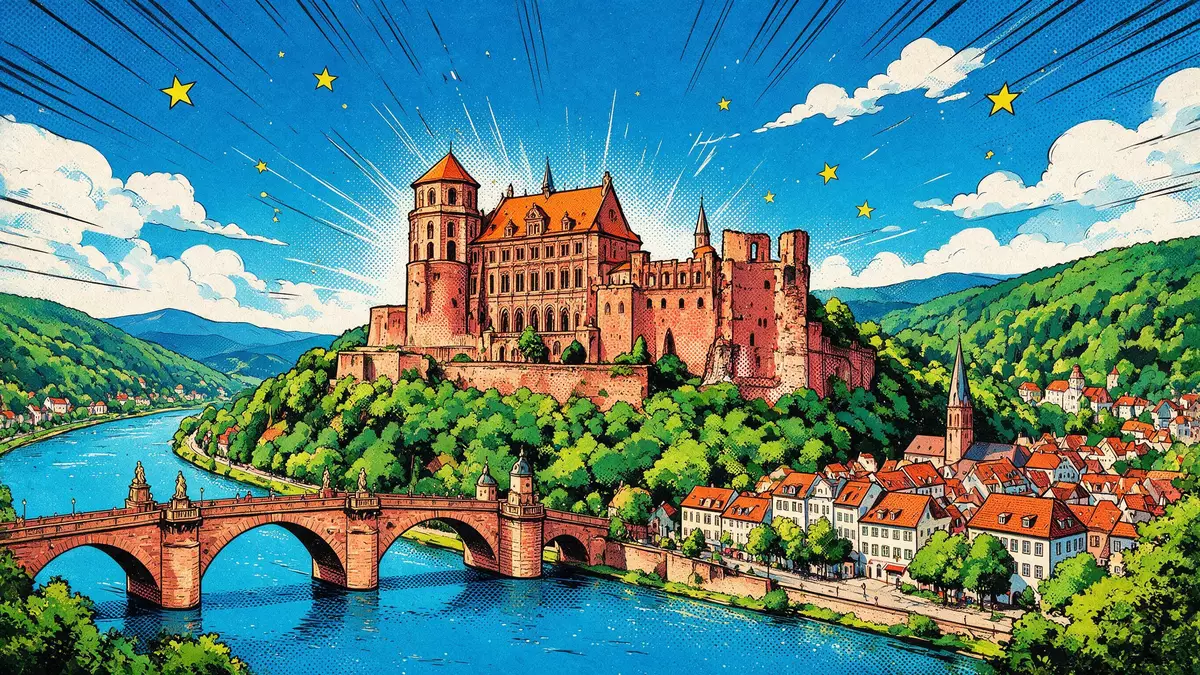
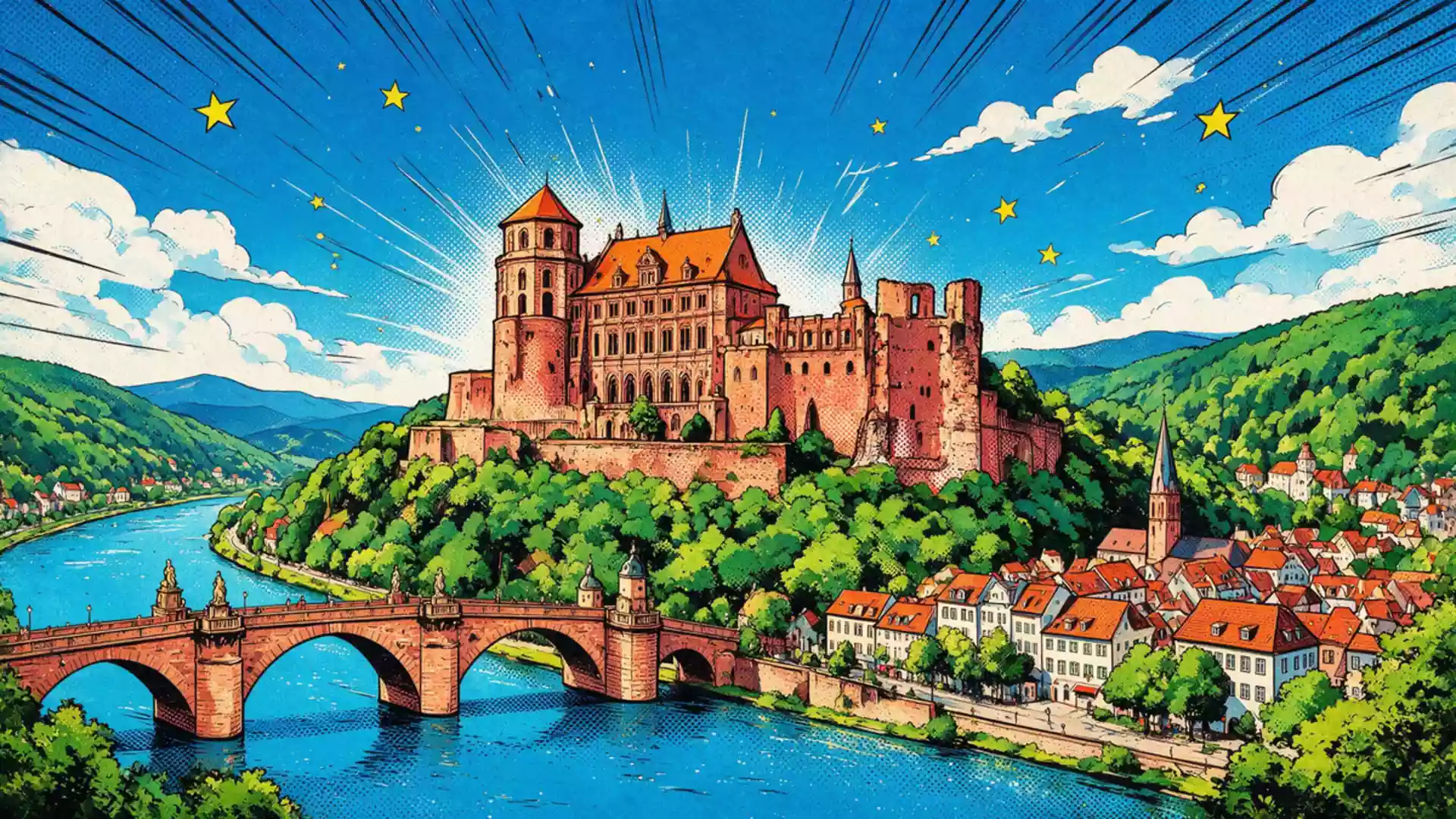
Schloss Heidelberg rises above the old town of Heidelberg as a vast ruined residence in red sandstone, suspended between fortress, palace and open hillside garden. Built for the Electors Palatine during the late Middle Ages and the Renaissance, it later became a broken shell after war and lightning left much of its fabric roofless, turning the complex into a dramatic landmark that frames views across the Neckar valley.
From medieval stronghold to princely residence
The documented story of Schloss Heidelberg begins in the early thirteenth century, when a fortification at Heidelberg is first mentioned in Latin as a castrum, marking a defensive stronghold above the river.The first documentary reference dates to 1225, in a record granting the site as a fief, and over the following decades the lower castle took shape on the slope beneath the Königstuhl. By the late Middle Ages, the Electors Palatine, imperial princes within the Holy Roman Empire, had adopted Heidelberg as their main residence and began turning the original fort into a courtly seat with halls, chapels and state apartments.
Under rulers such as Ruprecht III and Ludwig V in the fifteenth and early sixteenth centuries, the fortress gradually shifted towards a princely palace, with strengthened walls and new gateways leading into the complex.A city overview of the castle summarises this phase as a transition from medieval fort to residence, running roughly between 1400 and the mid sixteenth century. During this period the Electors Palatine oversaw building campaigns that increased living quarters and representative spaces, setting the stage for the more showpiece architecture that followed in the Renaissance.
Renaissance façades and the famed ruin
The sixteenth century turned Schloss Heidelberg into one of the most ornate princely complexes in what is now south-west Germany, as successive Electors commissioned palace wings in the latest architectural styles.The history of design at Heidelberg Castle identifies the Ottheinrichsbau, built for Elector Palatine Ottheinrich between 1556 and 1559, as a key Renaissance structure, with a façade carrying statues and decorative reliefs. Nearby, the Friedrichsbau associated with Friedrich IV added further sculpted architecture at the turn of the seventeenth century, while the Englischer Bau extended the residential quarters and complemented the formal castle gardens, known as the Hortus Palatinus.
In the seventeenth century the castle complex paid a heavy price for its strategic position along the Rhine corridor. During the War of the Palatine Succession, French troops twice besieged and damaged Heidelberg, blasting fortifications and leaving sections of the residence in ruins.A museum profile of Schloss Heidelberg notes that on 6 September 1693 French sappers destroyed towers and walls, and that further destruction followed in the eighteenth century. In 1764 two lightning strikes set off a fire that burned through rebuilt sections, after which full reconstruction was abandoned and the court moved down into the valley, leaving the broken ensemble on the hillside.
Red sandstone terraces above the Neckar
Schloss Heidelberg occupies a steep terrace on the northern slope of the Königstuhl, cut into the hillside above the Neckar and the Altstadt. The remaining walls and façades are built in red sandstone quarried from the surrounding valley, giving the ruins a warm colour that contrasts with the forested ridge behind them.The northern slope location defines the castle’s silhouette: façades rise directly from the drop towards the river, while inner courtyards open onto terraces that look across the tiled roofs of Heidelberg and towards the hills on the far bank.
Within the complex, visitors encounter distinct architectural periods edged against one another. Medieval curtain walls and towers frame Renaissance palace blocks with statued fronts, while Baroque elements appear in the ordering of windows and cornices noted in art historical surveys.A general view in the Web Gallery of Art emphasises how each major building represents a different phase of German architecture, and how the later decision to preserve the castle as a ruin created a layered ensemble rather than a single unified palace. The result is a place where roofless walls, surviving wings and garden terraces together form an open-air record of changing styles and the fortunes of a princely residence.
Visiting Schloss Heidelberg: what travellers from Western Europe should know
- Schloss Heidelberg stands on the hillside immediately above the Altstadt of Heidelberg in south-west Germany, on the northern slope of the Königstuhl looking over the Neckar valley.
- The castle complex is reached from the old town by steep paths and stairways that climb the slope, and by a historic funicular railway running up the Königstuhl.
- Within the ruins, courtyards, staircases and garden terraces involve uneven paving and changes of level, so moving between the different wings requires walking across sloping ground and climbing various stairways.
- The official language is German and the currency is the euro.
Searching for Schloss Heidelberg on social platforms
These links open searches for Schloss Heidelberg on each platform.
Frequently asked questions about Schloss Heidelberg
Where is Schloss Heidelberg located?
Schloss Heidelberg stands above the old town of Heidelberg in south-west Germany, on the hillside of the Königstuhl overlooking the Neckar river.
What can visitors expect at Schloss Heidelberg?
Visitors encounter extensive castle ruins in red sandstone, inner courtyards framed by Renaissance façades and terraces that offer wide views over Heidelberg and the surrounding valley.
What makes Schloss Heidelberg distinctive among German castles?
The combination of intact palace wings, roofless walls, formal gardens and a decision to preserve the complex as a ruin gives Schloss Heidelberg a layered character that reflects several centuries of architectural change.