Schloss Heidelberg and the romance of a ruined Renaissance castle
Published on 08/27/2026 at 10:31 | Editorial responsibility: Rafael Müller, Editor-in-Chief AD HOC NEWS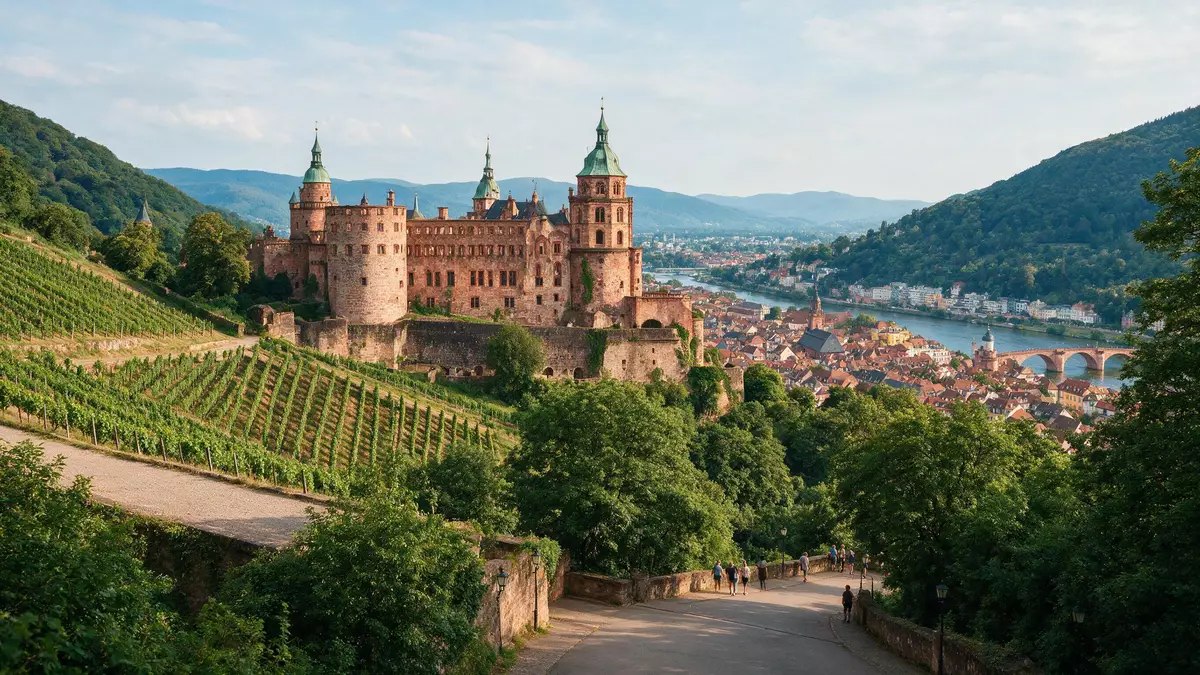
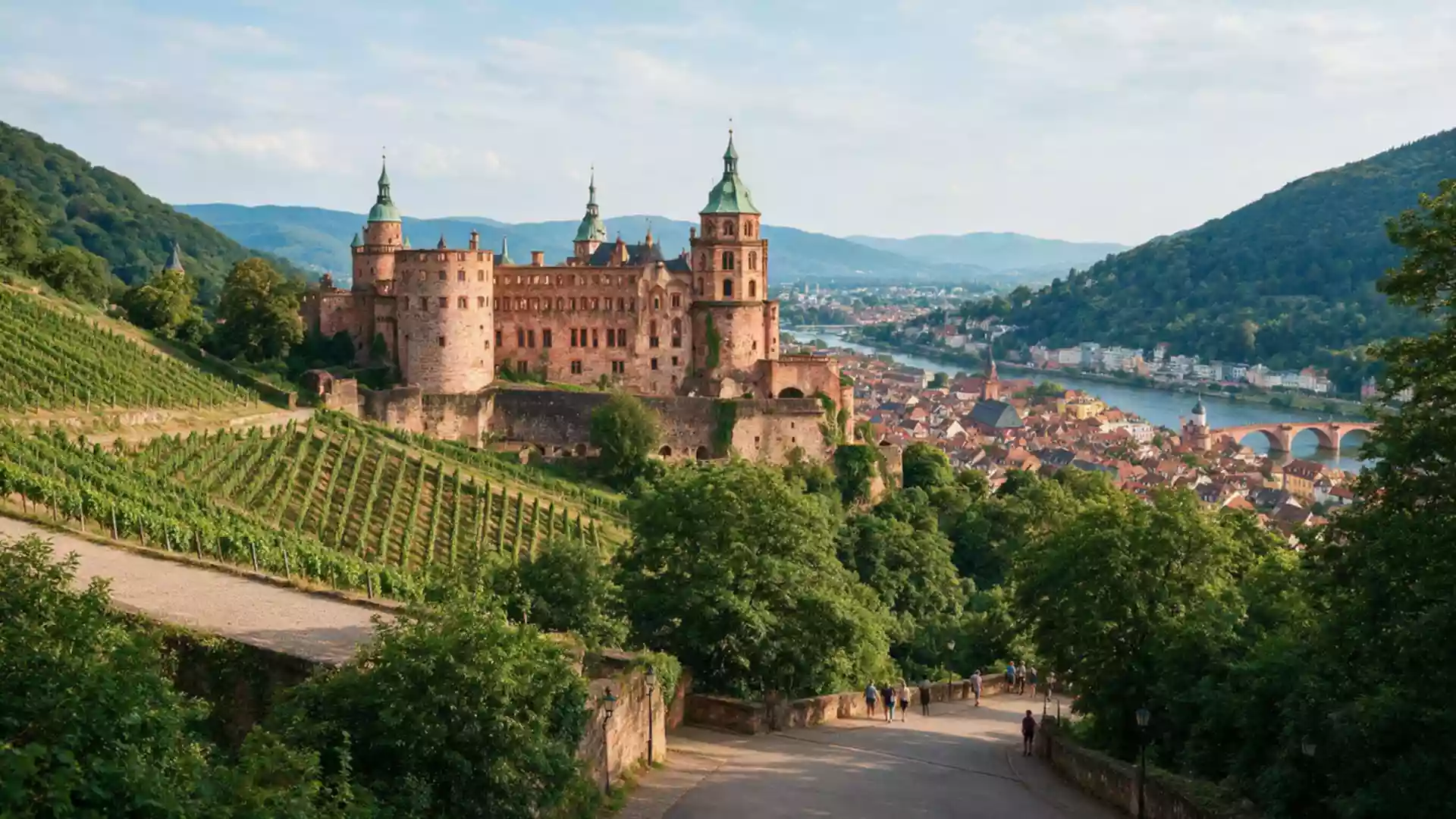
Schloss Heidelberg rises above the Neckar valley as a vast broken shell of sandstone, part fortress and part palace, where ruined walls frame views across Heidelberg and its river plain. The ensemble grew from a medieval stronghold into a Renaissance residence for the rulers of the Electoral Palatinate, and its present ruined state dates to war and lightning strikes in the seventeenth and eighteenth centuries.
A ruined residence above the Neckar
The castle stands on the northern flank of the Königstuhl hill, on a terrace directly above the old town of Heidelberg on the Neckar in south-west Germany. From this position it looks over a tight jumble of roofs, the river and the low hills beyond, so that the façades and broken towers read as much as a landscape feature as a building.
Schloss Heidelberg began as a defensive castle for the counts palatine of the Rhine, whose residence moved to Heidelberg in the thirteenth century.The rich and eventful history describes a fort above the town that developed into a princely seat. The site is first mentioned in 1225 as a castrum in a document linked to Duke Ludwig of Bavaria, placing it firmly in the high medieval period.A fort in Heidelberg was first mentioned in 1225 Later, Ruprecht III, prince elector of the Palatinate between 1398 and 1410, used the complex as a residence, marking the shift from fortress to courtly seat.Prince Elector Ruprecht III used the castle as a regal residence
Seen from the town, the most striking feature is the way the ruined outer walls and intact palace wings sit side by side. Sections of curtain wall stand broken off, exposing rooms and staircases, while the palace range still presents long façades and window lines towards the town. The contrast between elaborate stonework and raw breaks in the masonry gives Schloss Heidelberg its particular character.
Renaissance façades and broken towers
The most celebrated façades date from the sixteenth and early seventeenth centuries, when the medieval castle was expanded into a representative Renaissance residence for the prince electors.In the sixteenth century the medieval castle was expanded into a Renaissance castle During this period a sequence of new wings rose around the inner courtyards: the Ottheinrichsbau, the Friedrichsbau, the Gläserner Saalbau and the Englischer Bau, each with its own sculpted façade and architectural rhythm.Imposing constructions such as Gläserner Saalbau and Ottheinrichsbau
The Ottheinrichsbau, begun under Elector Palatinate Ottheinrich in the mid-sixteenth century, carries a dense façade of niches and statues facing the inner courtyard.The Ottheinrich Building has a façade with biblical and mythological figures Figures of biblical and mythological characters stand between pilasters, and the wall surface is broken up by windows and projecting elements rather than a single flat plane. Nearby, the Friedrichsbau, associated with Elector Palatinate Friedrich IV around the turn of the seventeenth century, presents a more ordered façade, with a regular grid of windows and niches holding statues of the Palatine rulers.Friedrichsbau added Baroque elements to the palace
Interspersed with these palace wings are the remains of towers and defensive walls that recall the older fortress. One of the most striking is a tower whose outer half has collapsed away, leaving a cross-section of chambers and masonry. From the courtyards and terraces, visitors move between preserved halls, open loggias and broken staircases that stop at the sky, so that every change of level brings another view through gaps in the walls to the town and river below.
War, lightning and the romantic ruin
Schloss Heidelberg’s ruined state is the result of repeated destruction in the seventeenth century followed by fire in the eighteenth century. French troops attacked the castle during the War of the Grand Alliance, also known as the Palatinate War of Succession, in 1689 and 1693, blasting apart fortifications and damaging the palace wings.During the Palatinate War of Succession the castle was destroyed twice In 1764 lightning struck the complex, igniting fires that destroyed additional sections and left the residence permanently uninhabitable.Lightning caused a fire in 1764 that destroyed rebuilt sections
By the nineteenth century the ruins had become a symbol of romantic decay, drawing travellers and artists who saw in the broken walls and overgrown terraces a picturesque counterpart to the ordered streets of the town below. The Hortus Palatinus, the castle gardens laid out in the seventeenth century under Prince Elector Friedrich V, left terraces and retaining walls that still step down the slope facing the Neckar.The magnificent Castle Gardens were gradually added Later conservation work in the nineteenth century stabilised parts of the complex while leaving others as open ruins, so that the site retains both preserved interiors and exposed masonry.
Among the later additions is a large wine barrel housed within the castle buildings, associated with the region’s wine production and often cited as one of the largest historic casks built for storage.Heidelberg Castle is home to a very large wine barrel Alongside this barrel, staircases, viewing platforms and exhibition spaces present parts of the castle’s interior as a sequence of rooms and vaulted spaces, while other sections remain roofless and open to the elements.
Visiting Schloss Heidelberg: what travellers from Western Europe should know
- Schloss Heidelberg stands on a hillside immediately above the Altstadt of Heidelberg, on the south side of the Neckar, and is reached by paths and roads that climb from the old town.
- The terrain within the castle includes uneven cobbled courtyards, sloping ramps and staircases that rise to the terraces and viewing platforms.
- A funicular railway known as the Bergbahn links the Altstadt with the castle terrace and continues up the Königstuhl, providing an alternative to the walk up the hillside.
- The official language is German and the currency is the euro.
Searching for Schloss Heidelberg on social platforms
These links open searches for Schloss Heidelberg on each platform.
Frequently asked questions about Schloss Heidelberg
Where is Schloss Heidelberg located?
Schloss Heidelberg stands on a hillside terrace above the old town of Heidelberg in south-west Germany, overlooking the Neckar river and the surrounding valley.
What can visitors expect when exploring Schloss Heidelberg?
Visitors encounter a mixture of preserved Renaissance palace wings, open courtyards and broken defensive towers, with terraces that give wide views over Heidelberg and the Neckar.
What makes Schloss Heidelberg distinctive among German castles?
The combination of extensive ruins, richly decorated Renaissance façades and hillside gardens above an intact historic town gives Schloss Heidelberg a character that is strongly tied to its setting.