
Schloss Belvedere, where baroque architecture frames Austrian art
Published on 09/18/2026 at 13:02 | Editorial responsibility: Rafael Müller, Editor-in-Chief AD HOC NEWS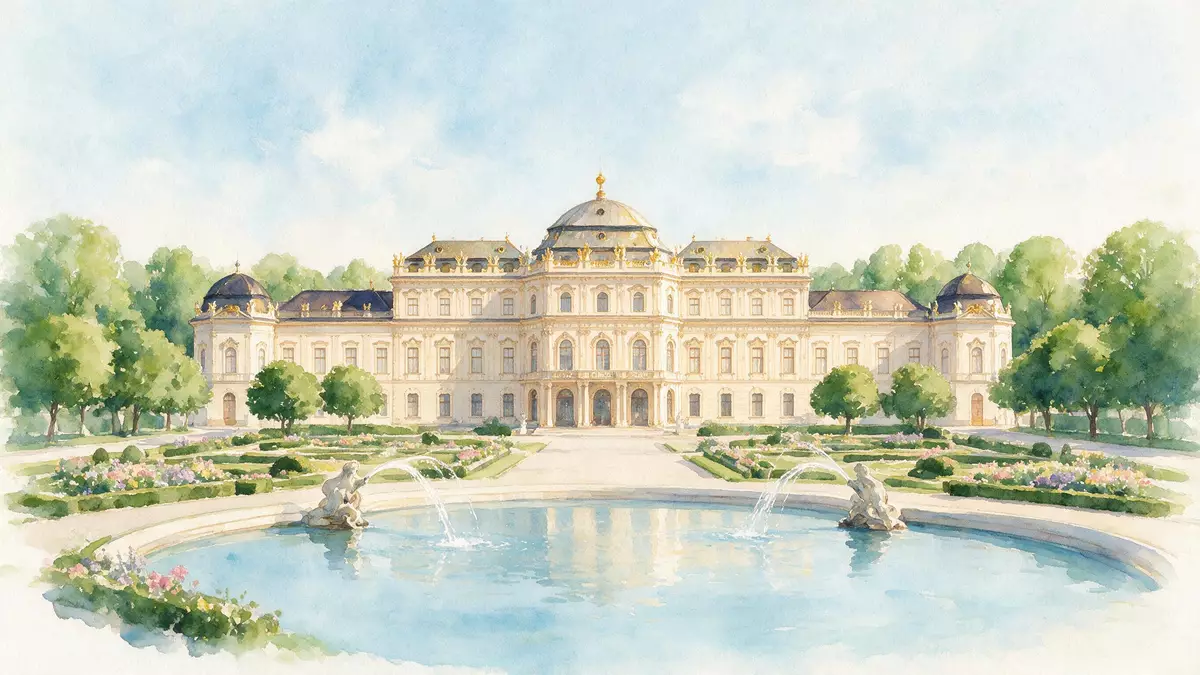
Schloss Belvedere in Wien unfolds along a gentle slope on the south?eastern side of the historic centre, pairing high baroque architecture with one of Austria’s leading art collections. Built in the early eighteenth century as the summer residence of Prince Eugene of Savoy, the ensemble of Upper and Lower Belvedere, garden terraces and ancillary buildings still shows how architecture, landscape and display spaces were conceived together in the Habsburg capital.
A baroque palace ensemble on a Viennese slope
Schloss Belvedere occupies ground in Vienna’s Landstraße district, rising between Rennweg and Prinz?Eugen?Straße on terrain that drops towards the city centre. The complex consists of two principal palaces, the Lower Belvedere at the lower edge of the site and the Upper Belvedere at the crest, tied together by formal gardens, fountains and sculptural decoration.two principal palaces This layout gives the ensemble a strong axial alignment, with the palaces and garden aligned along a straight line that leads the eye towards the skyline of Wien.
The name “Belvedere” derives from Italian, referring to a beautiful view, and the orientation of the Upper Belvedere towards the city makes the prospect part of the experience of the palace.Italian origin of the name Both palaces share the baroque architectural language associated with Johann Lukas von Hildebrandt, the architect responsible for the ensemble, whose façades combine pilasters, reliefs and sculpted figures with elaborate rooflines. The overall impression is of a palace complex composed as much for distant views as for close inspection.
Prince Eugene, Johann Lukas von Hildebrandt and the early eighteenth century
Schloss Belvedere was created as the summer residence of Prince Eugene of Savoy, the Habsburg general whose campaigns in the late seventeenth and early eighteenth centuries brought him considerable prominence and wealth.summer residence of Prince Eugene Prince Eugene commissioned Johann Lukas von Hildebrandt, one of the leading baroque architects in Austria, to design not a single palace but an ensemble of buildings linked by a garden on sloping ground. Construction of the Lower Belvedere began in the 1710s, with the Upper Belvedere following on the higher ground; the overall project was completed in 1723, giving the complex its clear dating within the high baroque period.completed in 1723
In its original arrangement the Lower Belvedere on Rennweg contained Prince Eugene’s living quarters and representative rooms, including richly decorated halls and cabinets, while the Upper Belvedere on the crest functioned as a ceremonial palace for festivities and formal receptions.Lower and Upper Belvedere The period after Prince Eugene’s death in 1736 brought the complex into Habsburg ownership, and Empress Maria Theresa integrated Schloss Belvedere into the wider system of imperial residences.Empress Maria Theresa integrated the complex Under Joseph II, the imperial picture gallery was moved to the Upper Belvedere and opened to the public in 1781, giving the palace an early role in the history of European museums.
Gardens and galleries: baroque landscape with Austrian art
Between the two main palaces lies a formal garden laid out in the baroque manner, with terraces, ornamental basins, flights of steps and sculptural groups aligned along the central axis.formal garden laid out in the baroque manner Hedges, clipped trees and stone figures frame views both up towards the Upper Belvedere and down towards the roofscape of Wien, and the garden’s composition reinforces the sense that architecture and landscape were planned as a single work. Ancillary structures such as the orangery and former stables extend the ensemble along the slope, contributing to its status as one of the major baroque palace complexes in Austria.orangery and stables
Schloss Belvedere today houses the Österreichische Galerie Belvedere, the federal museum for Austrian art, with the Upper Belvedere presenting works that range from medieval panels to the early twentieth century.Österreichische Galerie Belvedere Among its most noted holdings are paintings by Gustav Klimt, including “The Kiss (Lovers)” and “Judith”, which form part of the Art around 1900 presentation alongside works by Egon Schiele and Oskar Kokoschka.Klimt paintings including “The Kiss” The Lower Belvedere is used for exhibitions and provides access to Prince Eugene’s historic apartments, while Belvedere 21 in the wider complex focuses on contemporary art, giving the ensemble an art?historical range that spans many centuries.
Visiting Schloss Belvedere: what travellers from Western Europe should know
- Schloss Belvedere stands in Vienna’s Landstraße district, south?east of the historic centre; the palaces face Prinz?Eugen?Straße and Rennweg and are reached easily by urban public transport.
- The site extends along a slope, and moving between Upper and Lower Belvedere involves walking outdoor terraces and stairways; interiors include grand staircases with several flights.
- The official language is German and the currency is the euro, used throughout Austria for payments in the museum and surrounding district.
Searching for Schloss Belvedere on social platforms
These links open searches for Schloss Belvedere on each platform.
Frequently asked questions about Schloss Belvedere
Where is Schloss Belvedere located within Wien?
Schloss Belvedere stands in Vienna’s Landstraße district on a slope south?east of the historic centre, between Rennweg and Prinz?Eugen?Straße.
What can visitors expect when exploring Schloss Belvedere?
Visitors encounter two baroque palaces, garden terraces, historic interiors and galleries housing Austrian art, including Gustav Klimt’s “The Kiss” and other works from around 1900.
What makes Schloss Belvedere distinctive among Viennese palaces?
The combination of Johann Lukas von Hildebrandt’s baroque ensemble, the axial garden on a slope and the role of the Upper Belvedere as a major art museum gives the complex its distinctive character.


