
Schloss Belvedere in Wien and its baroque palaces and gardens
Published on 09/17/2026 at 14:22 | Editorial responsibility: Rafael Müller, Editor-in-Chief AD HOC NEWS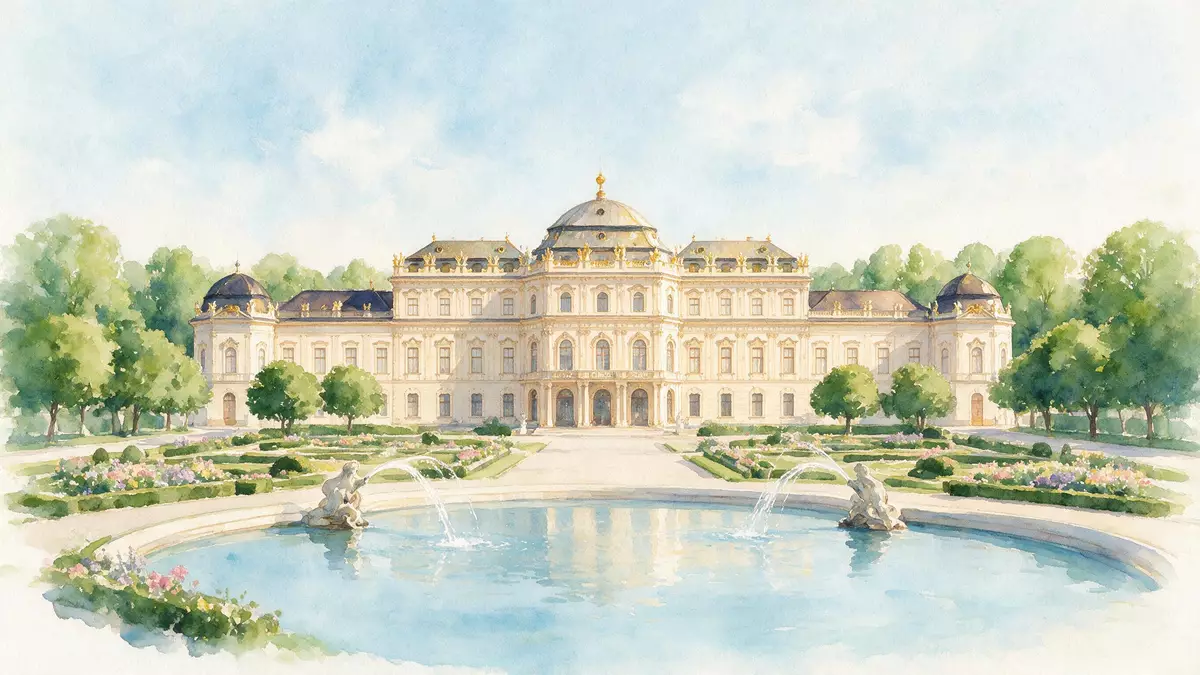
Schloss Belvedere in Wien is a baroque palace ensemble of Upper and Lower Belvedere set on a gentle slope, framed by formal gardens and filled with Austrian art from many periods. Built as the summer residence of Prince Eugene of Savoy in the early eighteenth century, it links court architecture, garden design and museum galleries in one continuous sequence.
Baroque palaces on a Viennese slope
Schloss Belvedere occupies a rise in Vienna’s Landstraße district, south-east of the historic centre, with the two palaces aligned along a central axis that climbs from the lower level up towards the crest.occupies a slope in Vienna’s Landstraße district The complex was conceived as the summer residence of the Habsburg military commander Prince Eugene of Savoy, whose estates around Vienna allowed room for a broad baroque layout.Built as the summer residence of Prince Eugene of Savoy
The ensemble brings together two principal buildings, the Upper Belvedere on the higher ground and the Lower Belvedere closer to the city, with the Orangery, Palace Stables and garden elements completing the site.The complex consists of two Baroque palaces, the Upper and Lower Belvedere, together with the Orangery, the Palace Stables, and a formal Baroque garden The architect Johann Lukas von Hildebrandt worked within the high baroque style, giving the palaces articulated façades and an axial plan that ties interiors to the garden outside.architect: Johann Lucas von Hildebrandt
From princely residence to Habsburg art collection
Construction of Schloss Belvedere took place in the early eighteenth century, with the Lower Belvedere dating from the 1710s and the Upper Belvedere completed in 1723.construction period Upper Belvedere:1717 – 1723 At that time, the Lower Belvedere served as Prince Eugene’s living quarters, while the Upper Belvedere at the top of the slope functioned as a ceremonial setting for receptions and gatherings.Lower Belvedere, completed around 1716 as Prince Eugene's living quarters, and the Upper Belvedere, finished in 1723 for state receptions
After Prince Eugene’s death in 1736 the estate passed to his heirs and later entered imperial ownership, when Empress Maria Theresa bought the complex for the Habsburg crown in the mid-eighteenth century.Empress Maria Theresa bought it for the Habsburg crown in November 1752 By 1781 the imperial picture gallery here was open to the public, giving Belvedere an early role as a museum in Vienna and laying foundations for the Österreichische Galerie Belvedere that now occupies the palaces.from 1781 the imperial picture gallery was open to the public here
Gardens and Austrian paintings around 1900
Between the Upper and Lower Belvedere stretches a formal garden laid out in the French manner, with terraces, symmetrically arranged parterres, fountains and clipped vegetation leading the eye along the central axis between the palaces.Belvedere’s garden is one of Europe’s most significant historical gardens in French style The garden design is attributed to Dominique Girard, a landscape designer trained in the gardens of Versailles, and forms part of the overall baroque composition of the site.The Belvedere Gardens were designed in the formal French manner by Dominique Girard
Inside the palaces the Österreichische Galerie Belvedere presents works spanning the Middle Ages to modernity, with a strong focus on Austrian art around 1900 and the years that followed.It houses the most important collection of Austrian art spanning the Middle Ages to Modernity Among the highlights are paintings by Gustav Klimt, including “The Kiss (Lovers)” from 1907–08 and “Judith” from 1901, shown alongside works by artists such as Egon Schiele and Oskar Kokoschka.Its highlights are Klimt’s “The Kiss (Lovers)” (1907/08) and “Judith” (1901)
Visiting Schloss Belvedere: what travellers from Western Europe should know
- Schloss Belvedere stands in Vienna’s Landstraße district, south-east of the historic centre, with the palaces reached by city public transport and local streets.
- The ensemble rises on a slope, and moving between Upper and Lower Belvedere involves walking up or down terraces and exterior stairways in the garden.
- The grounds combine formal garden surfaces with paved routes, so a visit typically includes time outdoors between the palaces and indoor gallery spaces.
- Austria’s official language is German and the currency is the euro, used throughout Wien for payments.
Searching for Schloss Belvedere on social platforms
These links open searches for Schloss Belvedere on each platform.
Frequently asked questions about Schloss Belvedere
Where is Schloss Belvedere located?
Schloss Belvedere stands in Vienna’s Landstraße district, south-east of the historic centre, with the two palaces set on a slope above local streets.
What can visitors expect at Schloss Belvedere?
A visit includes baroque palace interiors, formal French-style gardens between Upper and Lower Belvedere, and galleries of Austrian art from the Middle Ages to modernity.
What makes Schloss Belvedere distinctive among Viennese sites?
The ensemble combines early eighteenth-century baroque palaces by Johann Lukas von Hildebrandt, gardens laid out by Dominique Girard and a museum collection centred on Austrian painting around 1900.


