
Schloss Belvedere in Wien and its Baroque palace and garden ensemble
Published on 09/16/2026 at 21:09 | Editorial responsibility: Rafael Müller, Editor-in-Chief AD HOC NEWS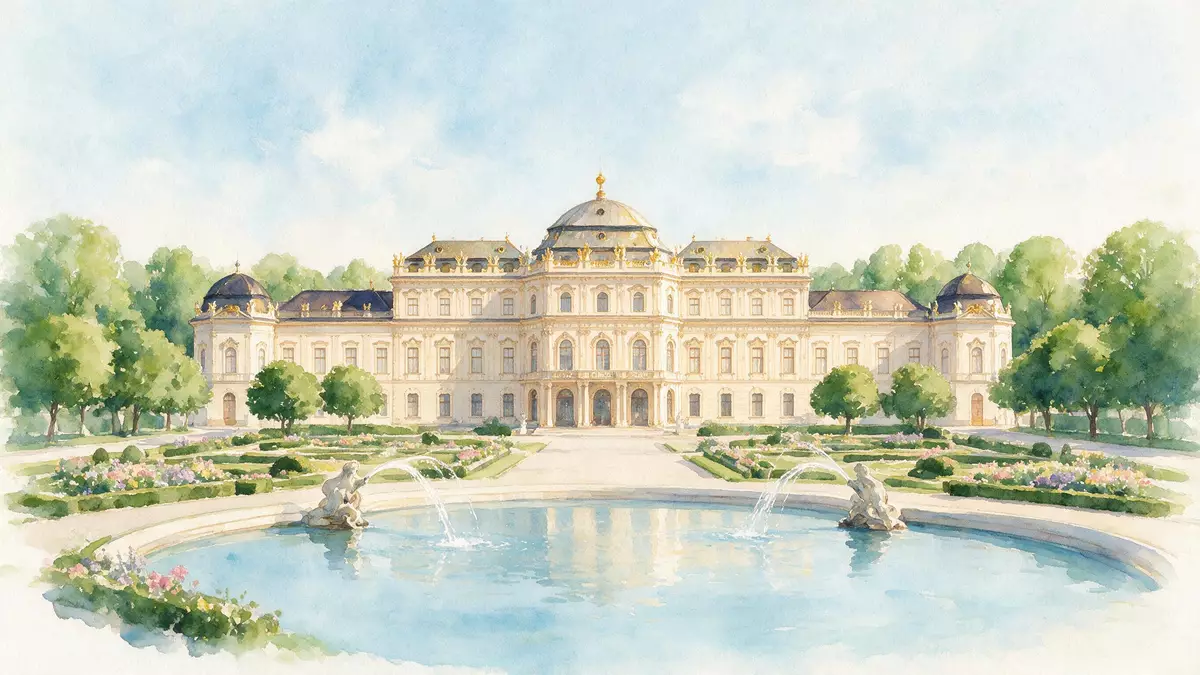
Schloss Belvedere in Wien is a Baroque palace ensemble where two grand residences face each other across formal terraces and gardens on a gentle slope above the city’s historic core. Built in the early eighteenth century as the summer residence of Prince Eugene of Savoy, it now houses major Austrian art collections in a setting that still reads as a carefully composed landscape of architecture, sculpture and water.
The Baroque hillside ensemble of Upper and Lower Belvedere
Schloss Belvedere occupies a rise in Vienna’s Landstraße district, with the Lower Belvedere towards the city and the Upper Belvedere on higher ground, linked by a sequence of terraces and axial paths. The complex took shape in the first decades of the eighteenth century, when Prince Eugene of Savoy commissioned architect Johann Lukas von Hildebrandt to design a summer residence that combined a residential palace with a ceremonial counterpart.summer residence of Prince Eugene Construction of the ensemble is dated to the period between 1712 and 1723, with the Lower Belvedere completed first and the Upper Belvedere following on the crest of the slope.built between 1712 and 1723
Johann Lukas von Hildebrandt worked within the high Baroque style, giving the palaces articulated façades, pronounced central projections and rich sculptural programmes that emphasise their position along the main axis of the gardens.planned an ensemble of two palaces linked by a garden The Lower Belvedere, closer to the inner city, served as Prince Eugene’s residential palace, while the Upper Belvedere functioned as a venue for receptions and gatherings in grand halls overlooking the terraces. Together, the two wings and their connecting garden form one of Vienna’s most coherent Baroque hillside compositions.
Gardens on a French axis: terraces, water and sculpture
The gardens between Upper and Lower Belvedere are laid out in the French formal style, with a strong central axis that runs up the slope and ties architecture and landscape into a single composition. Garden architect Dominique Girard, who had worked for the Elector of Bavaria, is credited with the design, which shows the characteristic elements of late Baroque garden architecture: symmetrical flower parterres, water basins, tiers and flights of steps, trimmed hedges and strategically placed sculptures.late Baroque garden design by Dominique Girard
Moving through the Belvedere gardens, the terraces rise in stages from the lower palace towards the upper one, with water features and cascades arranged along the same line so that the visitor is always aware of the slope and the relationship between buildings and landscape.late-Baroque garden with three large terraces Sculpted sphinxes, mythological figures and balustrades mark transitions between levels, and clipped hedges frame views back towards the Lower Belvedere or up to the Upper Belvedere. The ensemble extends beyond the main axis into additional planted areas, including an Alpine garden and other specialised sections, but the heart of the composition remains the stepped central space between the two palaces.
From princely residence to national art collection
After Prince Eugene’s death in 1736, Schloss Belvedere passed out of his personal ownership and into the hands of the Habsburg dynasty, with Empress Maria Theresa acquiring the complex for the crown in the mid-eighteenth century.Empress Maria Theresa bought it for the Habsburg crown In the decades that followed, parts of the Upper Belvedere began to serve as galleries for imperial collections, and by the later eighteenth century picture galleries here were open to the public, giving the palace ensemble an early role as a museum space.
That museum function grew over the nineteenth and twentieth centuries, and the complex is now home to the Österreichische Galerie Belvedere, a federal art museum that presents works from the Middle Ages through to modern art, including paintings by Gustav Klimt and other key figures in Austrian art.Österreichische Galerie Belvedere in the palace ensemble The Upper Belvedere has also played host to major historical events, among them the signing of the Austrian State Treaty in 1955 in its Marble Hall, which marked an important moment in the country’s twentieth-century political history.Austrian State Treaty signed in the Marble Hall in 1955 Today the palaces and gardens together combine courtly Baroque architecture with the functions of a modern museum complex, while retaining the hillside plan that has structured the site since the eighteenth century.
Visiting Schloss Belvedere: what travellers from Western Europe should know
- Schloss Belvedere stands in Vienna’s Landstraße district, south-east of the Innere Stadt, with the Upper Belvedere fronting Prinz-Eugen-Strasse and the Lower Belvedere near Rennweg. It is reached by city tram and S-Bahn lines, with Wien Rennweg station and various tram stops providing access along the western edge of the complex.
- The ensemble climbs a noticeable slope between the Lower and Upper Belvedere, with terraces linked by broad exterior stairways and paths. Moving between the palaces on foot involves ascending or descending these outdoor steps and crossing paved garden surfaces.
- The formal gardens sit beside urban streets but form a distinct landscaped zone, with balustrades, statues and hedges defining edges and level changes. Within the main axis the ground is laid out in terraces, so wheelchair users and others with limited mobility may prefer to focus on the individual palace buildings and adjoining level areas rather than traversing the full length of the hillside.
- Vienna lies in Austria, where the official language is German and the currency is the euro. English is used for visitor information in the museum complex, but signage in the surrounding district generally follows local language conventions.
Searching for Schloss Belvedere on social platforms
These links open searches for Schloss Belvedere on each platform.
Frequently asked questions about Schloss Belvedere
Where is Schloss Belvedere in Wien located?
Schloss Belvedere stands in Vienna’s Landstraße district, south-east of the historic city centre, with the Upper and Lower Belvedere aligned along a hillside axis.
What can visitors expect when exploring Schloss Belvedere?
Visitors encounter Baroque palace interiors, formal terraces and gardens arranged along a central axis, and museum galleries presenting Austrian art within the historic architecture.
What makes Schloss Belvedere distinctive among Vienna’s palaces?
The ensemble combines two Baroque palaces by Johann Lukas von Hildebrandt, French-style gardens by Dominique Girard and a long-standing role as the seat of the Österreichische Galerie Belvedere.


