
Scalinata di Trinita dei Monti between Piazza di Spagna and Trinita dei Monti
Published on 09/04/2026 at 13:34 | Editorial responsibility: Rafael Müller, Editor-in-Chief AD HOC NEWS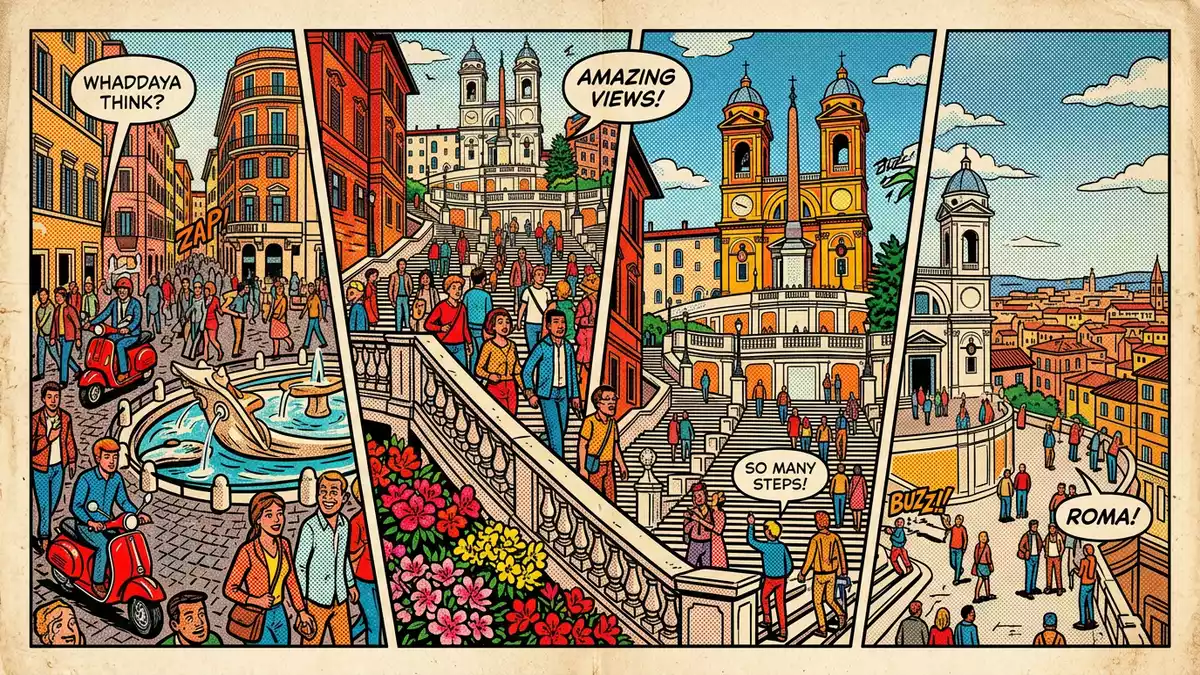
Scalinata di Trinita dei Monti, widely known in English as the Spanish Steps, is a grand baroque staircase on the slope between Piazza di Spagna and the church of Trinita dei Monti in Rome, Italy. Built in the early eighteenth century, it turns a steep hillside into a broad stone theatre of steps and landings, framing both the church above and the square below as a single architectural scene.
The baroque staircase on the Roman hillside
The staircase occupies the slope that rises from Piazza di Spagna to Piazza Trinita dei Monti, joining the square at the foot to the late Renaissance church that crowns the hill.Piazza di Spagna at the base sits in Rome’s historic centre, while the church and its small piazza form a quieter terrace above.The staircase connects the two spaces in a single continuous architectural composition.
Constructed between 1723 and 1725 and opened in 1725, the Scalinata di Trinita dei Monti belongs to the high baroque phase of Roman urban design.Work took place in the mid 1720s, following earlier centuries that had already given the hill its church and monastic buildings. The staircase is built in stone and laid out in flights and broad landings, adapting to the slope while maintaining a regular rhythm. From the bottom it appears as a wide fan of steps; from the top it unfolds in terraces that overlook the square and the city beyond.
Between Piazza di Spagna and Trinita dei Monti
At the lower end of the staircase lies Piazza di Spagna, one of Rome’s most recognisable urban spaces. The square takes its name from the Spanish Embassy to the Holy See, which has long been established in the area, and it is framed by palazzi, streets and the Barcaccia fountain near the foot of the steps.The staircase rises from Piazza di Spagna in a broad front, turning the entire slope into an extension of the square.
Above the staircase stands the church of Santissima Trinita dei Monti, often shortened to Trinita dei Monti, a late Renaissance church with a distinctive façade and twin bell towers.Construction of the church began in 1502 under Louis XII of France and the building was consecrated in 1585, placing it in the sixteenth century transformation of Rome. The church complex is historically linked to French patronage, and its position above the staircase gives it a commanding presence. From its terrace, the steps lead down in a long stone cascade towards the square, creating a visual axis that ties the church into the fabric of Rom.
Design, proportions and stonework
The Scalinata di Trinita dei Monti is a monumental work of urban design rather than a simple flight of stairs. It consists of multiple aligned flights and generous landings, arranged to accommodate the slope while providing spaces to pause and view the surroundings.The staircase is built in a baroque style between 1723 and 1726, using pale stone that catches the light and gives the steps their characteristic appearance. The composition is often described as having a butterfly-like plan, with sections that branch out and reunite, though the core experience remains that of ascending a broad and gently rising stair.
The work is commonly linked to the architect Francesco De Sanctis, associated with the design of the staircase around the mid 1720s.Francesco De Sanctis is named as the architect of the steps, drawing together the church, the embassy and the square in a single composition. The steps themselves are relatively shallow, laid out in long runs that allow a measured ascent. Balustrades, retaining walls and the edges of the landings form continuous lines, while the stone surfaces show the wear of centuries of use.
Visiting Scalinata di Trinita dei Monti: what travellers from Western Europe should know
- Scalinata di Trinita dei Monti stands in central Rom, linking Piazza di Spagna with Piazza Trinita dei Monti beside the church of Trinita dei Monti. The nearest metro station is Spagna on Linea A, with an exit directly onto Piazza di Spagna at the base of the staircase.
- The staircase is long and set on a steady gradient, with many stone steps and no lift or ramp on the stairway itself. The piazza at the bottom is level, and the upper piazza by the church can be reached without the steps by following streets such as Via Sistina or Via Gregoriana.
- The official language is Italian and the currency is the euro.
Searching for Scalinata di Trinita dei Monti on social platforms
These links open searches for Scalinata di Trinita dei Monti on each platform.
Frequently asked questions about Scalinata di Trinita dei Monti
Where is Scalinata di Trinita dei Monti located in Rom?
It stands on the slope between Piazza di Spagna and Piazza Trinita dei Monti in central Rom, connecting the square below with the church of Trinita dei Monti above.
What should visitors expect when climbing the staircase?
Visitors encounter a long series of stone steps arranged in flights and landings, with views over Piazza di Spagna from the terraces and over the city from the upper piazza beside the church.
What makes Scalinata di Trinita dei Monti distinctive among Rome’s staircases?
Its eighteenth-century baroque design links a major square with a sixteenth-century church in one continuous composition, turning a steep hillside into a wide architectural stage.


