
Savannah Historic District and its grid of moss-draped squares
Published on 09/12/2026 at 09:07 | Editorial responsibility: Rafael Müller, Editor-in-Chief AD HOC NEWS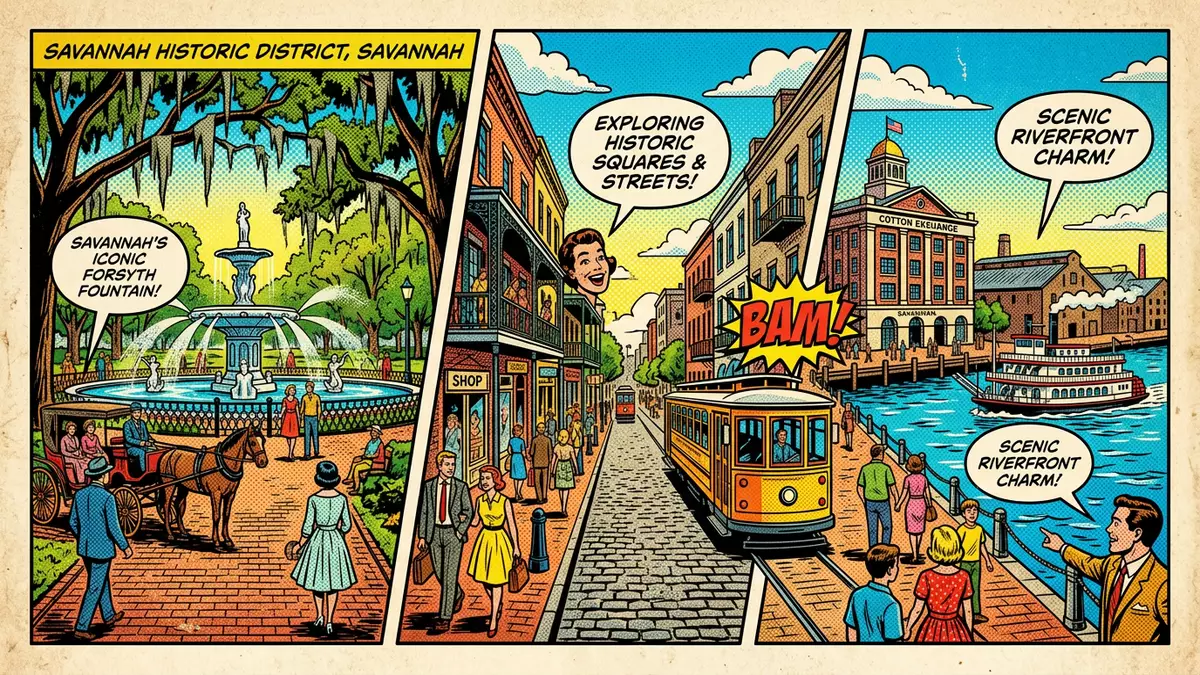
Savannah Historic District in Savannah, Georgia, forms a compact urban landscape where an eighteenth-century street grid, shaded public squares and historic architecture interlock into a distinctive city centre.
An eighteenth-century plan that still shapes the city
The structure of Savannah Historic District rests on a planned layout devised in 1733 by General James Oglethorpe, founding figure of the Georgia colony.urban plan created in 1733 The plan divides the city into wards, each centred on a public square with surrounding lots for civic buildings and houses, forming a repeating pattern that still defines the historic core.
In this ward system, the squares sit at the heart of each unit, with trust lots along one axis reserved for churches, markets and other public structures, and residential lots arranged in rows along the other.wards were public squares As Savannah expanded through the nineteenth century, more wards and squares were added using the same pattern, extending the planned grid as far as Forsyth Park and giving the historic district its recognisable rhythm of blocks and green spaces.
Squares, streets and architectural fabric
Savannah Historic District contains a network of public squares framed by streets such as Bull Street, which runs as a spine through a sequence of these spaces from Johnson Square near the river to Monterey Square further south.Bull Street runs like a spine Each square combines paving, planting and surrounding buildings, making them focal points where the city’s traffic, walking routes and historic structures meet.
The architectural fabric around the squares includes eighteenth- and nineteenth-century houses and civic buildings in styles such as Gothic, Greek Revival and Victorian, many of them protected within the district’s boundaries.18th– and 19th-century homes Along the northern edge by the Savannah River stand former cotton warehouses lining streets close to the waterfront, while streets like Broughton Street provide a commercial corridor with shops and other urban functions woven into the historic setting.old cotton warehouses now hold shops
A National Historic Landmark district and its boundaries
The area recognised as Savannah Historic District roughly corresponds to the pre–Civil War city limits and was designated a National Historic Landmark District in 1966, marking its national significance in United States urban history.declared a National Historic Landmark District in 1966 The recognised district extends from the Savannah River in the north to Gwinnett Street in the south and from East Broad Street to Martin Luther King Jr. Boulevard, enclosing the planned grid, squares and a dense concentration of historic buildings.extends from the Savannah River south to Gwinnett Street
The landmark area covers a substantial tract of downtown, measured in hundreds of hectares, and sits at the centre of wider districts and neighbourhoods whose later development surrounds the original grid.bounded by East Broad, Gwinnett and West Broad Streets and the Savannah River Within this zone, preservation efforts concentrate on maintaining the ward pattern, the streets, the squares and the historic architectural stock, ensuring that the eighteenth-century plan and its nineteenth-century elaboration remain legible in the modern city.
Visiting Savannah Historic District: what travellers from Western Europe should know
- Savannah Historic District sits in downtown Savannah on the Georgia coast, bordered by the Savannah River to the north and streets including Gwinnett Street and East Broad Street further inland.
- The terrain within the district is predominantly level, laid out as an urban grid of streets and squares that lends itself to exploration on foot across paved sidewalks and park paths.
- The area is reached by road from other parts of Savannah, with riverfront streets lined by former warehouse buildings and Bull Street providing a clear north–south axis through the sequence of squares.
- The official language is English and the currency is the United States dollar (USD).
- Entry requirements depend on your nationality; UK travellers can check the FCDO travel advice at gov.uk/foreign-travel-advice, Irish travellers the Department of Foreign Affairs at ireland.ie.
Searching for Savannah Historic District on social platforms
These links open searches for Savannah Historic District on each platform.Frequently asked questions about Savannah Historic District
Where is Savannah Historic District located?
Savannah Historic District occupies the historic core of Savannah in the state of Georgia, extending from the Savannah River towards Gwinnett Street and bounded laterally by East Broad Street and Martin Luther King Jr. Boulevard.
What should visitors expect on a first walk through the district?
Visitors encounter a regular grid of streets punctuated by shaded public squares, with historic houses, churches and commercial buildings lining the blocks and former riverfront warehouses marking the northern edge.
What makes Savannah Historic District distinctive among historic city centres?
The district stands out through its eighteenth-century ward system of repeating squares, its continuous historic architectural fabric and its formal recognition as a National Historic Landmark District since 1966.


