
Sassi di Matera, a stone city carved into the ravine
Published on 08/24/2026 at 13:24 | Editorial responsibility: Rafael Müller, Editor-in-Chief AD HOC NEWS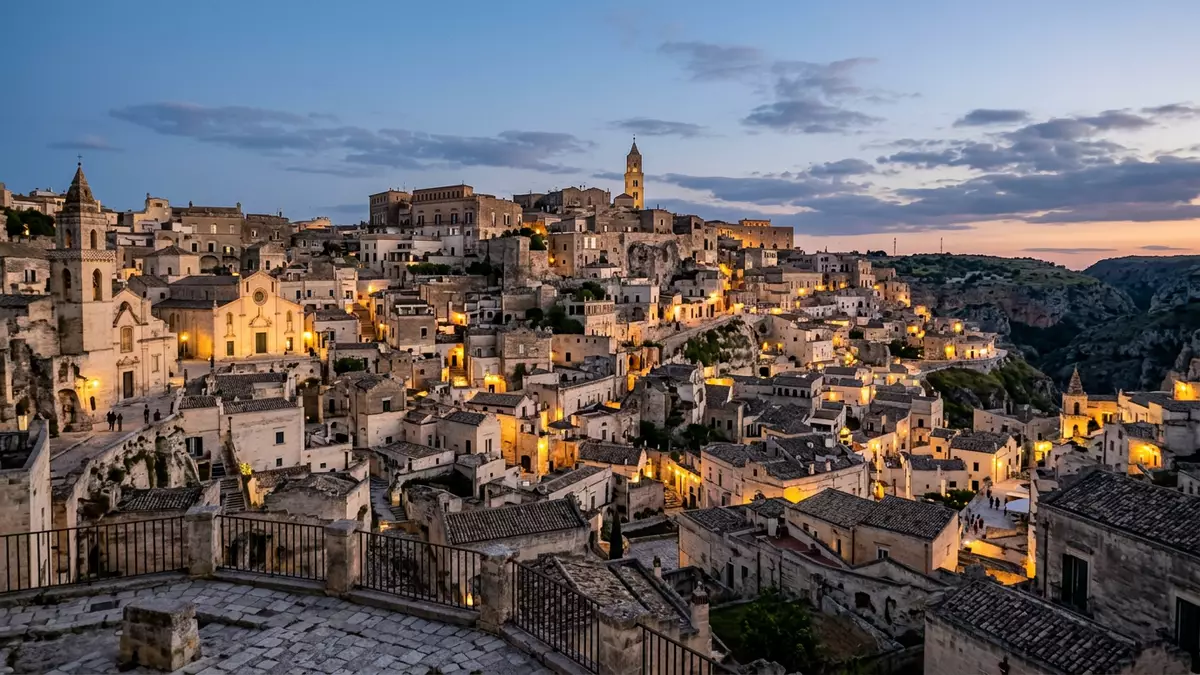
Sassi di Matera in Matera, Italy, is a compact stone city where houses, rock churches and lanes are carved directly into the ravine walls of the Gravina gorge. Its cave dwellings form two historic districts, Sasso Caveoso and Sasso Barisano, which together with the Civita ridge create the ancient core of Matera and carry a continuous record of human settlement from prehistoric times.
A troglodyte city shaped in stone
Sassi di Matera occupies the slopes of a deep limestone ravine on the edge of the Murgia plateau in Basilicata, southern Italy, its dwellings stepped one above another on the terraced hillside.The Sassi and the Park of the Rupestrian Churches of Matera describe a complex of houses, monasteries and hermitages cut into natural caves, with masonry structures built onto them over time. The two districts, Sasso Caveoso and Sasso Barisano, wrap around the Civita, an elevated spur that holds some of the oldest built fabric of the city and acts as a natural dividing ridge between them.The Sassi core around the Civita
The dwellings use the soft local rock, often described as tuff, to create interiors that extend back into the hillside, with façades forming continuous street frontages along the lanes.Matera guide to the Sassi Many houses rise above former caves, stacking rooms, terraces and courtyards in a vertical sequence that follows the slope of the ravine rather than a regular grid. In places roofs of one dwelling become the small open spaces or paths for those above, producing interlocking layers of stone surfaces that feel like a single carved landscape as much as a town.
From prehistoric settlement to UNESCO World Heritage
The origins of settlement around Matera reach back to the Palaeolithic, with evidence of human occupation on the surrounding plateau long before the development of the present cave districts.Historical chronology of Matera The Sassi themselves grew into recognisable districts during the medieval period, when communities expanded the natural cavities, extended them with built façades and developed cisterns and water channels to capture scarce rainwater in a dry karst landscape. Over centuries, the cave houses, lanes and stairways formed a densely inhabited urban ecosystem tied closely to the contours and geology of the ravine.
In 1993 the Sassi and the neighbouring Park of the Rupestrian Churches of Matera were inscribed on the UNESCO World Heritage List as a cultural property, recognised under criteria (iii), (iv) and (v) for their outstanding rock-cut settlement and long continuity of human use.UNESCO inscription of the Sassi UNESCO describes the ensemble as an intact troglodyte city adapted to its geomorphological setting and ecosystem, representing an example of traditional land use that maintained a close relationship with the natural environment.Outstanding Universal Value statement The World Heritage property covers the cave districts and the park on the opposite side of the ravine, where rock-hewn chapels cut into the cliffs echo the domestic caves facing them.
Cave churches, water systems and everyday architecture
Among the stone houses of Sassi di Matera are numerous rupestrian churches, carved partly or wholly into the rock and decorated with wall paintings that recall monastic and parish life embedded in the caves.Park of the Rupestrian Churches description Inside these sanctuaries, altars, niches and columns emerge from the same rock mass as the walls and ceilings, giving the spaces a continuity with the cliff itself. Many churches stand on small terraces overlooking the ravine, their façades built in masonry that hides interiors extending back into the rock.
The domestic architecture of the Sassi includes cisterns, cellars and storage spaces integrated into the cave houses, all connected by a network of steps, alleys and tunnels that follow the natural inclination of the hillside.Description of dwellings and water systems The wider World Heritage area incorporates the Archaeological Park of the Rock Churches, where scattered hermitages and chapels sit among rocky outcrops and ravines, extending the same cave-based way of building into the surrounding landscape.World Heritage Site travel overview Together they illustrate a long-lived pattern of inhabiting and sacralising the cliffs, in which everyday life and religious practice share the same carved stone environment.
Visiting Sassi di Matera: what travellers from Western Europe should know
- Sassi di Matera lies on the edge of Matera in Basilicata, in southern Italy, on the slopes above the Gravina di Matera ravine; it is reached along local roads from the modern city and regional highways.
- The districts are built on steep rocky hillsides, with many stairways and uneven stone lanes; moving between levels generally involves flights of steps rather than long flat streets.
- The cave quarters overlook a limestone gorge with cliffs and terraces; viewpoints on the plateau opposite provide broad views onto the stone dwellings and the rupestrian churches cut into the rock.
- The official language is Italian and the currency is the euro.
Searching for Sassi di Matera on social platforms
These links open searches for Sassi di Matera on each platform.
Frequently asked questions about Sassi di Matera
Where is Sassi di Matera located?
Sassi di Matera forms the historic cave districts of Matera in Basilicata, southern Italy, on the slopes above the Gravina ravine at the edge of the modern city.
What should visitors expect when walking through the Sassi?
Visitors encounter stepped stone lanes, houses that are partly cave and partly masonry, and rupestrian churches carved into the rock, all arranged on steep terraces overlooking a limestone gorge.
What makes Sassi di Matera distinctive among historic towns?
The districts are distinctive because their urban fabric is largely composed of cave dwellings and rock-cut churches adapted directly to the ravine walls, forming an intact troglodyte city recognised as a UNESCO World Heritage Site.


