
Sassi di Matera, a stone city carved into a ravine
Published on 08/26/2026 at 20:27 | Editorial responsibility: Rafael Müller, Editor-in-Chief AD HOC NEWS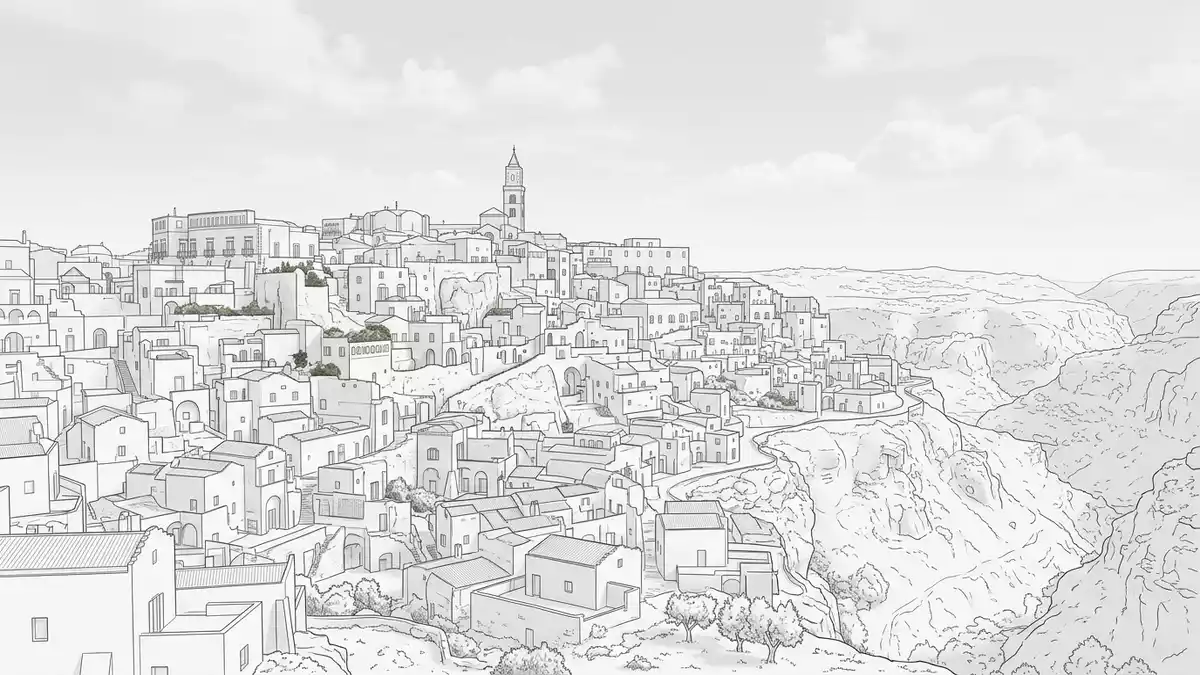
The stone districts known as Sassi di Matera in Matera, Italy, form a stepped city of cave dwellings cut into the side of a ravine, where homes, churches and lanes appear to grow directly from the rock. Here an ancient landscape of hollowed tufa and stair-like streets survives as a lived-in quarter, recognised as a UNESCO World Heritage Site in 1993 for its continuity of human settlement and its close fit with the surrounding terrain.
A ravine city of rock-cut quarters
Sassi di Matera occupies the slopes of a deep ravine carved by the Gravina stream on the edge of the Murge plateau in Basilicata, southern Italy. The two main districts, Sasso Caveoso and Sasso Barisano, face each other across the ravine, their dwellings and lanes arranged in terraces that follow the contours of the rock.The Sassi di Matera are described as two ancient cave-dwelling districts of the city of Matera, carved into the soft tufa rock.
Above these districts rises the Civita, the older nucleus of Matera, where a thirteenth-century Romanesque cathedral stands between the two Sassi.A Romanesque cathedral was built on the Civita between the two Sassi in the thirteenth century, giving the rock-cut quarters a visible landmark that marks the transition from ravine to plateau. From the opposite side of the gorge the Sassi appear as a dense cascade of stone facades, stairways and terraces, with cave interiors extending back into the rock.
Layers of habitation from prehistory to the twentieth century
The origins of Sassi di Matera lie in prehistory, when natural caves in the ravine were first occupied in the Palaeolithic and Neolithic periods.The World Heritage listing notes human occupation from the Palaeolithic through several millennia, and people adapted and expanded these cavities into more complex dwellings over time. As the settlement grew, simple caves gained stone-built fronts, turning rock shelters into house-fronts that align along lanes and stepped paths.
Evidence from archaeological and historical studies places continuous habitation of the Sassi across classical antiquity and the medieval period, with the pattern of rock-cut rooms and stone facades evolving rather than being replaced.Descriptions of Matera highlight the gradual deepening and expansion of natural caves into living spaces. People lived in these dwellings into the twentieth century, and relocation programmes in the 1950s moved many residents to new housing on the plateau, leaving the rock-cut quarters to be restored in later decades.
UNESCO recognition and a cultural landscape of stone
In December 1993 Sassi di Matera, together with the Park of the Rupestrian Churches of Matera, was inscribed on the UNESCO World Heritage List as a cultural property.The recognition in 1993 emphasised the Sassi and the rupestrian churches as a combined cultural landscape, where human-made structures and the ravine landscape form a single ensemble. The listing cites criteria that stress the site’s value as an outstanding example of a troglodyte settlement adapted to its environment, and as a record of human settlement over thousands of years.
The cultural landscape includes not only dwellings but also rock-cut churches, cisterns and lanes that step down the ravine, forming an urban fabric adapted to the limestone terrain.Matera’s official tourism information describes the Sassi as among the oldest urban settlements in Europe and highlights their integration with the surrounding park of rupestrian churches. For visitors the result is a city quarter where every path reveals another combination of stone walls, carved interiors and views across the Gravina.
Visiting Sassi di Matera: what travellers from Western Europe should know
- Sassi di Matera lies on the eastern side of Matera in the Basilicata region of southern Italy, on a ravine carved by the Gravina stream, and is reached from the modern city on the plateau above.
- The historic districts are built on steep slopes, with many routes involving long flights of uneven stone steps and narrow passageways that require careful footing.
- From the edges of the ravine there are wide views across to the opposite side, where rock-cut dwellings and churches face each other across the gorge.
- The official language is Italian and the currency is the euro.
Searching for Sassi di Matera on social platforms
These links open searches for Sassi di Matera on each platform.
Frequently asked questions about Sassi di Matera
Where is Sassi di Matera located?
Sassi di Matera forms part of the historic centre of Matera in the Basilicata region of southern Italy, on the slopes of a ravine carved by the Gravina stream.
What should visitors expect when exploring Sassi di Matera?
Visitors encounter a dense network of stone houses, rock-hewn interiors, churches and stepped lanes, arranged on terraces that descend towards the ravine and framed by views of the opposite cliff.
What makes Sassi di Matera distinctive?
The combination of prehistoric cave origins, continued habitation into the twentieth century and recognition as a UNESCO World Heritage cultural landscape gives Sassi di Matera a rare continuity of built and natural forms.


