Saqqara and the first stone pyramid of Egypt
Published on 09/01/2026 at 18:20 | Editorial responsibility: Rafael Müller, Editor-in-Chief AD HOC NEWS
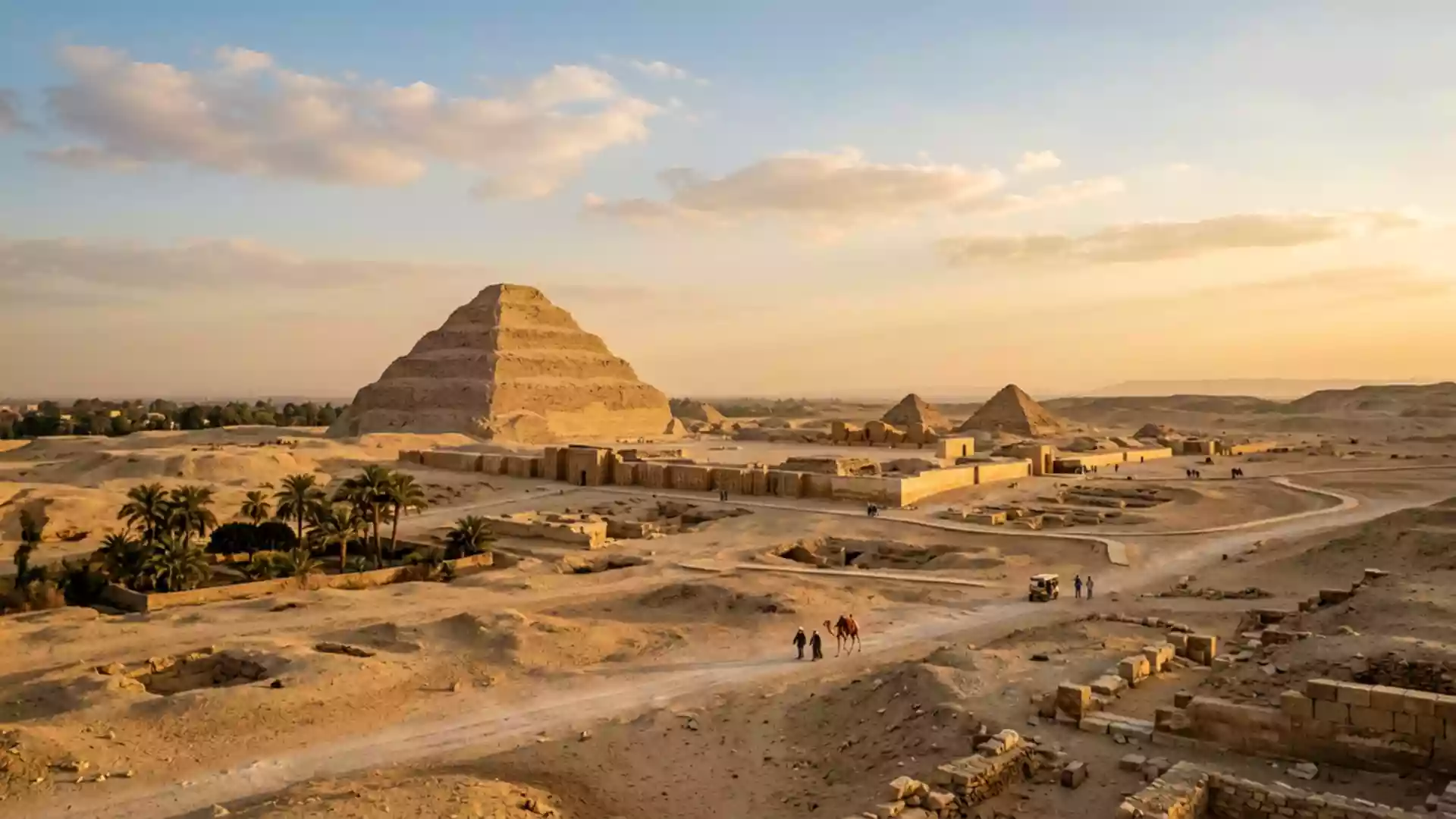
On the desert edge west of Gizeh, Saqqara spreads across a sandy plateau as the vast necropolis of ancient Memphis, the early capital of Egypt. Here the Step Pyramid of Djoser rises above courts, temples and tombs, marking one of the earliest large-scale stone complexes in Egyptian architecture and giving the site its distinctive silhouette.
A desert necropolis above the Nile valley
Saqqara occupies the western bank of the Nile valley, on the desert plateau that framed Memphis, the administrative centre of Egypt in the third millennium BC.part of the necropolis of Memphis The plateau runs roughly north–south between Abusir and Dahshur, with Saqqara forming one of the core pyramid fields along this strip.Memphis and its necropolis
The archaeological zone lies south of central Cairo in the Giza Governorate, with the modern village of Saqqara giving the site its name.Egyptian village in Giza Governorate Over centuries the desert edge accumulated royal pyramids and private tombs, creating a layered landscape of stone monuments and mudbrick mastabas stepping up from the cultivated land below.
The Step Pyramid of Djoser and its stone complex
The landmark of Saqqara is the Step Pyramid of Djoser, a six-tier stone structure built in the third dynasty and regarded as the first Egyptian pyramid.Step Pyramid of Djoser Rising to around 60 m (about 200 ft), it was conceived as a sequence of stacked mastabas, transforming the traditional flat-roofed tomb into a monumental vertical form.composed of six stacked mastabas
The pyramid stands inside a walled funerary complex laid out with courtyards, shrines and dummy buildings, all constructed in stone but imitating earlier timber and mudbrick architecture.vast walled funerary complex Beneath the enclosure runs a network of underground galleries and chambers, reflecting the importance of Djoser’s burial in the early third dynasty. The design is attributed to Imhotep, Djoser’s official, whose name is preserved as one of the earliest recorded architects in history.designed for King Djoser by his vizier Imhotep
Beyond Djoser: pyramids, mastabas and the Serapeum
The Step Pyramid anchors a wider field of monuments that trace Egyptian history over millennia. Later Old Kingdom kings built pyramids at Saqqara, including Unas and Teti, extending the royal presence on the plateau.royal necropolis of Memphis Around them spread mastaba tombs of officials and nobles, whose decorated chapels preserve daily-life scenes in painted relief.
One of the more unusual structures is the Serapeum, a series of underground vaults where sacred Apis bulls were interred in massive granite sarcophagi.Serapeum granite sarcophagi Other areas of the necropolis include complexes linked to later periods, such as the Bubasteion with its catacombs associated with the goddess Bastet and New Kingdom rock-cut tombs aligned along the northern escarpment.New Kingdom necropolis sectors
Visiting Saqqara: what travellers from Western Europe should know
- Saqqara lies southwest of central Cairo in the Giza Governorate, on the west bank of the Nile; it is reached by road from the city and from Gizeh.
- Much of the archaeological area stands on open desert ground, with uneven surfaces, stone terraces and stairways leading up and down between pyramid platforms and tomb entrances.
- The wider landscape includes other sites on the Memphis necropolis strip, with Abusir to the north and Dahshur to the south along the desert edge.
- The official language is Arabic and the currency is the Egyptian pound.
- Entry requirements depend on your nationality; UK travellers can check the FCDO travel advice at gov.uk/foreign-travel-advice, Irish travellers the Department of Foreign Affairs at ireland.ie.
Searching for Saqqara on social platforms
These links open searches for Saqqara on each platform.
Frequently asked questions about Saqqara
Where is Saqqara in relation to Cairo and Gizeh?
Saqqara lies southwest of central Cairo in the Giza Governorate, on the desert plateau above the Nile valley and west of the urban area of Gizeh.
What should visitors expect on a visit to Saqqara?
Visitors encounter a broad desert landscape with stone pyramids, mastaba tombs and underground complexes, centred on the Step Pyramid of Djoser and its enclosure.
What makes Saqqara distinctive among Egyptian sites?
Saqqara combines the earliest large-scale stone pyramid complex with subsequent royal pyramids, decorated mastabas and specialised structures such as the Serapeum within one continuous necropolis.