
Santuario de Las Lajas rises above the Guáitara gorge
Published on 09/22/2026 at 18:14 | Editorial responsibility: Rafael Müller, Editor-in-Chief AD HOC NEWS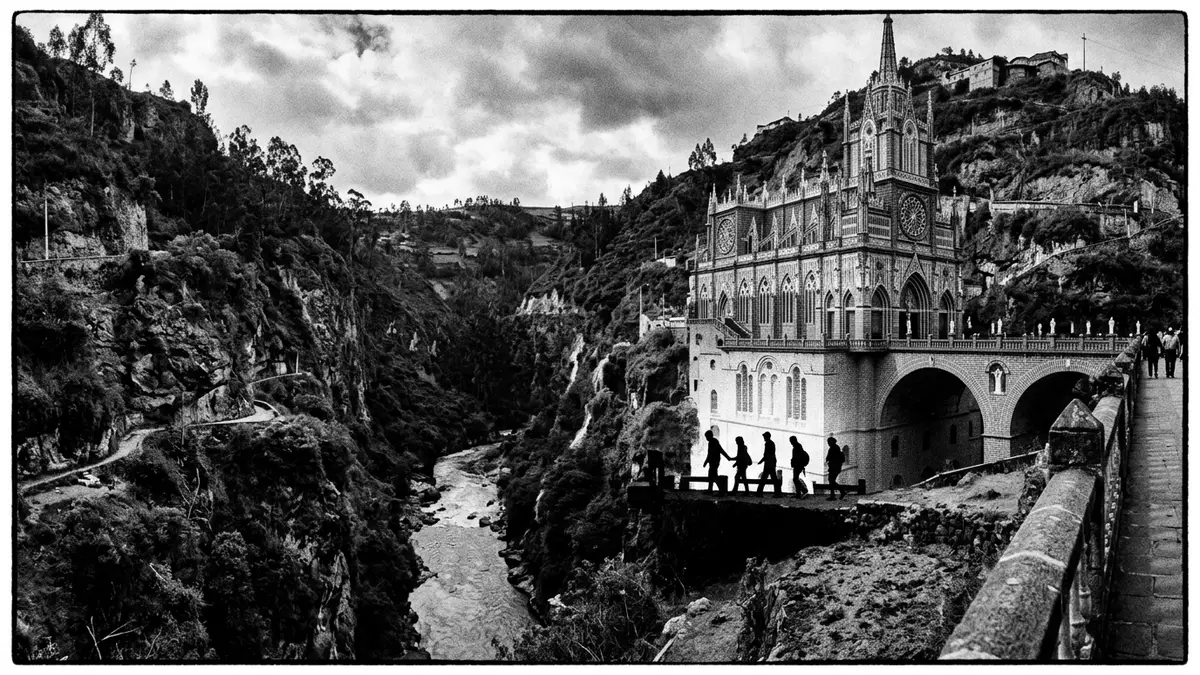
Santuario de Las Lajas rises from the narrow Guáitara gorge near Ipiales in southern Colombia. Its grey-and-white neo-Gothic basilica stands on a masonry bridge above the river, combining church, cliff and canyon in one visible composition.
A basilica carried across the Guáitara gorge
The sanctuary occupies a rocky section of the Guáitara River canyon. Its main platform crosses the gorge on a substantial stone bridge, while the church climbs against the rock face and extends upwards through pointed towers and pinnacles.
The arrangement gives Santuario de Las Lajas an unusual relationship with the landscape. The bridge forms the approach and lower architectural base, the cliff rises behind the church, and the river runs below the complex. The building is therefore read from several levels: the canyon floor, the bridge, the church interior and the surrounding slopes.
The basilica is constructed in ashlar masonry, with carefully cut stone forming walls, arches and vertical elements. Pointed arches, traceried windows, flying buttresses and slender spires identify the Gothic Revival vocabulary. Its stone colour contrasts with the vegetation and exposed rock of the gorge without separating the church from its setting.
Lucindo Espinosa and the twentieth-century church
The present church was built between 1916 and 1949 in a neo-Gothic style. Lucindo María Espinosa Medina is named as its architect, with Gualberto Pérez associated with the engineering of the structure. The completed basilica replaced earlier devotional buildings connected with the shrine.
The church belongs to a period when Gothic Revival forms were used for religious buildings across Europe and the Americas. At Las Lajas, that vocabulary appears in a distinctly Andean setting: stonework spans the gorge, towers rise above the river, and the rock wall remains part of the sanctuary’s interior setting.
Inside, the basilica follows a traditional arrangement with three naves. Vertical piers, pointed openings, stone surfaces and coloured glass create a strongly articulated interior. The Marian image associated with the shrine is located on the rock wall behind the altar, linking the devotional focus with the geology of the canyon.
The sanctuary’s full name is Santuario de Nuestra Señora del Rosario de Las Lajas, dedicated to Our Lady of the Rosary of Las Lajas. Its devotional history reaches back to the eighteenth century, and the site was raised to the status of a minor basilica in 1954.
A Marian shrine shaped by stone, water and pilgrimage
Tradition connects the shrine with an image of the Virgin Mary on the canyon wall. A chapel was recorded at the site in 1754, and successive structures appeared before the present basilica. The sequence gives the place a long religious history without changing its central visual fact: worship takes place beside exposed rock above a river gorge.
The bridge is more than an approach route. It carries the basilica’s principal platform and joins the architectural composition to both sides of the canyon. From below, the bridge reads as a horizontal stone span beneath a vertical church. From the sanctuary, the rock wall and gorge remain part of the setting.
Las Lajas is associated with the municipality of Ipiales in the department of Nariño, close to Colombia’s border with Ecuador. The sanctuary’s location places it within the southern Andes, where steep terrain, river-cut rock and highland vegetation frame the building.
The surrounding complex includes religious buildings, paths and viewpoints connected with the basilica. Stairs and sloping approaches lead between the canyon levels, while the church itself provides the central architectural space. The result is a place that can be understood as a basilica, a bridge and a gorge landmark at the same time.
Visiting Santuario de Las Lajas: what travellers from Western Europe should know
- Santuario de Las Lajas lies near Ipiales in Nariño, southern Colombia. Road transport from Ipiales reaches the canyon, and local routes descend towards the sanctuary.
- The approach crosses steep Andean terrain. Access involves slopes, stairs and changes between the canyon edge, bridge level and river area.
- The sanctuary stands beside the Guáitara River, with the basilica built above the gorge and the rock wall forming part of the interior setting.
- The official language is Spanish and the currency is the Colombian peso.
- Entry requirements depend on your nationality; UK travellers can check the FCDO travel advice at gov.uk/foreign-travel-advice, Irish travellers the Department of Foreign Affairs at ireland.ie.
Searching for Santuario de Las Lajas on social platforms
These links open searches for Santuario de Las Lajas on each platform.Frequently asked questions about Santuario de Las Lajas
Where is Santuario de Las Lajas?
It stands near Ipiales in Nariño, southern Colombia, above the Guáitara River gorge and close to the Ecuadorian border.
What can visitors expect at the sanctuary?
The complex combines a neo-Gothic basilica, a stone bridge, steep approaches and a rock wall associated with the Marian shrine.
What makes the building distinctive?
The church rises directly from a bridge spanning the gorge. Its stone Gothic Revival architecture shares the setting with the river, cliff and canyon.


