
San Pedro de Atacama, desert oasis at the edge of the Andes
Published on 09/16/2026 at 21:26 | Editorial responsibility: Rafael Müller, Editor-in-Chief AD HOC NEWS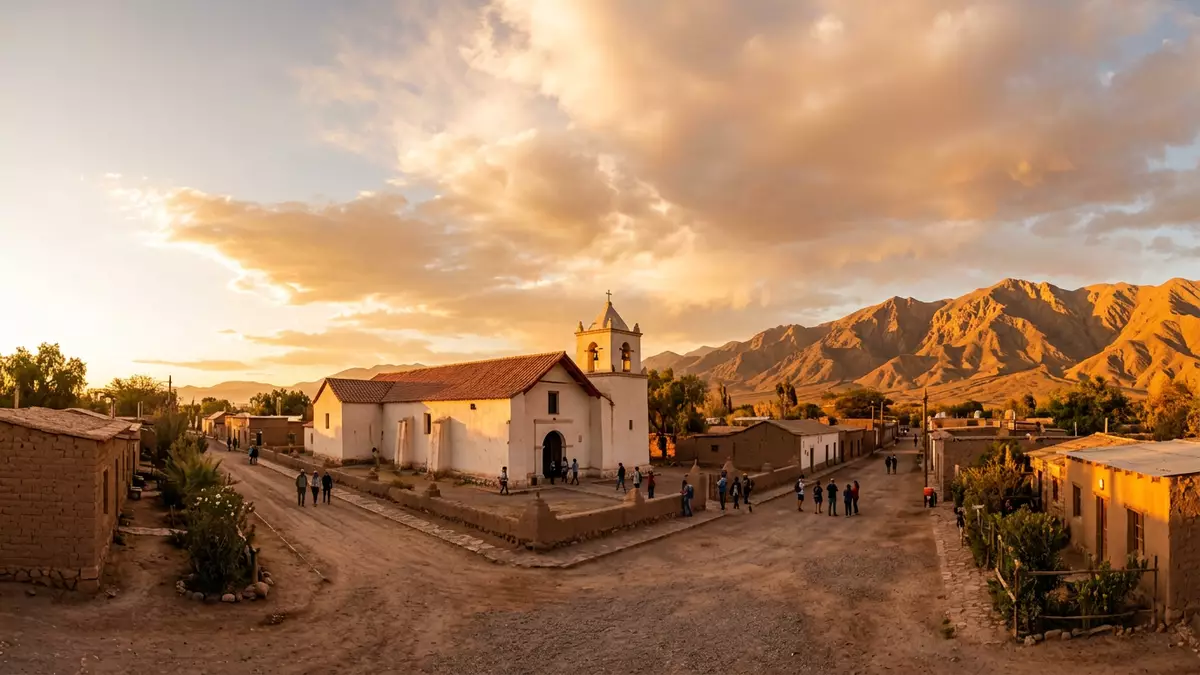
San Pedro de Atacama is a small adobe town in northern Chile, an oasis settlement in the Atacama Desert that has become a base for exploring salt flats, highland lagoons and volcanic slopes. Set at around 2,400 m (7,874 ft) above sea level in the Antofagasta Region, it looks towards the cone of Licancabur on the Andean frontier, giving the town a constant backdrop of mountain silhouettes.San Pedro de Atacama is a Chilean town and commune in El Loa Province
Adobe streets in a high desert oasis
The core of San Pedro de Atacama is compact, centred on low adobe houses and unpaved streets that reflect its long-standing role as a desert oasis town.San Pedro de Atacama is described as a small adobe town at 2,400 metres in the northern Chilean desert Buildings typically use thick earthen walls and simple timber details, helping them sit visually within the dusty surroundings and emphasising the town’s modest scale against the wide desert plain. The layout is easy to grasp on foot, with a main street lined by eateries and tour agencies and smaller lanes branching towards residential quarters and artisan workshops.
At the centre stands the whitewashed church of San Pedro, a colonial-era structure with adobe construction and distinctive wooden beams that has become a visual anchor for the town square.My Guide Chile notes a beautiful 18th-century church painted in white in San Pedro de Atacama Nearby, small shops sell textiles, ceramics and carved figures drawing on Atacameño motifs, while simple cafés open onto shaded courtyards. The scale of the town means the desert is never far away: a short walk from the centre brings views of the surrounding cordillera and the dry basin stretching towards the Salar de Atacama.
Layers of Atacameño history in the desert
Long before San Pedro de Atacama took its present form, the wider area was inhabited by Atacameño communities who exploited the oasis conditions and developed complex desert agriculture. Archaeological work has identified sites occupied for millennia, showing that this part of the Atacama Desert supported settled life far earlier than its harsh climate might suggest.The history of San Pedro de Atacama is traced through Pre-Columbian cultures and the Atacameñan people The Atacameño, also known as Lickanantay, cultivated crops using irrigation canals and terraced fields, leaving a network of sites around the oasis and the nearby river valleys.
Visitors encounter this depth of history at the Museo Arqueológico R. P. Gustavo Le Paige, named after the Jesuit priest whose collecting work formed its core holdings.
The museum in San Pedro de Atacama preserves thousands of artefacts from Atacama culture, including textiles, metals and everyday utensils recovered from settlement areas and tombs.My Guide Chile describes the Gustavo Le Paige Archaeological Museum and its collection of artefacts from the Atacama culture Beyond the town, the fortified hilltop of Pukará de Quitor, built between about 1,000 and 1,500 AD, forms a stone complex on a rise overlooking the river, giving a sense of how Atacameño communities defended and organised their territory. Another nearby site, the settlement of Tulor, preserves circular structures dating back to the early centuries AD, offering a rare glimpse of one of the oldest known village layouts in northern Chile.The archaeological sites of Pukará de Quitor and Tulor near San Pedro de Atacama are described as National Monuments and important Atacama culture remains
Salt flats, lunar valleys and geyser fields around the town
The landscape surrounding San Pedro de Atacama is dominated by the Atacama Desert, which stretches across northern Chile and is recognised as one of the driest non-polar regions on Earth.A travel guide notes San Pedro de Atacama as a gateway to northern Chile and its desert landscapes Immediately south lies the vast Salar de Atacama, a salt flat with rough white crusts and shallow lagoons that form part of a broader basin framed by mountains. One of these lagoons, such as the Tebenquiche area described in local guides, sits amid cracked salt ridges and shallow water, where mineral-rich surfaces take on unusual textures and colours under the strong desert light.Descriptions of the Salar de Atacama mention whitish rough tints and fissured terrain around lagoons near San Pedro
To the west of town, the Cordillera de la Sal forms a low mountain range of folded rock that hides the Valle de la Luna, a basin of ridges and dunes whose eroded forms resemble lunar or Martian terrain in dry conditions. Travellers from San Pedro follow tracks into this valley to see the interplay of rock, sand and shadow as the sun moves across the desert sky. Further afield, towards higher elevations, the geothermal field of El Tatio sits at around 4,000 m (13,123 ft), comprising dozens of fumaroles that emit steam and hot water from underground volcanic activity.El Tatio is described as a geothermal field of about 80 fumaroles north of San Pedro de Atacama In the opposite direction, high-altitude lagoons and the slopes of volcanoes shape routes towards the Andean border with Bolivia and Argentina, giving the town a sense of sitting at the meeting point between desert basin and Andean plateau.
Visiting San Pedro de Atacama: what travellers from Western Europe should know
- San Pedro de Atacama lies in Chile’s Antofagasta Region in the far north of the country, and is reached most commonly via Calama’s El Loa Airport and the road that runs south-east from Calama across the desert basin.
- The town sits at an altitude of around 2,400 m (7,874 ft), and walking between the centre and nearby viewpoints involves unpaved streets, dusty paths and occasional gentle gradients on desert slopes.
- Beyond the town, excursions to sites such as Pukará de Quitor, Tulor, the Salar de Atacama and El Tatio include stretches on rough ground, with some routes reaching higher elevations where temperatures and weather can change quickly.
- The Chilean Highlands landscape around San Pedro de Atacama includes salt flats, volcanic peaks and Andean passes near the borders with Bolivia and Argentina, making the town a practical hub for overland journeys in this part of South America.
- The official language is Spanish and the currency is the Chilean peso; entry requirements depend on your nationality, UK travellers can check the FCDO travel advice at gov.uk/foreign-travel-advice, Irish travellers the Department of Foreign Affairs at ireland.ie.
Searching for San Pedro de Atacama on social platforms
These links open searches for San Pedro de Atacama on each platform.
Frequently asked questions about San Pedro de Atacama
Where is San Pedro de Atacama located?
San Pedro de Atacama is a town and commune in El Loa Province, part of Chile’s Antofagasta Region in the far north of the country, east of the coastal city of Antofagasta.San Pedro de Atacama is located east of Antofagasta in El Loa Province
What should travellers expect on a visit?
Travellers encounter a compact high-altitude desert town built largely of adobe, with a central square, a white colonial church, unpaved streets and easy access to surrounding salt flats, valleys, lagoons and geyser fields.
What makes San Pedro de Atacama distinctive compared with other towns?
San Pedro de Atacama combines an oasis settlement of earthen architecture with close proximity to major desert sites such as the Salar de Atacama, Valle de la Luna, high-altitude lagoons and the geothermal field of El Tatio, all framed by the volcanic peaks of the Andes.


