
San Miguel de Allende, a highland city of stone streets and baroque towers
Published on 09/09/2026 at 10:51 | Editorial responsibility: Rafael Müller, Editor-in-Chief AD HOC NEWS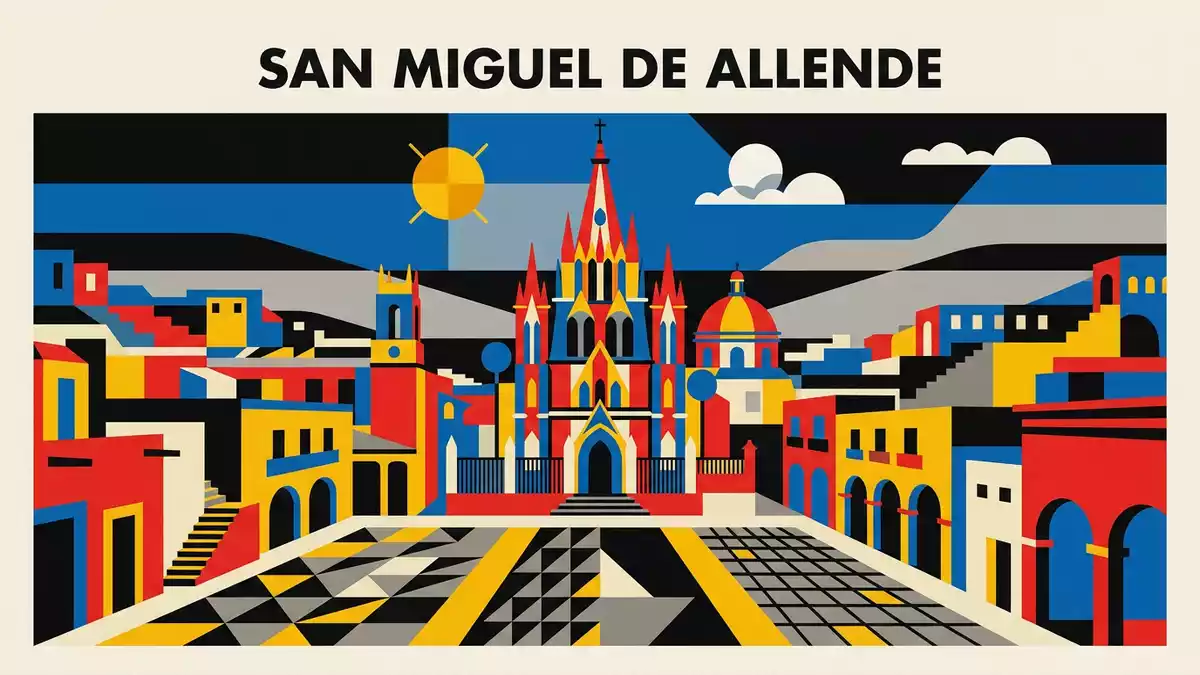
San Miguel de Allende in central Mexico is a highland city where stone streets, coloured facades and church towers rise above a compact historic centre recognised as a UNESCO World Heritage Site since 2008.UNESCO World Heritage Site The protected core, laid out in the colonial era, brings together religious and civic buildings in Mexican Baroque and related styles that reflect the city’s role in New Spain and the later Mexican War of Independence.Mexican War of Independence
Baroque streets and a planned colonial town
San Miguel de Allende lies in the state of Guanajuato, on uplands that formed part of the colonial silver route known as the Camino Real de Tierra Adentro, an inland road linking mining centres with Mexico City and beyond.Camino Real de Tierra Adentro The town was founded in 1542 as a fortified settlement on this route, and its historic centre still follows a regular street plan of blocks and plazas from the sixteenth and seventeenth centuries.founded in 1542
Walking the central streets, the character is defined by stone paving, low and medium-rise houses with thick masonry walls and a palette of earthy colours ranging from ochre and terracotta to soft pink. Many facades are punctuated by heavy wooden doors and wrought-iron balconies, while courtyards sit behind street walls, opening onto gardens, fountains or arcaded corridors. The layout converges on civic spaces such as the main square, framed by the parish church and municipal buildings, where arcades and frontages mark the transition between the intimate street grid and broader plaza spaces.central square and parish
The pink towers of the Parroquia de San Miguel Arcángel
Above the main square rises the Parroquia de San Miguel Arcángel, a parish church whose stone mass and striking towers have become a defining image of the city.Parroquia de San Miguel Arcángel The church building itself dates to the early eighteenth century, with 1709 recorded as the year of completion of the earlier structure, while the neo-Gothic facade with its pale pink stone and vertical pinnacles was added in the late nineteenth century by local stonemason Zeferino Gutiérrez.neo-Gothic facade
The facade rises in layered towers of carved stone, with slender columns and finials drawing the eye upward from the arcaded base towards lanterns and spires. Behind this front, the parish church retains elements of its earlier form, including vaulted interiors and chapels aligned with the nave, reflecting the long life of the building within the city’s religious fabric.historic downtown Around the plaza, smaller churches and civic buildings continue the theme of masonry construction, arcades and balconies, so that the parish towers stand not in isolation but as part of a stone ensemble visible from many streets.
World Heritage status and the Sanctuary of Jesús Nazareno de Atotonilco
The historic centre of San Miguel de Allende forms part of the World Heritage property titled “Protective town of San Miguel and the Sanctuary of Jesús Nazareno de Atotonilco”, inscribed as a cultural site under criteria (ii) and (iv) in 2008.Protective town of San Miguel The inscription recognises both the planned town, with its evolution from Baroque to later styles, and the sanctuary complex located about 14 km to the north, linked to San Miguel by history and pilgrimage.sanctuary complex north of the city
The Sanctuary of Jesús Nazareno de Atotonilco is described as a remarkable architectural ensemble whose interior murals and decoration make it a notable example of Mexican Baroque art in New Spain.Mexican Baroque art Together, the town and sanctuary illustrate the cultural exchanges between European and local traditions and the role of religion and civic life in colonial and independence-era Mexico.cultural exchange Within San Miguel de Allende itself, mansions, churches and public buildings display facades that move from Baroque ornament towards neoclassical ordering, while the neo-Gothic parish towers add a later layer, so the streets effectively read as a catalogue of styles from the seventeenth to nineteenth centuries.
Visiting San Miguel de Allende: what travellers from Western Europe should know
- San Miguel de Allende sits in the state of Guanajuato in central Mexico and is reached overland from larger Mexican transport hubs in the region.
- The historic centre is built on slopes, with cobbled streets and some steep approaches, so walking between squares and viewpoints involves gradients and uneven paving.
- The city’s elevation on the Mexican plateau gives it a highland climate, and temperatures can change between daytime and night, which is noticeable when spending time outdoors in plazas and streets.
- Within the protected area, many sights are concentrated within walking distance, including the main square, the parish church and smaller chapels and civic buildings around adjoining blocks.
- The official language is Spanish and the currency is the Mexican peso.
Searching for San Miguel de Allende on social platforms
These links open searches for San Miguel de Allende on each platform.
Frequently asked questions about San Miguel de Allende
Where is San Miguel de Allende?
San Miguel de Allende is a colonial-era city in the state of Guanajuato in central Mexico, historically linked to the silver route known as the Camino Real de Tierra Adentro.
What should visitors expect in the historic centre?
Visitors encounter cobbled streets, stone houses, arcaded plazas and churches, including the prominent Parroquia de San Miguel Arcángel, all within a compact walkable area.
What makes San Miguel de Allende distinctive?
The combination of a planned colonial street grid, well-preserved Mexican Baroque and related architecture, and the UNESCO recognition alongside the Sanctuary of Jesús Nazareno de Atotonilco gives the city a distinctive character.


