
San Carlos de Bariloche between lake and Andes
Published on 09/19/2026 at 18:49 | Editorial responsibility: Rafael Müller, Editor-in-Chief AD HOC NEWS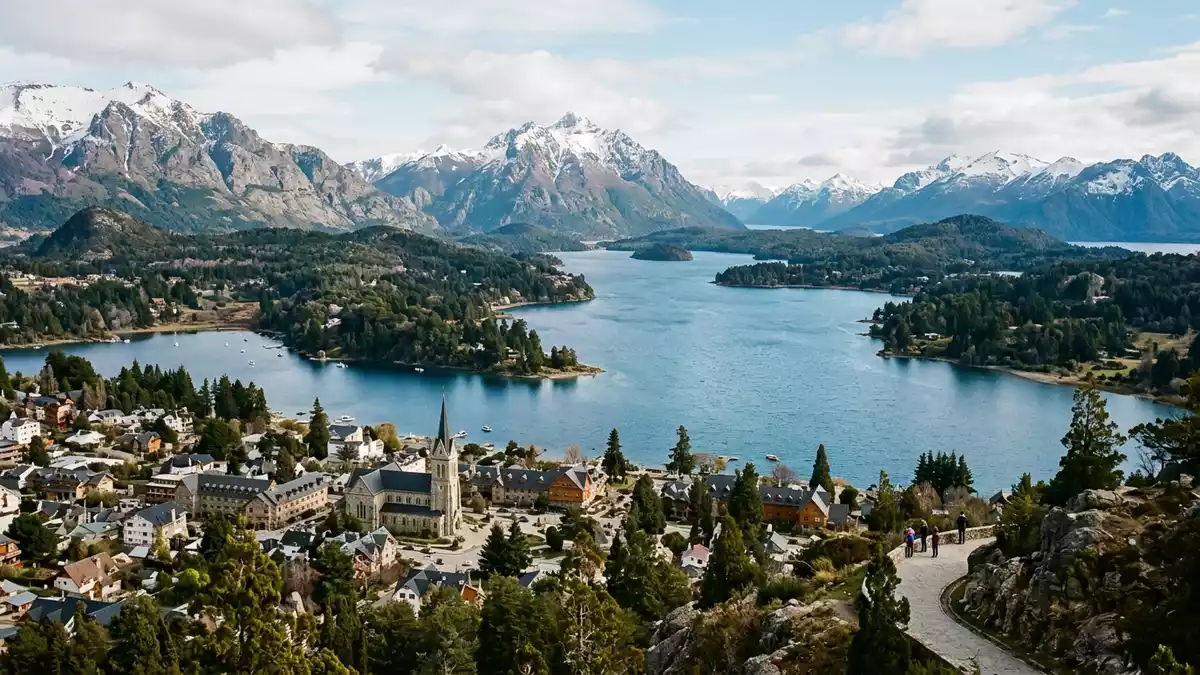
San Carlos de Bariloche is a lakeside city in southwestern Argentina where urban streets, mountain slopes and the waters of Lake Nahuel Huapi meet in a single panorama. Set in the Patagonian Andes and surrounded by protected landscapes, it serves as a gateway between Argentina’s lake district and the wider region of Patagonia, with the city stretching along the southern shore of the lake and rising towards nearby hills and peaks.
A mountain city on Lake Nahuel Huapi
San Carlos de Bariloche lies on the southern shore of Lake Nahuel Huapi, in the foothills of the Patagonian Andes in the province of Río Negro. The city forms the largest urban centre in the province, occupying slopes that rise from the lake and face towards the surrounding mountain ranges.largest city in Río Negro Streets follow the curve of the lakeshore, with views across the water to forested hills and more distant peaks that mark the frontier region close to Chile.
The wider setting belongs to Nahuel Huapi National Park, the oldest national park in Argentina, which was established in the early twentieth century to protect the Andean lake district.oldest national park in Argentina Within this protected area, San Carlos de Bariloche appears as a compact mountain city, with the built-up area bordered by water on one side and by slopes leading towards peaks such as López, Catedral and Otto on the other.between Otto, Catedral and López
From Mapuche lands to an Andean resort town
The landscape around Lake Nahuel Huapi formed part of Mapuche territory long before San Carlos de Bariloche became a city, and the name “Bariloche” itself is derived from a Mapuche word rendered as “Vuriloche”, referring to people from the other side of the mountain.Mapuche name Vuriloche European religious missions arrived in the region during the seventeenth century, followed in the nineteenth century by trading posts that linked the emerging settlement with Chile across the Andes.origins and early missions
San Carlos de Bariloche was officially founded on 3 May 1902, when a government decree established the city under its present name and recognised a growing settlement on the shore of Lake Nahuel Huapi.official founding date 3 May 1902 Early twentieth-century development produced an Andean town that combined lakeside streets with wooden and stone architecture, and the arrival of the railway in 1934 strengthened links with the Atlantic coast and contributed to the growth of tourism centred on the surrounding mountains and lake.railway arrival and tourism growth
Architecture, civic centre and scientific institutions
In the central districts, San Carlos de Bariloche presents a mix of stone and timber buildings that give the main civic spaces a distinct mountain character. The Civic Centre ensemble, inaugurated in the mid-twentieth century, groups buildings with wooden balconies and steep roofs around a central square, with the cathedral adding a taller vertical accent nearby.Civic Centre and cathedral ensemble Lakefront promenades connect these spaces to the waterfront, where open views extend across Nahuel Huapi and towards the surrounding hills.
San Carlos de Bariloche also hosts institutions that give the city a role beyond tourism within Argentina. The Balseiro Institute, founded in the 1950s, established the city as a centre for physics and engineering education, while the state-owned company INVAP, created in the 1970s, is based here and works in nuclear and space technologies.Balseiro Institute and INVAP These institutions sit within the same mountain setting as the ski slopes and lakeside quarters, adding a scientific dimension to a city otherwise known for its Andean landscape and resort character.
Visiting San Carlos de Bariloche: what travellers from Western Europe should know
- San Carlos de Bariloche lies in southwestern Argentina, in the province of Río Negro, on the southern shore of Lake Nahuel Huapi within Nahuel Huapi National Park.
- The city occupies sloping terrain between the lakeshore and nearby hills, with streets that rise away from the water and approaches to viewpoints involving gradients and sections on foot.
- San Carlos de Bariloche forms part of Argentina’s Patagonia region, and snow can cover higher ground in the surrounding mountains during the colder months.
- The official language is Spanish and the currency is the Argentine peso.
- Entry requirements depend on your nationality; UK travellers can check the FCDO travel advice at gov.uk/foreign-travel-advice, Irish travellers the Department of Foreign Affairs at ireland.ie.
Searching for San Carlos de Bariloche on social platforms
These links open searches for San Carlos de Bariloche on each platform.
Frequently asked questions about San Carlos de Bariloche
Where is San Carlos de Bariloche?
San Carlos de Bariloche is in southwestern Argentina, in the province of Río Negro, on the southern shore of Lake Nahuel Huapi in the Patagonian Andes.
What should visitors expect in San Carlos de Bariloche?
Visitors encounter a mountain city with stone and timber architecture, lakefront promenades and access to surrounding peaks and protected landscapes within Nahuel Huapi National Park.
What makes San Carlos de Bariloche distinctive?
The combination of Andean slopes, a major Patagonian lake, an early national park and institutions such as the Balseiro Institute gives San Carlos de Bariloche an unusual mix of resort and scientific city.


