
Salinas Grandes in Jujuy, a high-altitude sea of salt
Published on 08/31/2026 at 09:56 | Editorial responsibility: Rafael Müller, Editor-in-Chief AD HOC NEWS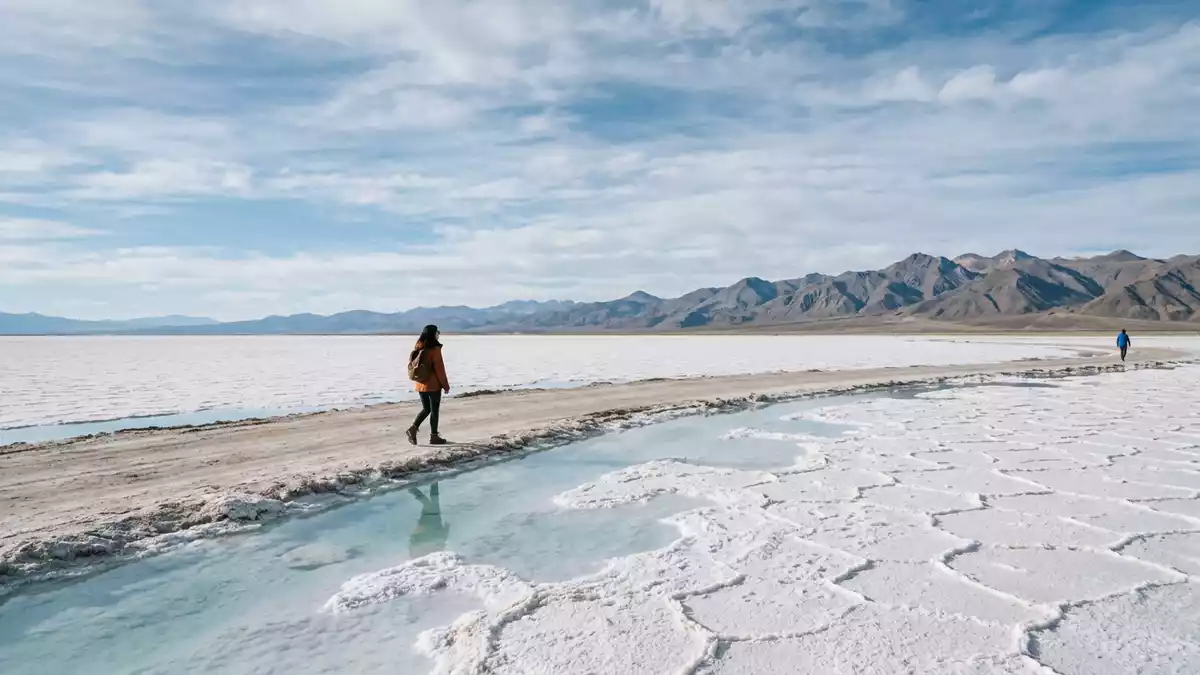
High on the Andean plateau in northwest Argentina, Salinas Grandes spreads out as a broad white salt flat between the provinces of Jujuy and Salta. The salar lies at an average altitude of around 3,450 m (11,320 ft), creating a stark contrast between its bright surface and the surrounding mountains, and has become one of Argentina’s recognised Natural Wonders.Salinas Grandes area and altitude
A high-Andean salt flat shaped by geology
Salinas Grandes is a salt plain that extends over more than 200 km², forming a broad basin shared by Jujuy and Salta.Salt flat size in Jujuy and Salta The surface is covered by a crust of salt that has built up over very long geological periods, as water carrying dissolved minerals evaporated in this closed basin. The result is a nearly level expanse of white, broken by shallow extraction pools and low piles of cut salt blocks.
The salar sits within the Puna, the high desert region of northwest Argentina, west of the Quebrada de Humahuaca. Beneath the hard crust lies brine rich in sodium and potassium, and the wider area is known for deposits that include lithium-bearing brines.Industrial importance of Salinas Grandes Low scrub and rocky slopes frame the salt flat, but inside the salar itself the surface appears almost continuous, with only shallow channels and working areas interrupting the white sheet.
Patterns of salt and horizon
One of the most striking features at Salinas Grandes is the patterning of the salt crust. As the surface dries and contracts, it forms polygonal plates separated by narrow edges, producing a regular geometric texture across large areas of the salar.Salt plain description In places, workers have cut straight-edged pools into the crust to reach the brine below; the water inside can take on pale blue or turquoise tones against the white salt.
The horizon around the salt flat is defined by Andean ranges that rise beyond the basin, so the view combines a flat foreground with layered peaks in the distance. On clear days, the light is strong and contrasts are sharp, emphasising the difference between the white surface and darker slopes. During the rainy season, parts of Salinas Grandes can be covered with a shallow film of water, turning sections of the salar into a reflective surface where the sky and mountains appear mirrored across the plain.Rainy season conditions on the salt flat
Salinas Grandes in Argentina’s northwest
Geographically, Salinas Grandes lies on the border between Jujuy and Salta, in the highlands north-west of San Salvador de Jujuy.Location between Jujuy and Salta The salt flat is reached on National Route 52, which crosses the salar itself and continues west towards the high pass at Paso de Jama, the road connection to Chile.Access via Ruta Nacional 52 The small town of Purmamarca on Route 9 is a common starting point for road journeys to the salt flat, as the road from there climbs through the Cuesta de Lipán mountain pass before descending again to the basin.
The altitude at Salinas Grandes is significant: sources place the salar around 3,400–3,450 m above sea level, while the Cuesta de Lipán pass on the approach rises to more than 4,000 m.Altitudes on National Route 52 This high-elevation setting gives the landscape its dry climate and wide temperature range, with an arid environment in which vegetation is sparse and the salt plain itself forms the dominant feature.
Visiting Salinas Grandes: what travellers from Western Europe should know
- Salinas Grandes lies in northwest Argentina between the provinces of Jujuy and Salta, and is reached on National Route 52 from Purmamarca and other towns in the region.
- The salt flat is at high altitude, around 3,450 m (11,320 ft), and the approach road crosses a mountain pass of more than 4,000 m, so the terrain involves significant elevation and open exposure.
- The salar surface is broad and level but made of hard salt crust, with shallow pools and working areas; walking involves uneven ground underfoot rather than formed pavements.
- The official language is Spanish and the currency is the Argentine peso.
- Entry requirements depend on your nationality; UK travellers can check the FCDO travel advice at gov.uk/foreign-travel-advice, Irish travellers the Department of Foreign Affairs at ireland.ie.
Searching for Salinas Grandes on social platforms
These links open searches for Salinas Grandes on each platform.Frequently asked questions about Salinas Grandes
Where is Salinas Grandes located?
Salinas Grandes lies on the high plateau of northwest Argentina, between the provinces of Jujuy and Salta, and is reached on National Route 52 from Purmamarca and other towns.
What should travellers expect when visiting Salinas Grandes?
Travellers encounter a broad salt flat at high altitude, with a hard white crust patterned by geometric plates, shallow pools cut into the salt and surrounding Andean ranges forming the distant horizon.
What makes Salinas Grandes distinctive among landscapes in Argentina?
Salinas Grandes is distinctive for its combination of large area, high elevation and almost continuous salt crust, creating a wide white plain on the Puna where geology, light and altitude define the scene.


