
Sainte-Chapelle and its walls of medieval light
Published on 09/16/2026 at 11:21 | Editorial responsibility: Rafael Müller, Editor-in-Chief AD HOC NEWS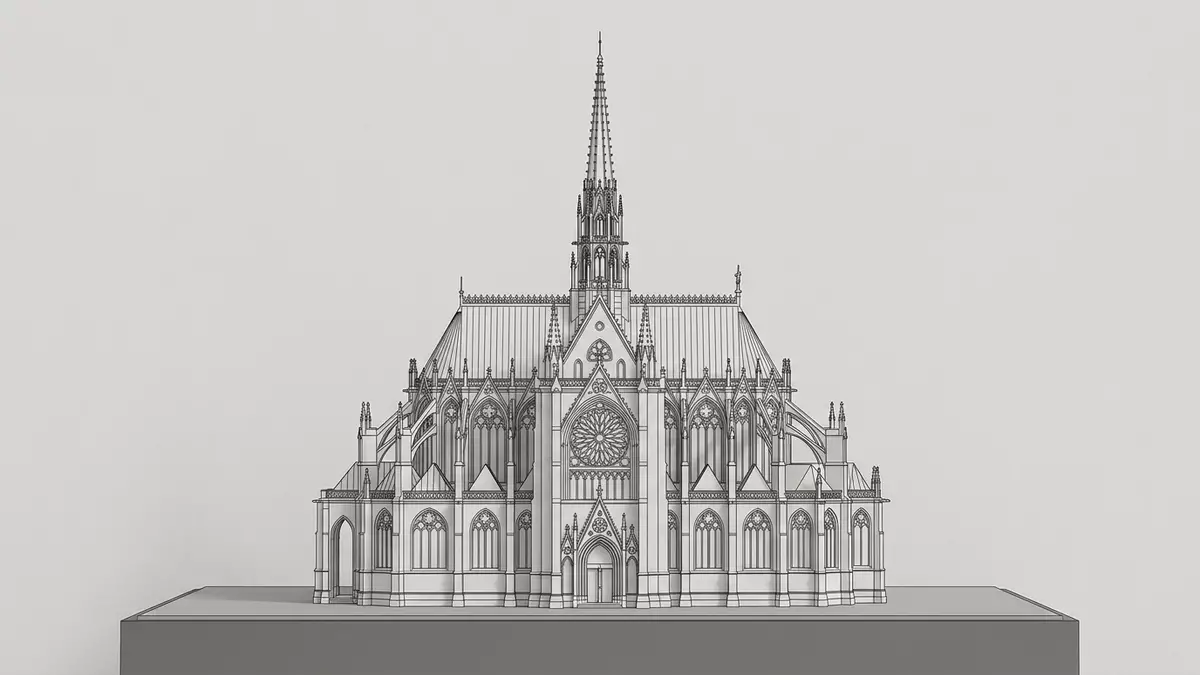
Sainte-Chapelle on the Île de la Cité in Paris is a royal Gothic chapel that turns stone, glass and vertical space into an almost continuous curtain of colour around a compact interior. Built under King Louis IX in the thirteenth century as part of the medieval Palais de la Cité, it stands as one of the clearest expressions of Rayonnant Gothic architecture, where light and height take precedence over solid wall.
A royal reliquary lifted into glass
Sainte-Chapelle is a two-level chapel embedded within the former royal palace complex of the Capetian kings on the island in the River Seine. The lower chapel served the household of the palace, while the upper chapel formed a raised sanctum directly associated with the king and his relics, an arrangement that still reads clearly in the vertical division of the building.royal chapel in the Gothic Rayonnant style The site’s address on Boulevard du Palais places it beside the present-day Palais de Justice, but the chapel itself belongs to an earlier royal landscape centred on the Palais de la Cité.within the medieval Palais de la Cité on the Île de la Cité
Construction of Sainte-Chapelle falls into the 1240s, and the chapel was consecrated on 26 April 1248, a rapid building campaign for such an ambitious structure by medieval standards.consecrated on 26 April 1248 Louis IX, later canonised as Saint Louis, commissioned the chapel to house Passion relics associated with Christ, including the Crown of Thorns and a fragment of the True Cross, turning the upper level into an architectural reliquary for objects that had travelled from Constantinople to the centre of the French kingdom.built in the middle of the 13th century by Louis IX to house Passion relics
Rayonnant Gothic in compact dimensions
The overall dimensions of Sainte-Chapelle underline how much of its effect comes from height rather than sheer size. The building measures about 36 m (118 ft) in length, 17 m (56 ft) in width and approximately 42.5 m (139 ft) in height, a relatively slender footprint wrapped in soaring vertical surfaces.a two-story building measuring 36 m long, 17 m wide and 42.5 m high The Rayonnant Gothic style seen here pushes the walls towards skeletal frames, with thin stone elements supporting large glazed fields that run nearly the full height of the interior.one of the purest expressions of Rayonnant Gothic architecture
In the upper chapel, stained glass occupies almost all available wall space. Fifteen tall window bays form a near-continuous band of coloured glass panels, each window rising for roughly 15 m (about 49 ft) and divided into dense sequences of small scenes framed by tracery.fifteen stained glass windows rise for roughly 15 m The result is a compact volume in which stone appears as thin vertical and horizontal lines between glowing pictorial fields, an effect reinforced by the ribbed vaults above and by the painted surfaces that continue the colour scheme across the structural elements.the building itself is compact yet the interior feels intensely vertical
From royal chapel to restored monument
Over the centuries Sainte-Chapelle has moved through several roles while retaining its physical form. As part of the royal palace, it initially served both liturgical functions and the display of relics within the framework of Capetian monarchy, its upper level reserved for the king and a small circle, and its lower level integrated into the life of the palace staff.constructed on two levels for staff below and relics above In the French Revolution the chapel suffered damage, its furnishings cleared and its role within the palace system broken, after which it served utilitarian functions such as storage and legal archives with large installations intruding into the interior.
In the nineteenth century the building became the subject of a long restoration programme led by architects including Eugène Viollet-le-Duc and Jean-Baptiste Lassus, who worked to recover the thirteenth-century character while dealing with gaps and alterations from previous centuries.renovation beginning in 1840 with architects such as Viollet-le-Duc and Lassus The stained glass has undergone careful conservation as part of this process, sustaining one of the most extensive ensembles of mid?thirteenth?century windows within a single Gothic interior in Europe.extensive 13th-century stained glass collection
Visiting Sainte-Chapelle: what travellers from Western Europe should know
- Sainte-Chapelle stands on the Île de la Cité in central Paris, within the historic Palais de la Cité complex beside the Palais de Justice and close to the River Seine.
- Access to the chapel involves moving through the enclosed courts of the former palace, with internal staircases linking the lower and upper chapels and steps within the historic structure.
- The surrounding district includes the Conciergerie and other remnants of the medieval royal palace, as well as the wider historic fabric of the first arrondissement on the island.
- The official language is French and the currency is the euro.
Searching for Sainte-Chapelle on social platforms
These links open searches for Sainte-Chapelle on each platform.
Frequently asked questions about Sainte-Chapelle
Where is Sainte-Chapelle located in Paris?
Sainte-Chapelle stands on the Île de la Cité in the first arrondissement of Paris, within the historic Palais de la Cité complex on Boulevard du Palais.
What can visitors expect inside Sainte-Chapelle?
Visitors encounter a compact Gothic chapel with two levels, the upper one surrounded by tall thirteenth-century stained glass windows that cover most of the wall surfaces.
What makes Sainte-Chapelle distinctive among Paris churches?
Its role as a royal reliquary chapel for Passion relics and its concentration of Rayonnant Gothic stained glass give Sainte-Chapelle a combination of height, colour and palace setting that differs from parish churches.


