
Sainte-Chapelle: a royal Gothic lantern of colour
Published on 09/09/2026 at 13:45 | Editorial responsibility: Rafael Müller, Editor-in-Chief AD HOC NEWS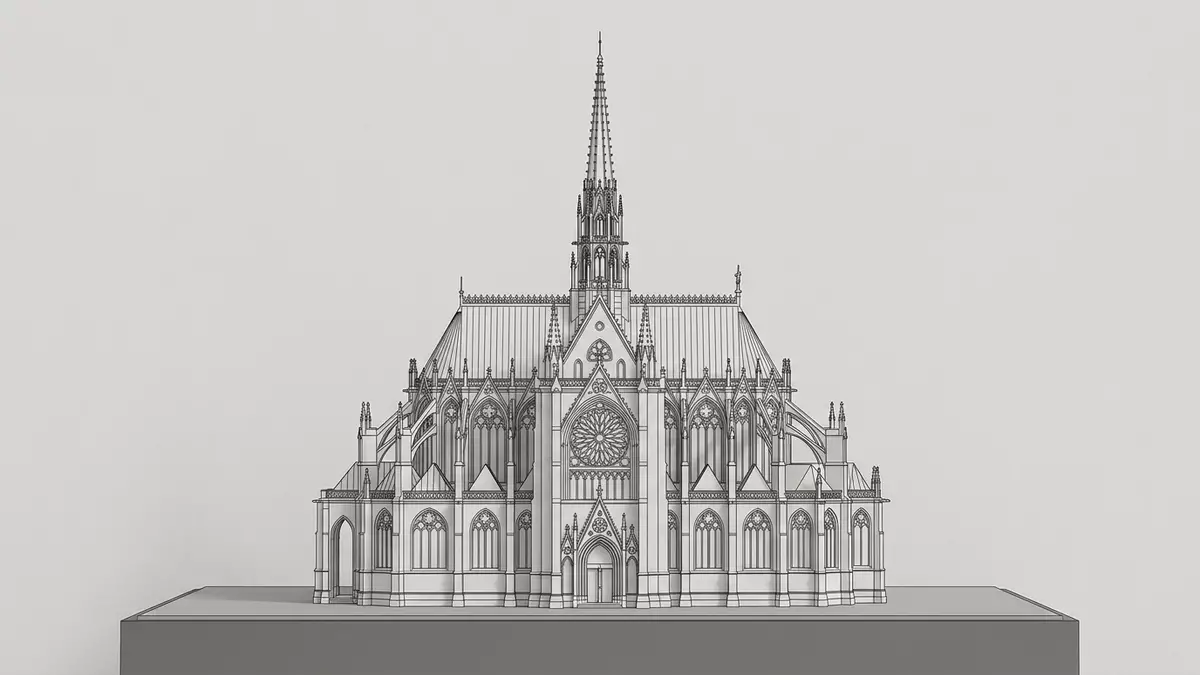
Sainte-Chapelle is a thirteenth-century royal chapel on the Île de la Cité in Paris, where stained glass rises almost unbroken from floor to vault so that the upper interior feels more like a vast lantern of colour than a conventional stone church. Built for King Louis IX and consecrated in 1248, it formed part of the medieval Palais de la Cité, the residence of the French kings beside the Seine.
A royal reliquary in the heart of medieval Paris
Sainte-Chapelle stands within the historic palace complex on the Île de la Cité, a compact island in the River Seine that long served as the political centre of medieval France. The chapel belonged to the royal residence known as the Palais de la Cité, whose surviving buildings now include the Conciergerie and the Palais de Justice.royal chapel within the Palais de la Cité The site on boulevard du Palais places Sainte-Chapelle close to Notre-Dame Cathedral, yet its role in the thirteenth century was distinct from that of a parish church.
King Louis IX, later canonised as Saint Louis, ordered the construction of Sainte-Chapelle in the 1240s to house relics associated with the Passion of Christ, notably the Crown of Thorns and fragments of the True Cross acquired from Constantinople.built by Louis IX to house Passion relics The building therefore functioned as a monumental reliquary embedded within the royal palace, a setting where the king could display his collection of relics and hold services in surroundings designed for the court rather than a wider urban congregation.two-level chapel for court and relics
Rayonnant Gothic architecture and the two-storey plan
Sainte-Chapelle is a textbook example of Rayonnant Gothic architecture, a mid-thirteenth-century phase that pushed French Gothic design towards ever larger windows, finer tracery and a reduced wall surface so that interiors could be dominated by light filtering through glass.Rayonnant Gothic emphasis on windows and light From outside, the chapel appears tall and slender, its walls heavily articulated by buttresses, pinnacles and traceried openings that signal an interior where stone has been pared back to the minimum required to support an extensive glazing scheme.high Gothic chapel with extensive stained glass
The building is organised on two levels. The lower chapel, with a relatively modest height, served the staff of the royal palace and carries painted decoration, ribbed vaulting and windows on a more human scale. Above, reached by a narrow staircase, the upper chapel was reserved for the king and his close circle and housed the relics. Here, slender stone piers and tracery carry walls composed largely of stained-glass windows, with only thin bands of masonry between them.upper chapel for relics and royal use This double-decker layout, rising from palace courtyard level to an elevated sanctum of glass above, gives Sainte-Chapelle a vertical drama that becomes apparent as visitors climb from the darker base to the luminous upper space.
Cycles of glass, revolution and restoration
Construction of Sainte-Chapelle took place in the 1240s, with the chapel consecrated in 1248, an unusually rapid building programme for such an ambitious Gothic project.built in the 1240s and consecrated in 1248 Thirteenth-century glass still fills most of the upper windows, arranged in tall lancets that together form one of the most substantial ensembles of medieval stained glass in France.extensive thirteenth-century stained glass cycles The panels depict biblical narratives and scenes associated with the relics, set against deep colours and delicate leading that turn the interior into a continuous story in glass.
Sainte-Chapelle has undergone marked changes of function. After serving for centuries as a royal chapel, it was secularised during the French Revolution, stripped of its reliquaries and damaged, then used as a storehouse and later as a legal archive, with fittings that obscured much of the glass.revolutionary damage and archive use In the nineteenth century a major restoration campaign sought to recover its medieval character, led by architects including Félix Duban, Jean-Baptiste Lassus, Émile Boeswillwald and Eugène-Emmanuel Viollet-le-Duc.nineteenth-century restoration by Viollet-le-Duc and Lassus That work combined conservation of surviving elements with careful reconstruction where necessary, producing the richly coloured, highly decorated interior seen today.
Visiting Sainte-Chapelle: what travellers from Western Europe should know
- Sainte-Chapelle stands on the Île de la Cité in central Paris, within the Palais de Justice complex on boulevard du Palais, reachable by city metro services that stop near the island.
- The approach from the street leads through palace courtyards and into the chapel, with stairs connecting the lower and upper levels, including a narrow internal staircase to reach the upper hall.
- The official language is French and the currency is the euro.
Searching for Sainte-Chapelle on social platforms
These links open searches for Sainte-Chapelle on each platform.
Frequently asked questions about Sainte-Chapelle
Where is Sainte-Chapelle located in Paris?
Sainte-Chapelle stands on the Île de la Cité in the River Seine, within the historic Palais de la Cité complex on boulevard du Palais in the 1st arrondissement.
What should visitors expect inside Sainte-Chapelle?
Visitors first enter the lower chapel, then ascend to the upper level, where thirteenth-century stained-glass windows form almost continuous walls of colour around a tall Gothic hall.
What makes Sainte-Chapelle distinctive among Paris churches?
Unlike larger cathedrals, Sainte-Chapelle is a compact royal chapel whose Rayonnant Gothic design turns the upper interior into an almost all-glass space, built to house Passion relics for King Louis IX.


