
Saint Catherine's Monastery at the foot of Mount Sinai
Published on 09/12/2026 at 09:57 | Editorial responsibility: Rafael Müller, Editor-in-Chief AD HOC NEWS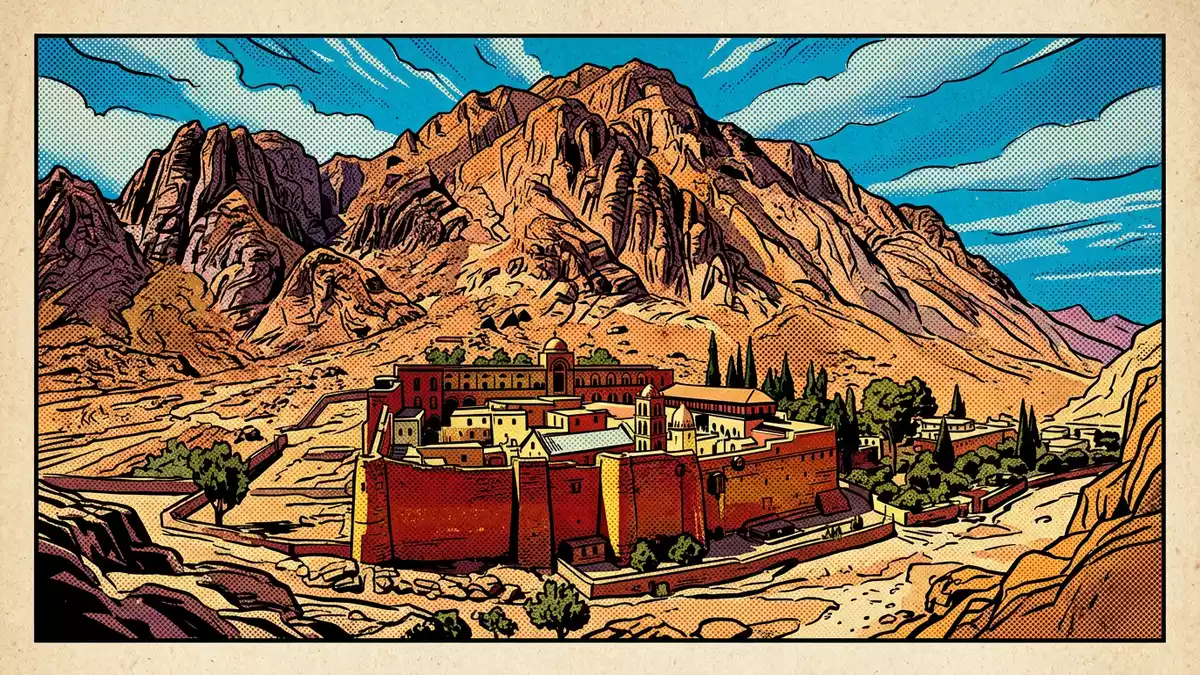
Saint Catherine's Monastery in Saint Catherine, Egypt, is a compact stone fortress of faith tucked into a high valley at the foot of Mount Sinai. Within its enclosure, Greek Orthodox monks have maintained worship and daily life on this desert mountainside since the sixth century, making it one of the world's most enduring Christian monastic communities.
A fortified monastery in the Sinai mountains
The monastery stands in the southern part of Egypt's Sinai Peninsula, in a basin surrounded by bare granite peaks that rise steeply above the valley floor. The settlement of Saint Catherine grew around the monastery and nearby Bedouin communities, creating a small town whose life is closely tied to this religious complex.The monastery and its surroundings form the town of Saint Catherine in the South Sinai Governorate.
Seen from outside, the monastery appears as a high-walled quadrilateral of thick stone, originally built as a defensive enclosure against the surrounding wilderness. The main walls form a near-rectangular footprint with robust corner sections and narrow entrances that emphasise enclosure and protection.Descriptions of the site emphasise its fortress character and dimensions, with the monastic buildings clustered tightly inside.
Sixth-century foundations and sacred associations
Saint Catherine's Monastery was founded in the reign of the Byzantine emperor Justinian I and built in the mid-sixth century, between 548 and 565, on a spot associated with the biblical story of Moses and the Burning Bush.The Sacred Monastery of the God-Trodden Mount Sinai was constructed under Justinian I in 548–565, and monastic life in the wider area is documented from the fourth century. Tradition connects the site with the moment in the Book of Exodus when Moses received the Ten Commandments, and the monastery lies near the route to the summit known locally as Jebel Musa.
The complex takes its name from Saint Catherine of Alexandria, a Christian martyr whose relics are venerated within the monastery church and whose story helped draw pilgrims from different parts of the Mediterranean world. Over many centuries, travelling clerics, scholars and lay pilgrims have climbed into the high valley to visit this monastery, contributing manuscripts, icons and liturgical objects that now form one of the most significant collections of early Christian art and writing in the region.UNESCO notes the monastery's outstanding manuscripts, religious books and artistic treasures, as well as its location within a landscape revered in Christianity, Islam and Judaism.
Architecture, worship and daily life inside the walls
Within the enclosure, the principal buildings of Saint Catherine's Monastery include the main church, chapels, domestic ranges and the monastic library, all constructed in stone and fitted closely against the inside of the outer walls. The church of the Transfiguration, dating from the sixth century, occupies a central position and retains early Byzantine architectural elements in its masonry and arrangement of spaces.The monastery complex grew around the sixth-century church, with later additions adjusted to the constrained footprint of the fortified courtyard.
The community follows the Greek Orthodox tradition and belongs to the autonomous Church of Sinai, headed by the Archbishop of Mount Sinai and Raithu under the wider jurisdiction of the Greek Orthodox Patriarchate of Jerusalem.Accounts of the monastery describe its status as an autonomous Greek Orthodox church, with a small number of monks living within the walls and maintaining regular liturgy, hospitality and stewardship of the collections. Life in the monastery combines spiritual routines with practical work needed to sustain a community in a remote high desert: tending courtyards, caring for buildings and gardens, and receiving visitors from many countries.
Visiting Saint Catherine's Monastery: what travellers from Western Europe should know
- Saint Catherine's Monastery stands in the town of Saint Catherine in Egypt's South Sinai Governorate, reached by road through the central Sinai mountains from coastal settlements on the Gulf of Suez and Gulf of Aqaba.
- The monastery occupies a high-altitude valley, above 1,500 m (4,921 ft), with approaches on mountain roads and internal access through stone paving, steps and staircases that require steady footing.
- The official language in the surrounding region is Arabic and the currency is the Egyptian pound.
- Entry requirements depend on your nationality; UK travellers can check the FCDO travel advice at gov.uk/foreign-travel-advice, Irish travellers the Department of Foreign Affairs at ireland.ie.
Searching for Saint Catherine's Monastery on social platforms
These links open searches for Saint Catherine's Monastery on each platform.
Frequently asked questions about Saint Catherine's Monastery
Where is Saint Catherine's Monastery located?
Saint Catherine's Monastery stands in the town of Saint Catherine in Egypt's South Sinai Governorate, in a high valley at the foot of Mount Sinai.
What can visitors expect when entering the monastery?
Visitors pass through thick stone walls into a compact courtyard and interior spaces that include the main church, chapels, domestic ranges and areas displaying icons and manuscripts.
What makes Saint Catherine's Monastery distinctive among Christian sites?
The monastery combines sixth-century Byzantine foundations, an unbroken Greek Orthodox monastic tradition, a major collection of early Christian texts and art, and a setting in a landscape revered by Christianity, Islam and Judaism.


