
Saint Catherine's Monastery and the granite valley of Sinai
Published on 08/29/2026 at 12:49 | Editorial responsibility: Rafael Müller, Editor-in-Chief AD HOC NEWS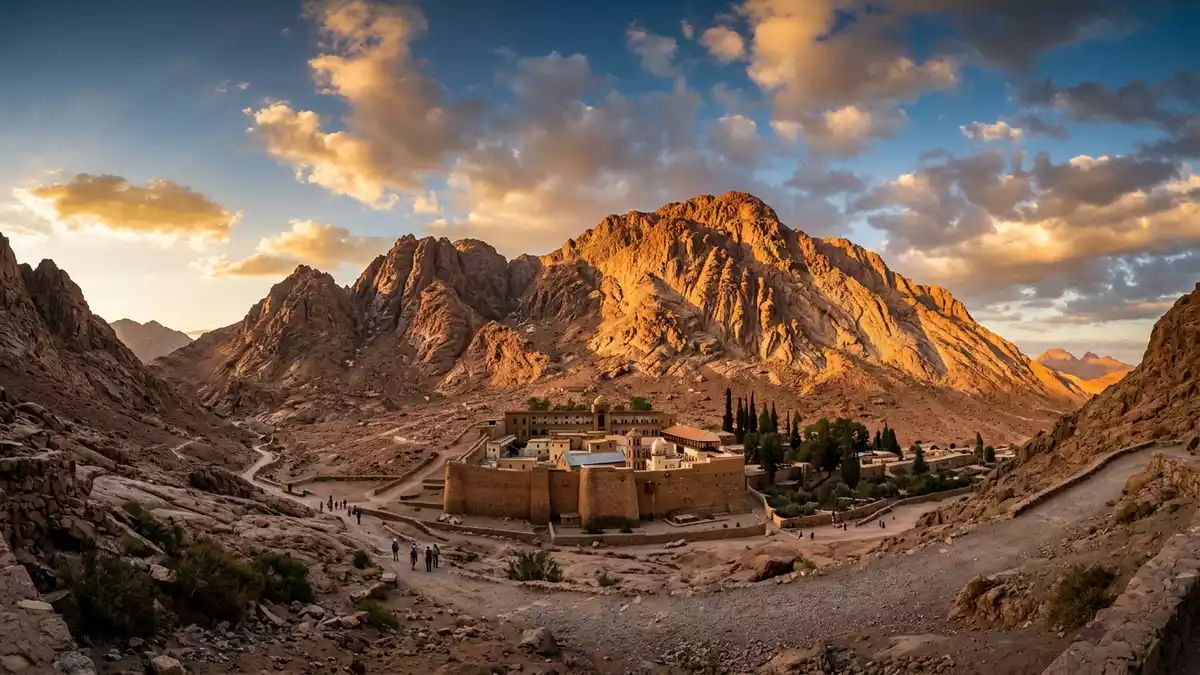
Saint Catherine's Monastery stands in Saint Catherine, Egypt, at the foot of Mount Sinai and within a UNESCO World Heritage landscape. Its strongest visual feature is the heavy enclosure that gathers church, tower, and courtyards into one fortified complex.
Justinian’s monastery in the Sinai valley
The monastery is linked with the reign of Justinian I and the sixth century, when the main phase of the present complex took shape. The Orthodox Monastery of St Catherine stands within a protected setting associated with Mount Horeb and the biblical story of Moses receiving the Tablets of the Law.
The site belongs to the Greek Orthodox world, but its setting gives it a wider historical reach. Saint Catherine's Monastery has long been tied to the Sinai Peninsula, the desert mount, and the religious memory of the Burning Bush.
Walls, manuscripts and a working monastery
The enclosure walls give the monastery its austere profile, with the church and other buildings held close inside them. The architectural mass feels compact rather than scattered, and the stonework sits naturally against the rocky valley.
Inside the complex are the church, monastic buildings, and a celebrated library of manuscripts. The monastery also preserves artistic treasures and religious objects that have made it an important centre of Christian scholarship and devotion across centuries.
Saint Catherine, the Burning Bush and layered memory
The monastery’s name comes from Saint Catherine of Alexandria, a Christian martyr from the early fourth century. Tradition connects the site with relics found on nearby Mount Saint Catherine, and the monastery’s identity grew from that association.
The Burning Bush adds another layer to the place’s meaning. That biblical association sits alongside the monastic buildings themselves, so the complex combines living religious use with memory rooted in scriptural landscape.
Visiting Saint Catherine's Monastery: what travellers from Western Europe should know
- The monastery lies in Saint Catherine in Egypt’s South Sinai, at the foot of Mount Sinai. It is reached through the mountain town rather than through a coastal city.
- The setting is high and rocky, with bare slopes around the enclosure. The approach and the surroundings are shaped by desert terrain and mountain stone.
- The monastery belongs to the Greek Orthodox tradition and remains a monastic complex. Its church, walls and library form the core of the site.
- The official language is Arabic and the currency is the Egyptian pound.
- Entry requirements depend on your nationality; UK travellers can check the FCDO travel advice at gov.uk/foreign-travel-advice, Irish travellers the Department of Foreign Affairs at ireland.ie.
Searching for Saint Catherine's Monastery on social platforms
These links open searches for Saint Catherine's Monastery on each platform.
Frequently asked questions about Saint Catherine's Monastery
Where is Saint Catherine's Monastery?
It stands in Saint Catherine, in Egypt’s South Sinai, at the foot of Mount Sinai. The setting is part of the wider Mount Sinai landscape.
What does a visit involve?
The site presents a fortified monastery with church, walls and library in a mountain valley. The terrain around it is rocky and high, so the setting feels remote and enclosed.
What makes Saint Catherine's Monastery distinctive?
Its sixth-century association with Justinian I, its Greek Orthodox monastic life and its UNESCO-listed setting give it a rare historical density. The connection with Saint Catherine and the Burning Bush adds another layer of meaning.


