
Sacsayhuaman and the zigzag stone walls above Cusco
Published on 09/19/2026 at 22:56 | Editorial responsibility: Rafael Müller, Editor-in-Chief AD HOC NEWS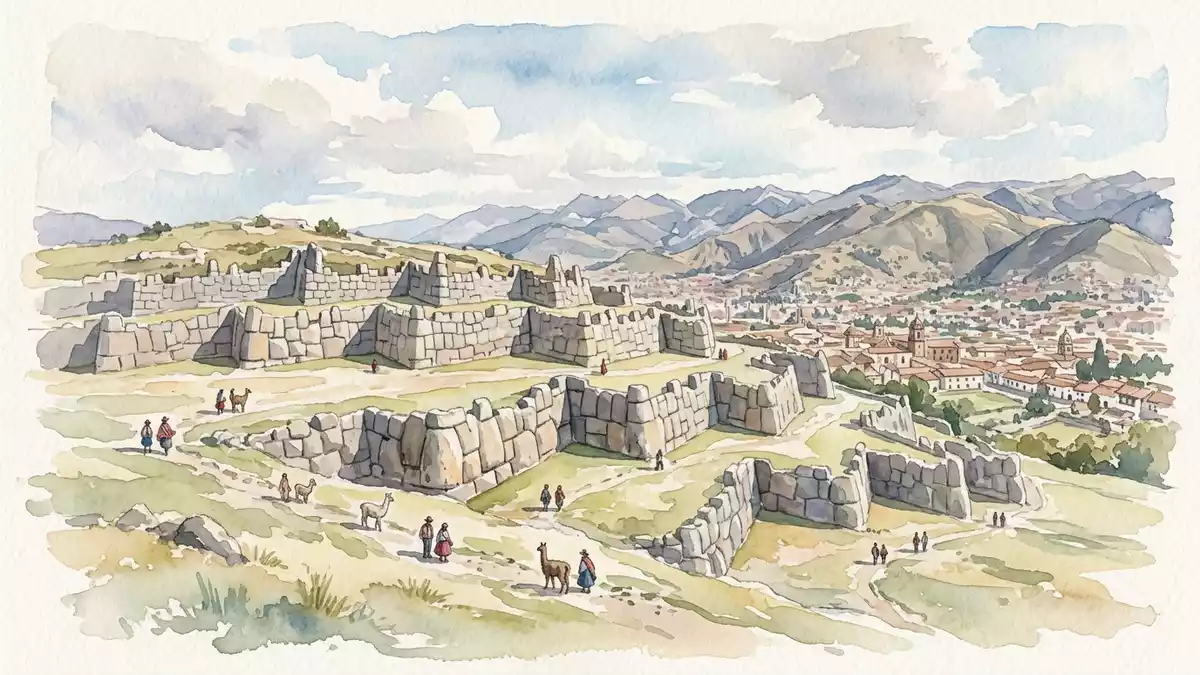
Sacsayhuaman rises above Cusco as a vast Inca stone complex, with three zigzag terraces stepping across the hill. It sits in the archaeological park on the city’s northern outskirts and belongs to the UNESCO-listed City of Cuzco ensemble.Inca stone complexUNESCO-listed ensemble
Zigzag terraces on a hill above Cusco
The best-known face of Sacsayhuaman is its long sequence of walls, built from huge limestone blocks that fit without mortar. The stepped lines run in a deliberate zigzag, and the masonry creates a strong rhythm across the slope.zigzag stone walls
The stones are irregular in outline rather than neatly rectangular, and the joints remain remarkably tight. The surface alternates between broad retaining walls and open spaces above them, giving the complex a layered appearance.irregular in outline
Pachacuti, the fifteenth century and Inca power
The complex is linked to the reign of Pachacuti Inca Yupanqui, the Inca ruler associated with Cusco’s expansion in the fifteenth century. Its scale places it among the most substantial surviving examples of Inca monumental architecture in the city.reign of Pachacuti
The hilltop position gives the site a clear relationship with the city below, and the masonry reads as both defensive and ceremonial architecture. Broad walls, terraced edges and upper platforms form the main visual pattern, rather than a single enclosed building.monumental architecture
Stone, scale and the Inca building tradition
The most striking material feature is the dry-laid stonework. Large blocks sit against one another with no visible mortar, and the masonry changes character from one terrace to the next.
Sacsayhuaman is part of a wider Inca building tradition visible across Cusco and the wider Andes. Its walls show polygonal stone fitting at a monumental scale, with a surface that feels far more sculpted than assembled.Inca building tradition
Visiting Sacsayhuaman: what travellers from Western Europe should know
- Sacsayhuaman lies on the northern side of Cusco, on a hill above the historic centre. The approach from the city is uphill and the site belongs to the wider archaeological park.
- The terrain is high and open, with broad stone terraces and exposed slope edges. The main walls rise in stepped lines rather than a single vertical face.
- The archaeological complex is tied to Cusco’s UNESCO World Heritage designation. That status places it within the historic urban landscape rather than apart from it.
- The stonework varies between huge irregular blocks and tighter polygonal joints. The change in masonry style is visible across different parts of the walls.
Searching for Sacsayhuaman on social platforms
These links open searches for Sacsayhuaman on each platform.
Frequently asked questions about Sacsayhuaman
Where is Sacsayhuaman?
It stands on a hill on the northern edge of Cusco, in southern Peru. The site overlooks the city and forms part of the archaeological park above the historic centre.
What does a visit involve?
The site is a hilltop complex of terraces, walls and open areas rather than a single building. The ground rises, the walls are large, and the masonry is exposed across several levels.
What makes Sacsayhuaman distinctive?
Its zigzag walls and massive fitted stones are the defining features. The combination of scale, polygonal masonry and hilltop setting gives the complex its character.


