
Sabratha’s Roman theatre on Libya’s Mediterranean shore
Published on 09/07/2026 at 13:38 | Editorial responsibility: Rafael Müller, Editor-in-Chief AD HOC NEWS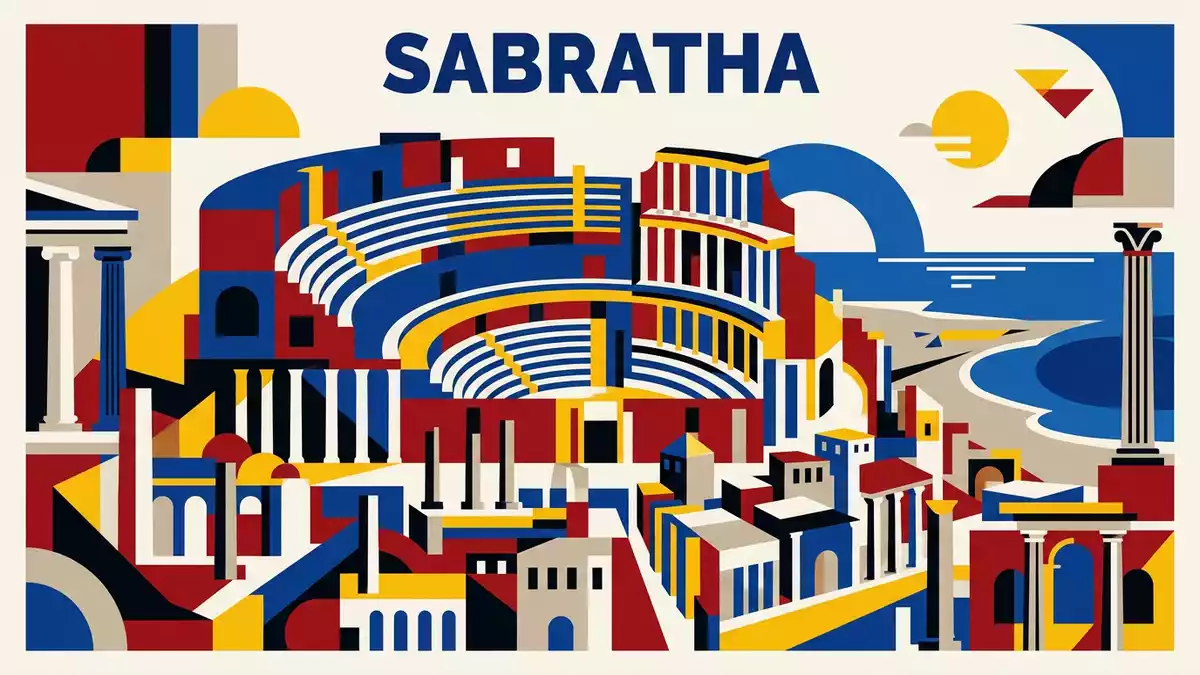
Sabratha on Libya’s Mediterranean coast combines an extensive archaeological site with a remarkably intact Roman theatre whose multi-storey stage front still dominates the shoreline landscape. The ruins form part of the Archaeological Site of Sabratha, a former Phoenician trading post later absorbed into Roman Africa and rebuilt in the second and third centuries AD.
A Roman theatre facing the sea
The Roman theatre at Sabratha stands within the eastern part of the coastal archaeological zone, close to the modern town of Sabratha in north-western Libya. Its stone seating curves around a central orchestra, rising in broad tiers that once accommodated crowds for performances and civic gatherings.The ancient theatre of Sabratha is widely recognised for the survival of its stage wall, where colonnades and niches rebuilt in the twentieth century recall the monumentality of imperial-period architecture.
Behind the orchestra, the theatre’s scaenae frons presents stacked rows of columns in multiple levels, framing an array of doorways and decorative relief panels. These elements form a vertical backdrop that would have supported statuary and painted decoration, and they still articulate the division between the performance space and the wider city beyond. Archaeological and historical studies place the construction of the theatre between the second and third centuries AD, aligning its development with a phase of prosperity under Roman rule.The Roman theatre in Sabratha retains enough of its form to suggest how sound and movement would once have been contained within the enclosure of stone.
From Phoenician port to Roman colony
The wider archaeological site preserves traces of Sabratha’s evolution from a coastal trading post to a Romanised urban centre tied into Mediterranean commerce. The settlement began as a Phoenician outlet for goods from the African interior before becoming part of the short-lived Numidian kingdom of Massinissa, and later entering the orbit of Roman provincial administration.The Archaeological Site of Sabratha records this sequence in its mix of monuments, ranging from temples to civic spaces that reflect different phases of patronage.
Under Roman rule, Sabratha was incorporated into the province of Africa and saw the construction of public buildings such as a forum, temples and the theatre, linking the town visually and functionally to Rome’s wider architectural repertoire.Descriptions of the site highlight the presence of a temple complex and a Christian basilica with mosaic floors, indicating continued occupation into the late antique period. The theatre itself forms part of this urban fabric, aligned with streets and other structures that reveal the planned nature of the Roman colony and its adaptation of an earlier coastal setting.
A World Heritage coastal cityscape
The ruins of Sabratha, including the theatre, form a recognised World Heritage ensemble, reflecting their significance for understanding Phoenician and Roman activity along the Libyan coast.The Archaeological Site of Sabratha was inscribed on the UNESCO World Heritage List in 1982, acknowledging both the quality of its surviving architecture and its historical role as a maritime city connected to inland trade routes. The coastal setting places the theatre within sight of the Mediterranean, where the light and horizon line give the stone structures a distinct backdrop.
Within the site, blocks of sandstone, limestone and marble appear in walls, columns and pavements that trace out streets and public squares. The theatre’s masonry contrasts with nearby remains of temples and domestic buildings, creating a layered cityscape in which different types of construction sit side by side.Historical overviews of Sabratha emphasise the town’s role in supplying Rome with goods and animals via routes towards the interior, a trade that underpinned investment in stone architecture whose ruins are visible on the ground.
Visiting Sabratha: what travellers from Western Europe should know
- Sabratha lies on Libya’s north-western Mediterranean coast west of Tripoli, with the archaeological site positioned near the shoreline and the modern town inland. The ruins are reached over level ground from the surrounding urban area.
- The theatre and adjoining monuments stand on exposed coastal terrain, where approaches involve walking across uneven stone surfaces and low steps between different parts of the site.
- The archaeological zone includes open areas without shade and roofed spaces such as parts of the basilica and museum structures, so conditions can vary between sunlit courtyards and enclosed interiors.
- The official language is Arabic and the currency is the Libyan dinar.
- Entry requirements depend on your nationality; UK travellers can check the FCDO travel advice at gov.uk/foreign-travel-advice, Irish travellers the Department of Foreign Affairs at ireland.ie.
Searching for Sabratha on social platforms
These links open searches for Sabratha on each platform.
Frequently asked questions about Sabratha
Where is Sabratha and its Roman theatre located?
Sabratha lies on Libya’s north-western Mediterranean coast, with the Roman theatre forming part of the Archaeological Site of Sabratha close to the shoreline.
What can visitors expect when exploring the theatre?
Visitors encounter a Roman theatre with extensive stone seating and a rebuilt multi-level stage wall, alongside other ruins such as temples, streets and a basilica.
What makes Sabratha distinctive among ancient coastal cities?
Sabratha’s combination of Phoenician origins, Roman urban planning and the survival of a monumental theatre façade creates a distinctive archaeological landscape on the Libyan coast.


