
Sabratha’s Roman theatre on Libya’s Mediterranean shore
Published on 09/05/2026 at 11:15 | Editorial responsibility: Rafael Müller, Editor-in-Chief AD HOC NEWS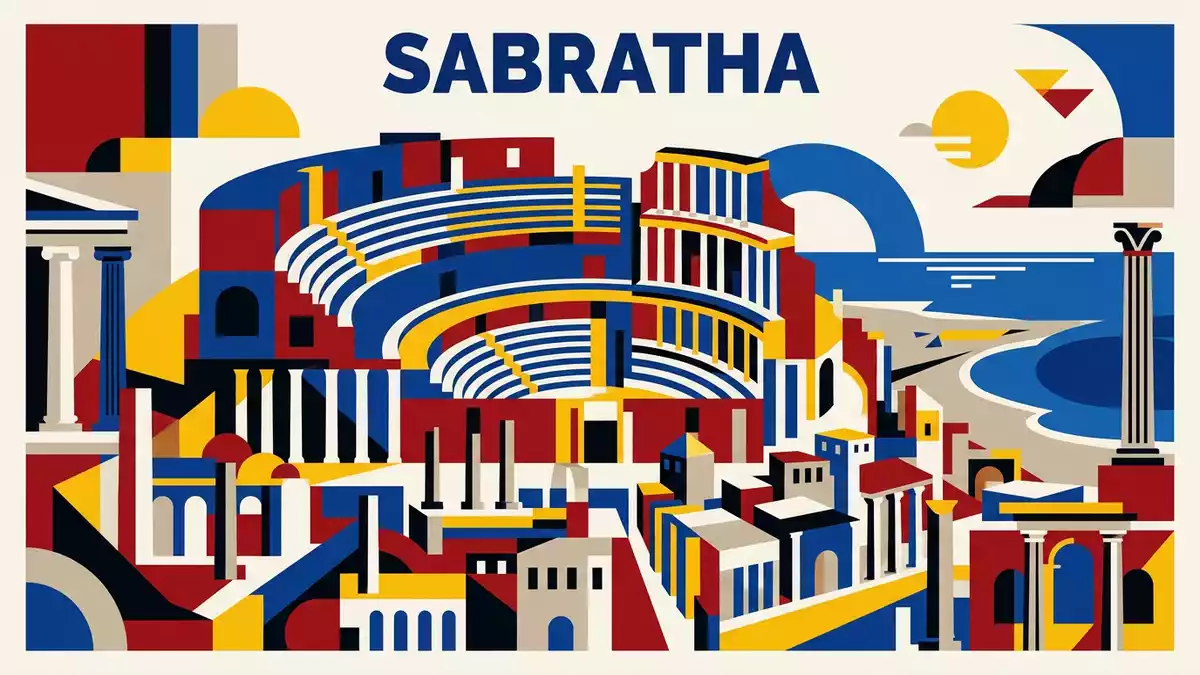
Sabratha on the Mediterranean coast of Libya combines the remains of an ancient city with a Roman theatre whose towering stage front has become the site’s defining silhouette. The ruins form part of the Archaeological Site of Sabratha, inscribed on the UNESCO World Heritage List in 1982, and preserve layers of Phoenician, Roman and later history in a compact coastal setting.
From Phoenician trading post to Roman Tripolitania
Sabratha began as a Phoenician coastal settlement facing the central Mediterranean, linked to caravan routes that reached deep into North Africa’s interior.Phoenician trading-post Over time it formed part of the territory known as the Emporia, alongside other ports whose agricultural hinterland and maritime access made them valuable nodes in regional exchange.Emporia in Tripolitania The town’s name appears in early records in several forms, reflecting its role as a grain market and outlet for inland produce.
After the Punic Wars in the second century BC, Sabratha was incorporated into the Roman province of Africa, sharing a trajectory with nearby Oea (modern Tripoli) and Leptis Magna as part of Roman Tripolitania.Roman Tripolitania The settlement’s streets were reorganised on a more regular plan, and by 157 AD Sabratha held the status of a Roman colony, a sign of its growing importance within the imperial system.Roman colony in 157 AD Public buildings followed: forum structures, temples and a theatre that still anchors the archaeological landscape.
The Roman theatre and its monumental stage front
The Roman theatre of Sabratha occupies the eastern side of the archaeological site close to the sea, forming a near semicircular performance space backed by a high stage wall.theatre in the eastern sector The auditorium is carved and built in concentric tiers, with entrances distributed around its perimeter, and in antiquity it accommodated around 5,000 spectators for performances and civic gatherings.audience of 5,000 In its restored state the theatre remains a legible example of Roman stage architecture in North Africa, with stairways, seating blocks and the orchestra area clearly defined.
The most striking feature is the scaenae frons, the sculpted stage front rising in three superposed orders of columns and niches.three orders of columns This multi-storey façade has been extensively reconstructed from surviving elements, reinstating its vertical rhythm and the interplay of columns, entablatures and statuary bases. Reliefs decorate the base of the stage towards the orchestra, adding carved detail at eye level. The combination of the high stage wall and stepped cavea creates a stone amphitheatre open to the sky yet enclosed enough to convey the form of a Roman theatre that once anchored civic life.
A compact World Heritage city by the sea
The Archaeological Site of Sabratha lies on Libya’s north-western coastline, west of modern Tripoli, where the ruins extend between the shore and inland fields.coastal setting in Libya Within this relatively compact area stand forum remains, temple platforms and residential quarters that trace Sabratha’s development from a Phoenician port through Roman prosperity to later Byzantine occupation.Archaeological Site of Sabratha The UNESCO inscription in 1982 recognises both the urban ensemble and the theatre as representative of Mediterranean coastal cities shaped by long-distance trade and imperial rule.
Sabratha became a centre of North African Christianity in the third century AD, gaining a bishopric and later seeing the construction of churches under Byzantine rule.Christian and Byzantine phases Political fortunes shifted as Vandals, Byzantines and Arab powers successively controlled the region, and the city experienced periods of decline and revival. The ruins visible now, framed by the sea and low modern structures, reflect these layered histories in masonry, inscriptions and building forms that still mark out streets, public squares and performance spaces.
Visiting Sabratha: what travellers from Western Europe should know
- Sabratha lies on Libya’s Mediterranean coast west of Tripoli, and the archaeological site is reached from the modern town of Sabratha along local roads.
- Within the site, the approach to the Roman theatre involves walking across uneven ancient paving and ascending stone steps in the auditorium.
- The ruins stand near the shoreline, and exposed areas around the theatre and forum offer little shade among the excavated structures.
- The official language is Arabic and the currency is the Libyan dinar.
- Entry requirements depend on your nationality; UK travellers can check the FCDO travel advice at gov.uk/foreign-travel-advice, Irish travellers the Department of Foreign Affairs at ireland.ie.
Searching for Sabratha on social platforms
These links open searches for Sabratha on each platform.
Frequently asked questions about Sabratha
Where is Sabratha and what kind of place is it?
Sabratha is a coastal city in north-western Libya, known for its archaeological site that preserves a former Phoenician settlement and later Roman colony.
What should visitors expect when exploring the ruins?
Visitors encounter a compact site with stone remains of streets, forums, temples and a Roman theatre, set between the Mediterranean shoreline and the modern town.
What makes the Roman theatre at Sabratha distinctive?
The theatre is distinguished by its restored multi-storey stage front with three orders of columns, rising above a stepped auditorium that once seated thousands.


