
Sabratha and the Roman theatre beside the Mediterranean
Published on 09/23/2026 at 01:53 | Editorial responsibility: Rafael Müller, Editor-in-Chief AD HOC NEWS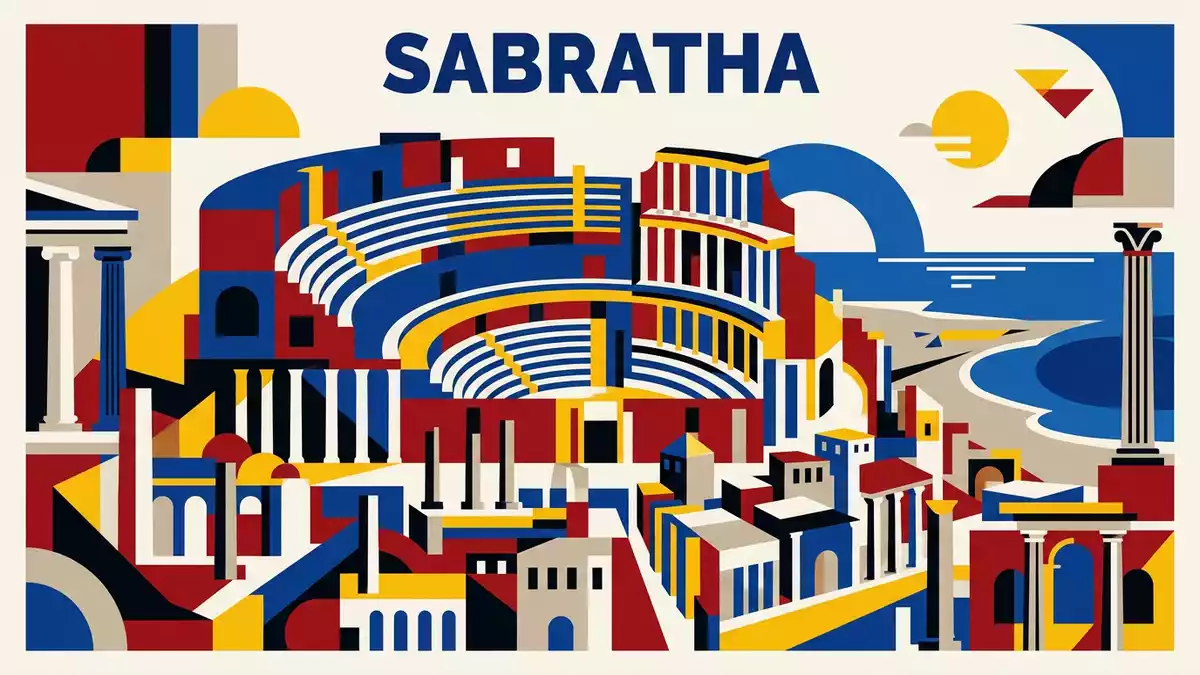
Sabratha is an archaeological city on Libya’s Mediterranean coast, where a Roman theatre rises among the remains of a Phoenician trading settlement. The theatre’s tall stage wall, layered columns and sculpted niches form the clearest surviving silhouette across the site.
Sabratha’s theatre and its stone stage wall
The theatre belongs to the Roman period and is generally dated to the late second or early third century AD. Its auditorium curves around the orchestra, with stone seating arranged below a broad stage structure.
The three-storey scaenae frons, the architectural wall behind the stage, carries rows of Corinthian columns, niches and relief decoration. This layered arrangement makes the theatre a substantial architectural composition, not simply a semicircular bank of seats. The building is associated with the period when Sabratha formed part of Africa Proconsularis, the Roman province covering much of the central North African coast.
From Phoenician harbour to Roman city
Sabratha began as a Phoenician coastal trading post linked to routes between the Mediterranean and the African interior. Its urban remains preserve that earlier commercial setting alongside Roman public architecture.
After the Punic Wars, the settlement entered the Roman sphere and became a Roman colony in the second century AD. The city’s excavated remains include a forum, temples, baths, basilicas, harbourside installations and residential quarters with mosaic floors. Sabratha’s excavated urban remains extend beyond the theatre into the civic and residential areas.
Temples, mosaics and the coastal archaeological landscape
The Roman city contains several religious buildings, including temples associated with Jupiter, Liber Pater, Serapis and Isis. Their surviving columns, platforms and fragments belong to a wider urban landscape rather than a single isolated monument.
A Christian basilica and mosaic floors record a later phase in the history of the settlement. The combination of Phoenician origins, Roman monumental construction and Christian remains gives Sabratha a long cultural sequence within one archaeological zone. The site entered the UNESCO World Heritage List in 1982 as the Archaeological Site of Sabratha, a designation that includes the theatre and the surrounding ruins. The 1982 World Heritage inscription identifies the place as a cultural property with remains from successive civilisations.
The theatre remains the most visually legible part of Sabratha because its stage architecture retains a strong vertical presence. Columns, carved frames, stairways, seating blocks and the orchestra show how Roman performance buildings combined engineering with formal decoration. The theatre’s architectural backdrop preserves the principal elements of a Roman stage setting in North Africa.
Visiting Sabratha: what travellers from Western Europe should know
- Sabratha lies on Libya’s Mediterranean coast, west of Tripoli. The archaeological area is reached by road from the capital and lies near the modern town of Sabratha.
- The site is an outdoor ruin field with uneven ground, exposed stonework and stairways around the theatre. Movement between the monuments involves walking across archaeological terrain.
- The coastal setting places the theatre beside the remains of the ancient harbour and civic quarters. The forum, temples, basilica and mosaic-bearing buildings form part of the same archaeological landscape.
- The official language is Arabic and the currency is the Libyan dinar.
- Entry requirements depend on your nationality; UK travellers can check the FCDO travel advice at gov.uk/foreign-travel-advice, Irish travellers the Department of Foreign Affairs at ireland.ie.
Searching for Sabratha on social platforms
These links open searches for Sabratha on each platform.
Frequently asked questions about Sabratha
Where is Sabratha?
Sabratha is on Libya’s Mediterranean coast, west of Tripoli. The ancient city forms an archaeological area beside the modern settlement.
What can visitors see at Sabratha?
The ruins include the Roman theatre, forum, temples, baths, basilica, harbour installations, residential quarters and mosaic floors.
What makes the theatre distinctive?
Its three-storey stage wall combines Corinthian columns, niches and relief panels. The theatre’s vertical façade contrasts with the curved auditorium and orchestra.


