
Ruinas de Sao Paulo and the stone façade above Macau’s steps
Published on 09/14/2026 at 10:22 | Editorial responsibility: Rafael Müller, Editor-in-Chief AD HOC NEWS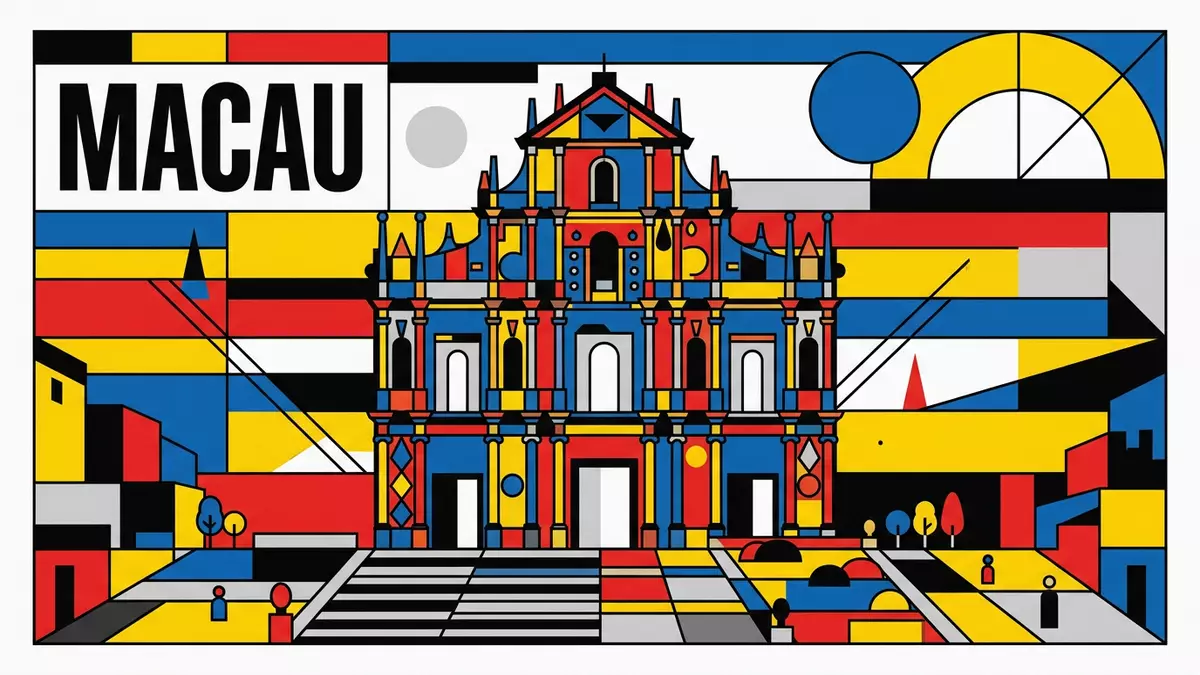
Ruinas de Sao Paulo, better known in English as the Ruins of St Paul’s, is the surviving stone façade of a seventeenth-century Catholic complex in Macau’s Santo António district. Built as the Church of Mater Dei and the adjoining College of St Paul between 1602 and 1640, the structure was largely destroyed by fire in 1835, leaving the decorated front wall and a broad stairway as one of the most recognisable landmarks in the Historic Centre of Macau.
A baroque façade held open to the sky
The defining feature of Ruinas de Sao Paulo is the granite façade that once formed the front wall of the Church of Mater Dei, standing above a long flight of stone steps on Rua de Sao Paulo.The façade measures about 23 m in width and 25.5 m in height, giving the ruin the scale of a complete church front despite the absence of a roof or nave behind it.
The façade belongs to an early baroque idiom introduced to East Asia through Portuguese colonial building, with layered horizontal bands, sculpted figures and reliefs set into the stone.It formed part of a Jesuit complex dedicated to Saint Paul the Apostle, and the surviving masonry carries both Christian imagery and references to the wider mission field in which the Jesuits worked. From the stairway below, visitors see the façade standing free against the sky, a complete front wall whose interior face opens onto archaeological foundations and museum spaces rather than a functioning nave.
From Jesuit college to World Heritage landmark
The construction of the Church of Mater Dei and the College of St Paul in the early seventeenth century anchored Jesuit activity in Macau, which served as a key base for Portuguese trade and missionary work in East Asia.Work on the complex is recorded between 1602 and 1640, and the completed ensemble became one of the largest Catholic institutions in the region, combining a substantial church with an ecclesiastical college that taught subjects such as theology and languages.
The present ruin dates from a fire in 1835, when flames destroyed most of the church and college buildings, leaving the front wall and parts of the foundation standing on their stone platform.The site was later incorporated into the Historic Centre of Macau, inscribed as a UNESCO World Heritage Site in 2005, recognising the ensemble of streets, churches and fortifications that record the encounter between Portuguese and Chinese urban traditions. For visitors, Ruinas de Sao Paulo reads both as an architectural fragment and as a formal gateway into this historic district, with the granite front facing the city and the foundations opening towards the remains of the old Jesuit acropolis.
Stairs, streets and the setting in Macau
Ruinas de Sao Paulo stands in the Santo António area on the Macau Peninsula, above Rua de Sao Paulo and close to the open space often identified as Company of Jesus Square.The ruin lies a short walk north of Senado Square, one of Macau’s principal civic spaces, and forms part of a sequence of historic streets lined with buildings from the Portuguese period. The stone staircase in front of the façade rises from the surrounding lanes to the platform of the former church, creating a clear axis between the commercial streets below and the high ground of the Jesuit site.
Behind the façade, the ground drops to reveal the foundations of the former church and college, which have been integrated into a museum display of sacred art and archaeological remains.In this configuration, the surviving elements form a layered ensemble of façade, steps and platform within the wider Historic Centre of Macau, framed by the nearby Fortaleza do Monte and other colonial-era structures. Standing at the top of the stairs, the view runs back across the tiled roofs and newer towers of Macau, while at the same level the carved stonework of the façade reveals its mixture of European figures and motifs drawn from the cultures the Jesuits encountered.
Visiting Ruinas de Sao Paulo: what travellers from Western Europe should know
- Ruinas de Sao Paulo stands on Rua de Sao Paulo in the Santo António district of the Macau Peninsula, north of Senado Square, and is reached on foot through the Historic Centre from the surrounding streets.
- The approach from the lower streets involves a broad stairway with many stone steps, and movement around the ruin takes place on paved surfaces with changes in level between the staircase, platform and museum areas.
- Macau lies in the Macao Special Administrative Region of China; the official languages are Chinese and Portuguese, and the currency in use is the Macanese pataca.
- Entry requirements depend on your nationality; UK travellers can check the FCDO travel advice at gov.uk/foreign-travel-advice, Irish travellers the Department of Foreign Affairs at ireland.ie.
Searching for Ruinas de Sao Paulo on social platforms
These links open searches for Ruinas de Sao Paulo on each platform.
Frequently asked questions about Ruinas de Sao Paulo
Where are Ruinas de Sao Paulo and what surrounds them?
Ruinas de Sao Paulo stands in the Santo António district on the Macau Peninsula, above Rua de Sao Paulo and close to Senado Square within the Historic Centre of Macau.
What should a visitor expect on a first visit?
A visit centres on the granite façade rising above the stone stairway, the platform on which the former church stood and the foundations and museum spaces behind the wall.
What makes Ruinas de Sao Paulo distinctive among Macau’s historic sites?
The site combines a free-standing seventeenth-century church façade, a long stairway and archaeological remains, forming a landmark that links Jesuit baroque architecture with the surrounding streets of Macau.


