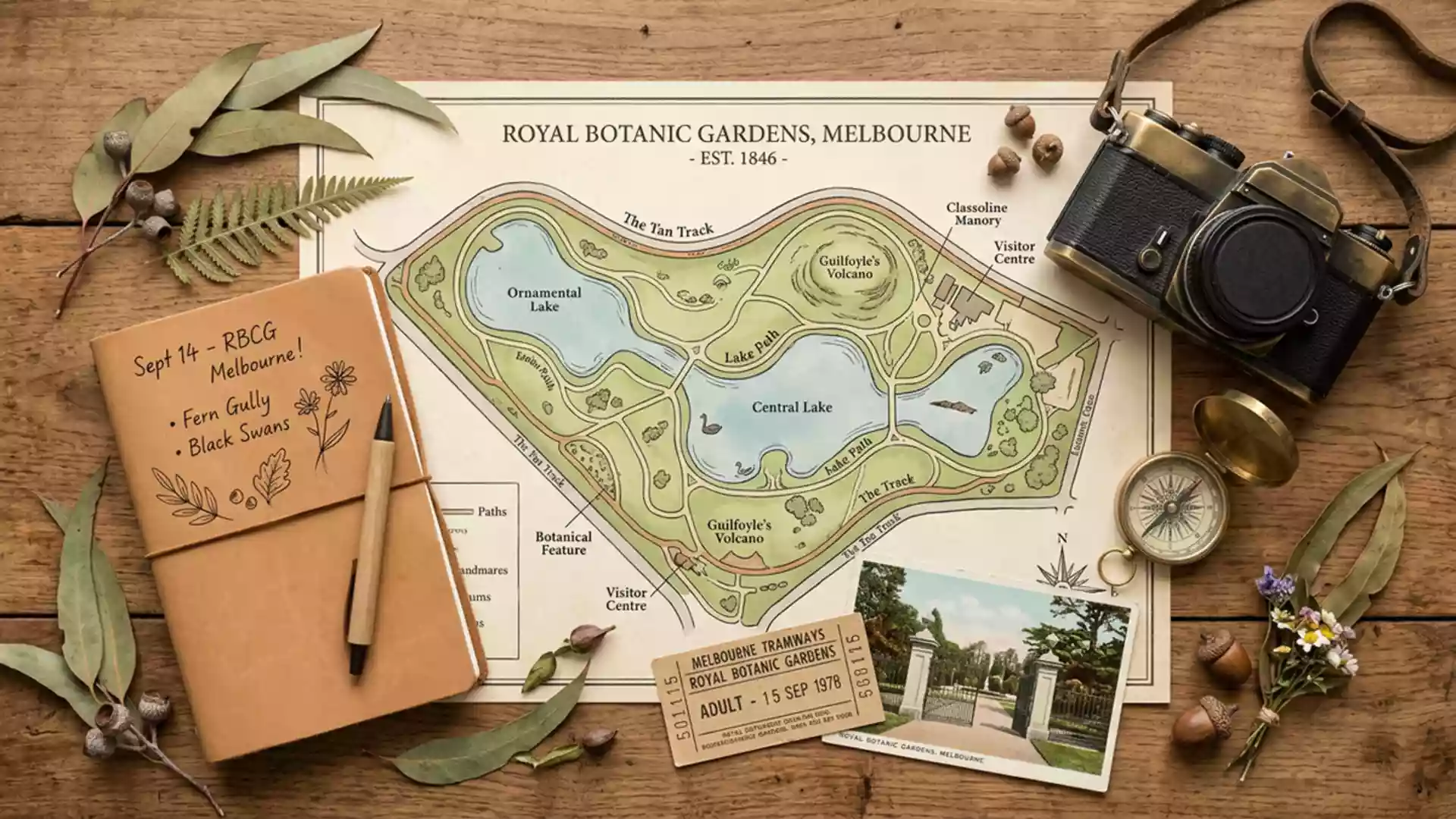
Royal Botanic Gardens, Melbourne’s riverside landscape of lawns and lakes
Published on 09/09/2026 at 22:00 | Editorial responsibility: Rafael Müller, Editor-in-Chief AD HOC NEWS
On the south bank of the Yarra River in Melbourne, Royal Botanic Gardens forms a broad nineteenth?century landscape where sweeping lawns slip down to ornamental lakes and dense plant collections line curving paths. First reserved as a botanic garden in 1846 under Superintendent Charles La Trobe, the site has grown into an extensively designed green space that reflects successive layers of botanical science and landscape art across Victoria’s colonial and modern history.Royal Botanic Gardens Victoria
A nineteenth?century garden shaped by science and scenery
The land that became Royal Botanic Gardens was selected in the mid?1840s on former marsh and swamp beside the Yarra River, adjacent to Government House and the Melbourne Observatory, placing the garden at the edge of the young colonial town with close links to scientific institutions and political power.commenced in 1846 on the south side of the Yarra River Early plantings under curators such as John Arthur and William Dallachy laid out fenced beds beside the river, but the character of the garden shifted markedly after Ferdinand von Mueller became Director in 1857, when he expanded the reserve and built the National Herbarium of Victoria as a centre for botanical research and the cataloguing of flora from across Australia and overseas.National Herbarium of Victoria
From the 1870s the overall layout was reimagined under William Guilfoyle, whose work transformed the grounds into a picturesque landscape of broad lawns, winding paths, ornamental lakes and carefully framed vistas, using subtropical plants and varied topography to create changing scenes as visitors move through the garden.William Guilfoyle transformed the Gardens into a landscape Later administrations maintained Guilfoyle’s composition, while the garden’s role as a scientific institution continued through the herbarium and related facilities, leading to its recognition as Victoria’s principal botanical resource and its designation as Royal Botanic Gardens Melbourne in the mid?twentieth century.Royal warrant in 1958 and Royal Botanic Gardens Act 1991
Lawns, lakes and plant collections beside the Yarra River
Royal Botanic Gardens spreads across an undulating reserve of around three dozen hectares on the south side of the river, its ground rising and falling between low lakeside walks and higher lawns with views towards central Melbourne.expanded in area to 36 hectares Within this area, paths curve between groves of trees, shrubberies and display beds, connecting quieter pockets of planting with open lawn panels where paths edge the grass and trees form enclosed outer boundaries.
The lakes are central to the garden’s layout, holding islands, planted margins and crossing points that link the main lawns with more densely planted areas, while along the higher ground the National Herbarium of Victoria and former Melbourne Observatory recall the site’s scientific role.Melbourne Gardens Across the gardens thousands of plant species are cultivated, including collections that represent Australian habitats as well as plants from other continents, set out so that visitors move between shaded tree canopies, more exposed lawns and rich mixed borders in a single circuit.8,000 plant species planted across the site
A heritage landscape in Melbourne’s cultural belt
Royal Botanic Gardens sits within a broader band of parks and institutions stretching along the Yarra River, with Government House, the Domain parkland and the sporting precinct lying nearby, which places the garden within a continuous chain of public open space and civic buildings that frame the southern edge of Melbourne’s central district.adjacent to Government House, Melbourne Observatory and the Domain Heritage listings highlight the gardens as Victoria’s earliest botanic garden and emphasise the significance of its layered design, combining early fenced plots with Guilfoyle’s Victorian landscape and later maintenance of his structure by subsequent directors.comprehensively relandscaped from 1873-1909 by William Guilfoyle
Beyond the plant collections and lawns, the reserve includes built elements such as avenues, pavilions and service buildings that support its dual identity as both a public pleasure garden and a working centre for botanical study and conservation. This combination of designed scenery, scientific institutions and proximity to major cultural venues gives Royal Botanic Gardens a central place in Melbourne’s urban layout, linking botanical heritage with everyday city life.
Visiting Royal Botanic Gardens: what travellers from Western Europe should know
- Royal Botanic Gardens lies south of central Melbourne on the southern bank of the Yarra River, bounded by Birdwood Avenue, Government House and the broader Domain parklands.
- The terrain combines level lakeside paths with rising lawns and occasional steep sections; many routes involve gradients and steps as paths climb and descend between different parts of the garden.
- Melbourne is reached by international flights to Melbourne Airport, from where urban rail and tram networks connect into the city area near the northern bank of the Yarra River opposite the gardens.
- The official language is English and the currency is the Australian dollar.
- Entry requirements depend on your nationality; UK travellers can check the FCDO travel advice at gov.uk/foreign-travel-advice, Irish travellers the Department of Foreign Affairs at ireland.ie.
Searching for Royal Botanic Gardens on social platforms
These links open searches for Royal Botanic Gardens on each platform.
Frequently asked questions about Royal Botanic Gardens
Where is Royal Botanic Gardens in Melbourne?
Royal Botanic Gardens occupies a riverside reserve south of Melbourne’s central district, on the south bank of the Yarra River near Government House and the Domain.
What should visitors expect on a visit to the gardens?
Visitors encounter curving paths through varied planting, open lawns and lakes, together with heritage buildings such as the National Herbarium and former Melbourne Observatory embedded within the landscape.
What makes Royal Botanic Gardens distinctive among city parks?
The gardens combine a nineteenth?century picturesque design by William Guilfoyle with extensive scientific collections and institutions, creating a landscape that is both decorative and deeply rooted in botanical research.