
Royal Botanic Gardens, Melbourne’s living landscape of science and leisure
Published on 08/27/2026 at 21:21 | Editorial responsibility: Rafael Müller, Editor-in-Chief AD HOC NEWS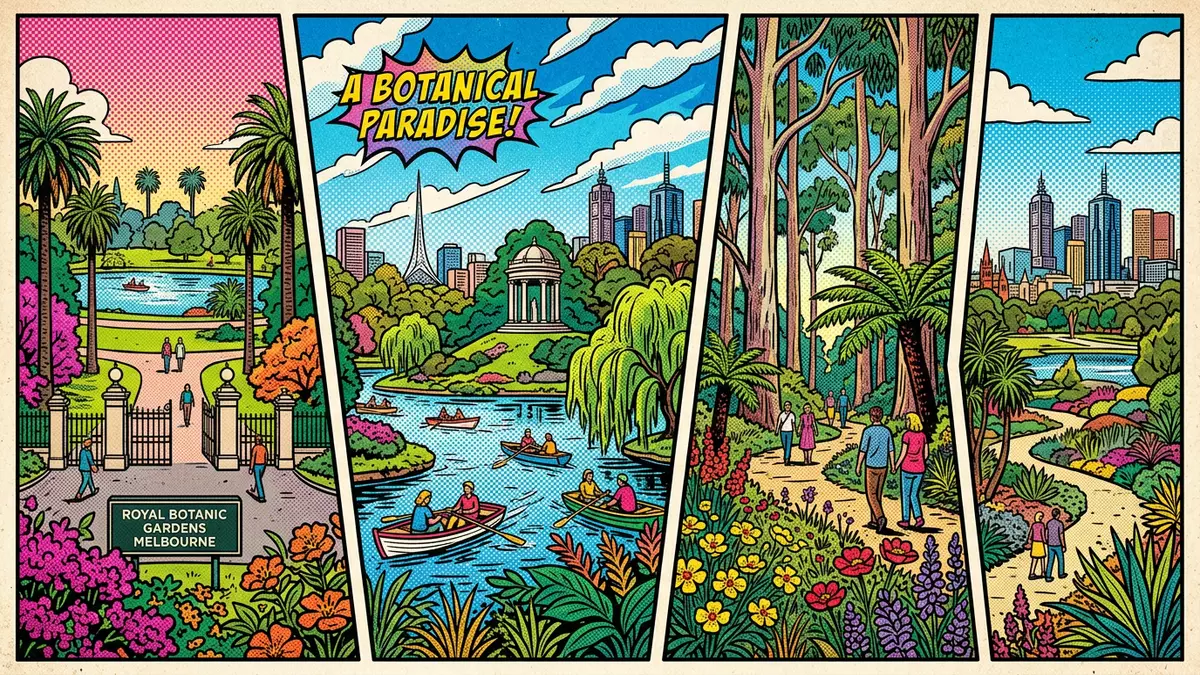
Royal Botanic Gardens in Melbourne is an expansive nineteenth-century landscape garden on the south side of the Yarra River, shaped over generations into a place where scientific plant collections and leisurely walking lawns share the same ground. Founded in 1846 and granted the “Royal” title in 1958, it remains one of Australia’s best-known horticultural institutions and a central green space in the city’s inner south.
A riverside garden shaped by Victorian-era ambition
Royal Botanic Gardens occupies rolling ground beside the Yarra River, close to Government House and the former Melbourne Observatory, forming part of a larger precinct of parkland often referred to as the Domain.The gardens were commenced in 1846 when land on the river’s south bank was set aside for a botanic garden serving the young colonial town.Queen Elizabeth II approved the addition of “Royal” to the title in 1958, marking more than a century of botanical work on the site.
Early development was guided by figures such as Charles La Trobe, who selected the location, and Ferdinand von Mueller, the German-born botanist appointed director in the 1850s.Mueller established the National Herbarium of Victoria within the grounds, embedding a formal scientific institution among the ornamental plantings. In 1873 William Guilfoyle became director and recast the garden into a picturesque composition, replacing straight avenues with curved paths, creating sweeping lawns and framing long views through carefully arranged trees and shrubs.His design work continued into the early twentieth century, and many of those vistas still structure a visit.
Plant collections between lakes, lawns and the herbarium
Melbourne Gardens, the main site of Royal Botanic Gardens in the city, extends across more than 30 hectares of landscaped slopes and low-lying ground, with ornamental lakes, islands and wide lawns forming the canvas for botanical collections.The gardens reserve is recorded as 36 hectares of parkland, making it a substantial open space within walking distance of central Melbourne. The planting scheme today includes thousands of species drawn from Australia and other continents, arranged in themed areas that highlight particular climates, ecosystems or horticultural stories.Royal Botanic Gardens Victoria notes approximately 8,000 plant species planted across the site, from large specimen trees to detailed display beds.
Near the centre of the grounds stands the National Herbarium of Victoria, a purpose-built facility that houses preserved plant specimens and botanical archives linked to the gardens’ scientific role.The herbarium grew out of Mueller’s nineteenth-century work and continues to underpin research into Australian and international flora. Scattered through the landscape are specialised spaces such as the Arid Garden, with its organised display of cacti and succulents, and conservation plantings featuring rare or threatened species recorded by horticultural staff.Public information from the City of Melbourne describes the gardens as featuring a diverse collection of plants from around the world, set among water features and broad lawns that invite slow exploration.
Heritage structures and contemporary garden experiences
Royal Botanic Gardens is more than planted beds: a visit brings encounters with historical structures and carefully designed modern features that articulate different layers of the site’s story. One of the most striking is Guilfoyle’s Volcano, a raised, terraced earthwork first built in the nineteenth century as part of Guilfoyle’s reworking of a hilltop reservoir.City guides describe it as a decorative garden reshaped to showcase drought-tolerant planting around a water storage feature, combining historical infrastructure with contemporary landscape design. Close by, the historic Melbourne Observatory, once a centre for astronomical observation, remains a prominent cluster of buildings at the edge of the grounds, linking the gardens to a wider scientific tradition.Royal Botanic Gardens Victoria identifies the observatory as one of the site’s heritage landmarks, alongside cottages and other nineteenth-century structures.
Contemporary additions include dedicated spaces for children and educational programming, where water features, climbing structures and plantings are arranged to introduce younger visitors to horticulture and ecology through play.The Ian Potter Foundation Children’s Garden is highlighted as an interactive environment designed for learning and exploration. Paths range from broad avenues suitable for relaxed strolling to smaller tracks that wind close to garden beds and lakeshores, while ornamental and shade trees create contrasting rooms of foliage and open spaces. Together, these elements make Royal Botanic Gardens a layered landscape where heritage buildings, living collections and designed experiences sit within one continuous piece of city parkland.
Visiting Royal Botanic Gardens: what travellers from Western Europe should know
- Royal Botanic Gardens sits south of central Melbourne on the south bank of the Yarra River, bordered by Birdwood Avenue and close to Government House and the Shrine of Remembrance. Public transport in Melbourne includes tram and bus routes that serve streets near the garden entrances.
- The terrain across the gardens includes gentle slopes, lakesides and large lawn areas, with numerous paths, steps and informal tracks. Comfortable walking shoes are advisable for exploring the varied surfaces and gradients.
- Melbourne Gardens lies in a temperate climate zone, with warm summers and cooler winters. Weather conditions influence how visitors experience the open lawns, shaded groves and exposed hilltops, so seasonal differences in vegetation and light are noticeable on repeat visits.
- The official language is English and the currency is the Australian dollar.
- Entry requirements depend on your nationality; UK travellers can check the FCDO travel advice at gov.uk/foreign-travel-advice, Irish travellers the Department of Foreign Affairs at ireland.ie.
Searching for Royal Botanic Gardens on social platforms
These links open searches for Royal Botanic Gardens on each platform.
Frequently asked questions about Royal Botanic Gardens
Where is Royal Botanic Gardens in Melbourne located?
Royal Botanic Gardens lies on the south side of the Yarra River in inner Melbourne, bordered by Birdwood Avenue and forming part of the Domain parklands.
What can visitors expect during a visit to the gardens?
Visitors encounter extensive lawns, lakes, themed plant collections and heritage buildings such as the National Herbarium and Melbourne Observatory, linked by a network of paths across gently varied terrain.
What makes Royal Botanic Gardens distinctive among urban gardens?
The combination of nineteenth-century picturesque design, large-scale scientific plant collections and heritage structures like Guilfoyle’s Volcano and the observatory gives the gardens a layered character uncommon in city parklands.


