
Rottnest Island, Wadjemup: limestone shores and quokkas off Perth
Published on 08/31/2026 at 07:03 | Editorial responsibility: Rafael Müller, Editor-in-Chief AD HOC NEWS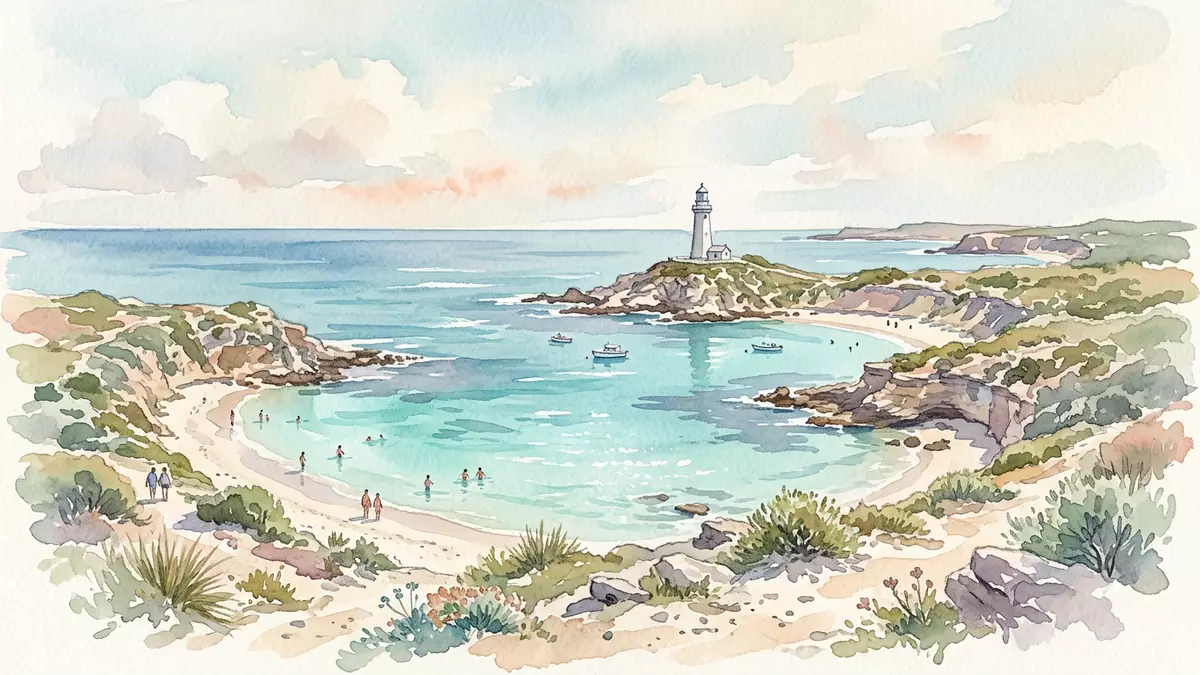
Rottnest Island, known to the Whadjuk Noongar people as Wadjemup, is a low limestone island sitting off the coast of Perth in Western Australia, shaped by beaches, salt lakes and coastal scrub. A short way across the Indian Ocean from Fremantle, this Class A nature reserve is best known for its relaxed holiday settlement and the small marsupial quokka, yet the ground beneath the sand and cottages carries traces of Aboriginal presence and of a long period as a prison island.
Limestone, salt lakes and an island shaped by the sea
Rottnest Island lies in the Indian Ocean off Western Australia, around 19 km (12 mi) from the port city of Fremantle and visible from the mainland on clear days as a low strip on the horizon.lying 19 km offshore The island’s core is coastal limestone, a fragment of the continental shelf that remained above sea level when rising seas separated it from the mainland roughly 7,000 years ago, leaving a platform with sand dunes and a chain of shallow lakes in its interior.a coastal limestone fragment with dunes and salt lakes
The plan of the island runs roughly along an east–west axis: a settlement area and sheltered bay on the eastern side, more exposed bays and reefs towards the west, and a spine of low rises between them.an 11 km-long island with an eastern settlement Inland, the salt lakes sit in shallow depressions where seawater and groundwater have left mineral crusts, contrasting with the surrounding scrub and low woodland. Walking across the island, the ground shifts between firm sandy tracks, sections of exposed limestone and boardwalks near fragile lake edges, with distant views of the Indian Ocean and the mainland.
Wadjemup and its layered human history
Long before ferries linked Rottnest Island with Perth, the land now known as Wadjemup formed part of a wider coastal landscape used by Whadjuk Noongar people for cultural purposes, with artefacts in ancient soils indicating occupation tens of thousands of years before it became an island.artefacts dating back between 10,000 and 49,000 years Rising seas around 6,500 to 7,000 years ago cut Wadjemup off from the mainland, turning it into an island across the water rather than a continuous part of the coastal plain.separated from the mainland around 6,500 years ago
European contact came much later. In 1696 Dutch captain Willem de Vlamingh anchored off the northern shore and, seeing small animals among the scrub, mistook the quokkas for large rats; he named the place “t Eylandt ’t Rottenest”, Rats’ Nest Island, a name that evolved into Rottnest Island.Willem de Vlamingh’s 1696 naming of Rottenest After the foundation of the Swan River Colony in 1829, colonial authorities used Wadjemup as a place of incarceration. From 1838 Aboriginal men and boys from across Western Australia were transported to a prison established on the island, and over the decades that followed several thousand Aboriginal prisoners were held there under harsh conditions, with many buried in what is now known as the Wadjemup Aboriginal Burial Ground.Aboriginal prison on Wadjemup from 1838 to 1904
Quokkas, beaches and a car-free holiday reserve
The Rottnest Island seen from a ferry today is both a resort landscape and a nature reserve. The island is listed as a Class A reserve, a designation in Western Australian law that offers strong protection for its environment and restricts uses that would alter its character.a car-free Class A reserve Private cars are not part of the everyday scene on Wadjemup; visitors move around by foot, bicycle, shuttle bus or organised transport, sharing roads with service vehicles rather than general traffic.movement by foot, bicycle and shuttle
Rottnest’s shoreline is broken into bays and coves with sandy beaches backed by low dunes and coastal vegetation. Offshore, reefs and submerged limestone ledges shape the surrounding waters, creating shallower, calmer areas near shore and more exposed sections where surf reaches the outer edge of the island.a protected nature reserve with beaches and marine life Among the scrub and near the settlement areas, the quokka is a familiar sight. This small wallaby-like marsupial, endemic to south-western Australia, has a strong association with Rottnest Island, where its relaxed behaviour and facial features make it especially noticeable along paths and near accommodation.
Visiting Rottnest Island: what travellers from Western Europe should know
- Rottnest Island lies offshore in the Indian Ocean, west of Fremantle and Perth in Western Australia, and is reached by ferries and small aircraft that cross the coastal waters.
- Getting around the island involves walking for stretches over firm sandy tracks and paved roads, cycling on undulating terrain, and using buses or shuttles on roads that carry limited vehicle traffic.
- The island sits at low elevation above sea level, with gentle rises rather than steep mountains, but some paths and stairways climb dunes or rocky ground and involve short, sustained gradients.
- Rottnest Island is part of Australia; the official language is English and the currency is the Australian dollar.
- Entry requirements depend on your nationality; UK travellers can check the FCDO travel advice at gov.uk/foreign-travel-advice, Irish travellers the Department of Foreign Affairs at ireland.ie.
Searching for Rottnest Island on social platforms
These links open searches for Rottnest Island on each platform.
Frequently asked questions about Rottnest Island
Where is Rottnest Island in relation to Perth?
Rottnest Island lies off the coast of Western Australia in the Indian Ocean, around 19 km from Fremantle and across the water from the metropolitan area of Perth.
What can visitors expect on a visit to Rottnest Island?
Visitors encounter a car-free island with beaches, bays, salt lakes, walking and cycling routes, a compact settlement area and frequent encounters with quokkas in the scrub and near paths.
What makes Rottnest Island distinctive among islands near Perth?
Rottnest Island combines a protected limestone landscape of dunes and lakes with a strong association with the quokka, and a deep Aboriginal and prison history that sits beneath its holiday setting.


