
Rottnest Island’s quokkas, beaches and deep history
Published on 08/28/2026 at 12:30 | Editorial responsibility: Rafael Müller, Editor-in-Chief AD HOC NEWS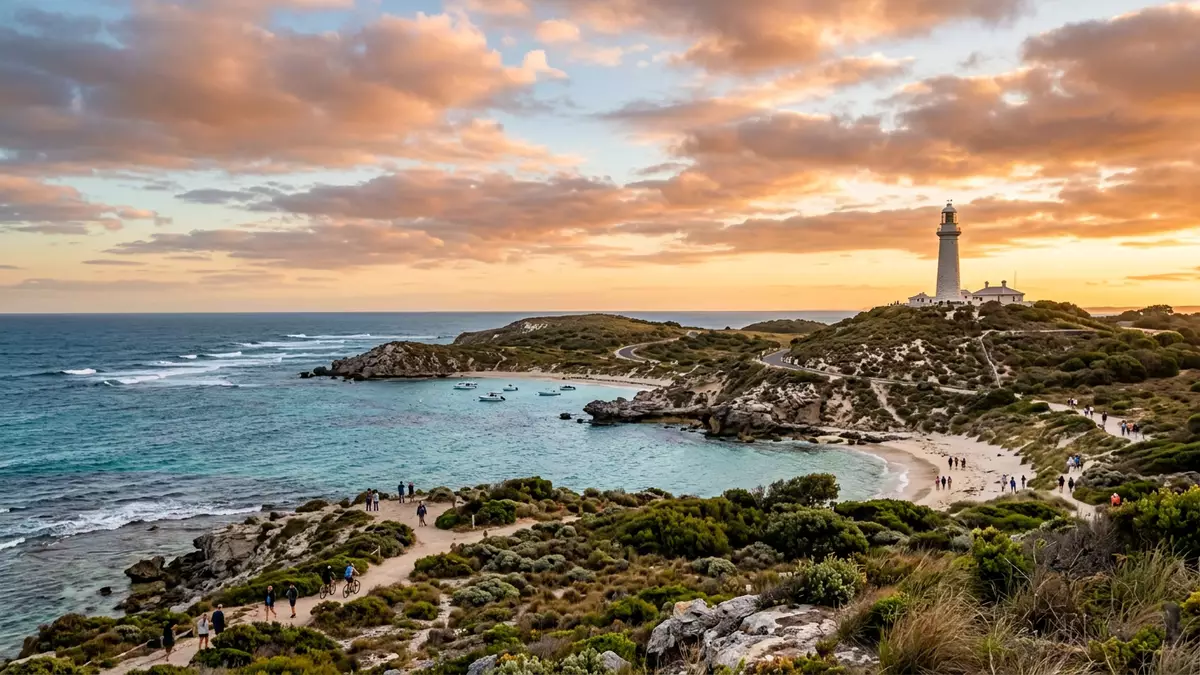
Rottnest Island off the coast of Perth brings three stories together in a compact landscape: the shallow Indian Ocean bays, the quokkas that shaped its Dutch name, and the deep Aboriginal history of Wadjemup in Western Australia. The island lies off Fremantle in the Indian Ocean and covers about 19 square kilometres, with low limestone ground rising only modestly above sea level.
Wadjemup: an island with a much older name
Long before charts used the name Rottnest Island, Whadjuk Noongar people knew this low limestone outcrop as Wadjemup, a term translated as “place across the water where the spirits are”.Whadjuk Noongar people knew this low limestone outcrop as Wadjemup Archaeological work and oral histories indicate that Aboriginal people used this land for cultural purposes when it was still joined to the mainland, before rising sea levels turned it into an island several thousand years ago.Aboriginal people used this land for cultural purposes when it was still joined to the mainland
After the Swan River Colony was founded in 1829, European settlement pushed into these waters, and Wadjemup acquired a second, darker layer of meaning as a prison island for Aboriginal men and boys from across Western Australia.a prison island for Aboriginal men and boys from across Western Australia From 1838 to 1931 thousands of Aboriginal prisoners were incarcerated here in stone buildings near the main bay, and many of them died on the island.From 1838 to 1931 thousands of Aboriginal prisoners were incarcerated here
From “rats’ nest” to quokka encounters
The name Rottnest goes back to a Dutch misreading of the island’s most emblematic animal. In 1696 the Dutch navigator Willem de Vlamingh landed here, saw small, stocky marsupials hopping through the low scrub and thought they were large rats, naming the place “’t Eylandt ’t Rottenest”, or rats’ nest island.Willem de Vlamingh landed here and named the place for its supposed rats The animals were not rodents but quokkas, short-tailed wallabies that still roam the island’s paths and thickets.
Quokkas thrive in the island’s patchwork of coastal scrub, salt lakes and modest woodland, and they move freely through the settlement areas and along the tracks that criss-cross the interior.Quokkas thrive in the island’s patchwork of coastal scrub They share the low dunes and rocky points with other native wildlife, from seabirds along the limestone cliffs to reptiles basking on warm rock in the Australian sun.
Beaches, bays and low limestone high points
Rottnest Island sits roughly 19 km off Fremantle and about 33 km from central Perth, separated from the mainland by a stretch of shallow Indian Ocean water that can look almost translucent on calm days.Rottnest Island sits roughly 19 km off Fremantle and about 33 km from central Perth The land itself is relatively low, with the highest point rising around 45 m above sea level, so the relationship between sky, sea and shore feels intimate and accessible rather than mountainous.the highest point rising around 45 m above sea level
The island measures about 11 km in length and 4.5 km at its widest point, making it small enough to cross in a single outing but large enough for its bays and headlands to feel distinct from one another.The island measures about 11 km in length and 4.5 km at its widest point White-sand beaches alternate with rocky coves, and inland salt lakes occupy shallow basins behind the dunes, giving the island a layered profile when viewed from the walking and cycling tracks that run between the main settlement and the far western points.
Visiting Rottnest Island: what travellers from Western Europe should know
- Rottnest Island lies off the coast of Western Australia west of Perth, reached across the Indian Ocean from Fremantle and other coastal points by passenger ferries or private vessels.
- The terrain is low and gently undulating, with limestone ground, sandy tracks and paved paths, and distances between the main settlement and outer bays that favour walking or cycling.
- The island’s inland is dotted with shallow salt lakes, and coastal paths cross open ground with little shade, so exposed stretches alternate with more sheltered pockets of vegetation.
- The official language is English and the currency is the Australian dollar. Entry requirements depend on your nationality; UK travellers can check the FCDO travel advice at gov.uk/foreign-travel-advice, Irish travellers the Department of Foreign Affairs at ireland.ie.
Searching for Rottnest Island on social platforms
These links open searches for Rottnest Island on each platform.
Frequently asked questions about Rottnest Island
Where is Rottnest Island and how large is it?
Rottnest Island lies off the coast of Western Australia near Perth, about 19 km from Fremantle, and measures roughly 11 km by 4.5 km with an area close to 19 square kilometres.
What can visitors expect on a day on Rottnest Island?
Visitors encounter a mix of white-sand beaches, rocky headlands, shallow salt lakes and low shrubland, with quokkas moving freely through the settlement and along walking or cycling routes.
What makes Rottnest Island distinctive compared with other offshore islands?
The combination of its quokka population, the Whadjuk Noongar heritage of Wadjemup and the extensive history as an Aboriginal prison gives Rottnest Island an unusually layered character for such a small landmass.


