
Roman Baths and the springs beneath Bath
Published on 08/31/2026 at 07:05 | Editorial responsibility: Rafael Müller, Editor-in-Chief AD HOC NEWS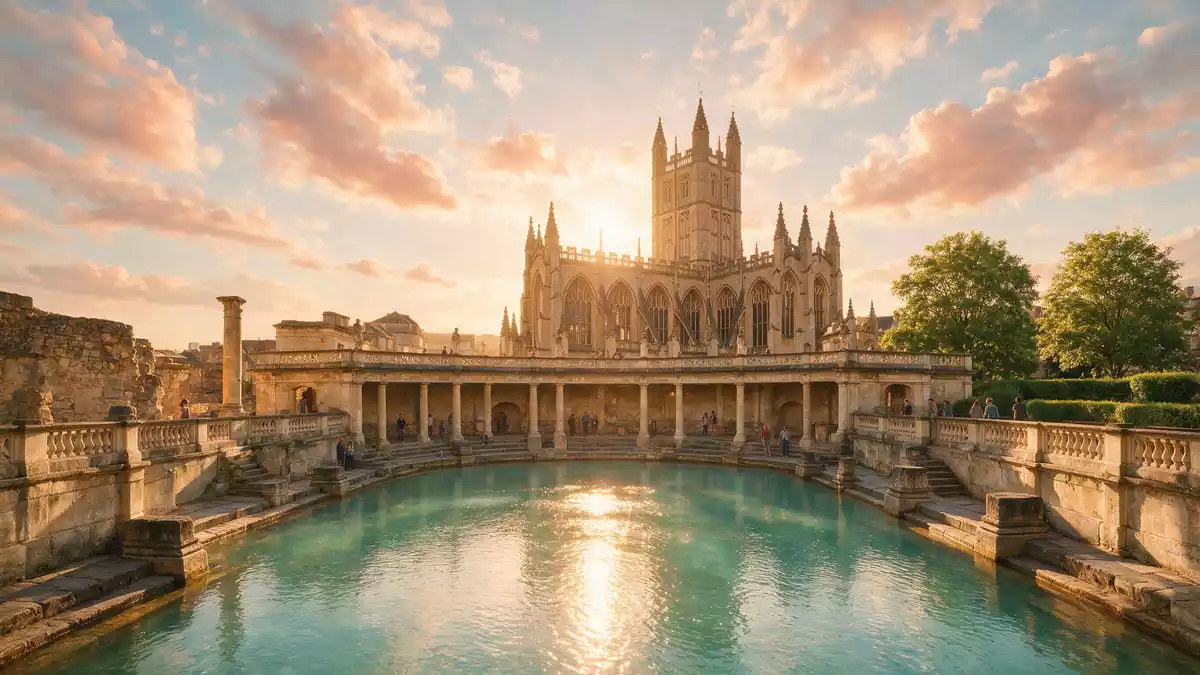
Roman Baths in Bath brings together Roman masonry, a sacred spring complex and later Georgian additions in one of the city’s most layered landmarks. The Roman core dates to around 70 CE, and the wider setting belongs to Bath’s UNESCO-listed historic city.
Roman masonry around the hot springs
The surviving complex centres on the Great Bath, the Temple precinct and the spring-fed waters that made Aquae Sulis a Roman settlement. The site combines stone, lead and arches with later visitor routes, so the building remains legible as both ruin and monument.
Bath’s Roman remains sit within a city known for its hot springs, and the Roman Baths are the most direct encounter with that origin. The open water, colonnaded edges and carved details create a setting that is as archaeological as it is architectural.
A Roman site in a Georgian city
The Roman remains beneath Bath were exposed and studied over centuries, while the surrounding city developed a strong Georgian character. John Wood the Elder and John Wood the Younger helped shape that later Bath, which gives the Roman Baths an unusual relationship with the streets around them.
The contrast is visible in the fabric itself: Roman stonework and temple remains sit below a city of ordered classical facades. That combination makes the place read as a continuous urban palimpsest rather than a detached ruin.
What survives from Aquae Sulis
The Roman Baths belong to Aquae Sulis, the Roman name for Bath, and the temple complex was linked to the goddess Sulis Minerva. The site’s formal significance comes from that religious and bathing function, which remains clear in the surviving layout.
Later centuries did not erase the Roman plan. Instead, the baths preserve walls, channels and ceremonial space that point back to the city’s Roman foundations.
Visiting Roman Baths: what travellers from Western Europe should know
- The Roman Baths stand in central Bath, close to the Abbey Churchyard and the city centre streets that frame the historic core.
- The site includes steps, uneven surfaces and narrow passages in places, with routes that move between archaeology below ground and open courtyards above.
- Bath is the English name for the city, and the official language is English.
- The currency is the pound sterling.
Searching for Roman Baths on social platforms
These links open searches for Roman Baths on each platform.
Frequently asked questions about Roman Baths
Where are Roman Baths?
Roman Baths are in Bath, England, in the historic centre near the Abbey Churchyard. The complex sits within the city’s Roman and Georgian heart.
What will a visit show?
Visitors encounter Roman stonework, spring water, temple remains and later layers of Bath’s built history. The place reads as an archaeological site rather than a reconstructed set piece.
What makes Roman Baths distinctive?
The site combines a Roman bathing complex with the sacred spring of Aquae Sulis and the later city built around it. That mix of water, ruins and urban setting defines the place.


