
Robben Island, the prison island turned memorial off Kapstadt
Published on 09/12/2026 at 18:38 | Editorial responsibility: Rafael Müller, Editor-in-Chief AD HOC NEWS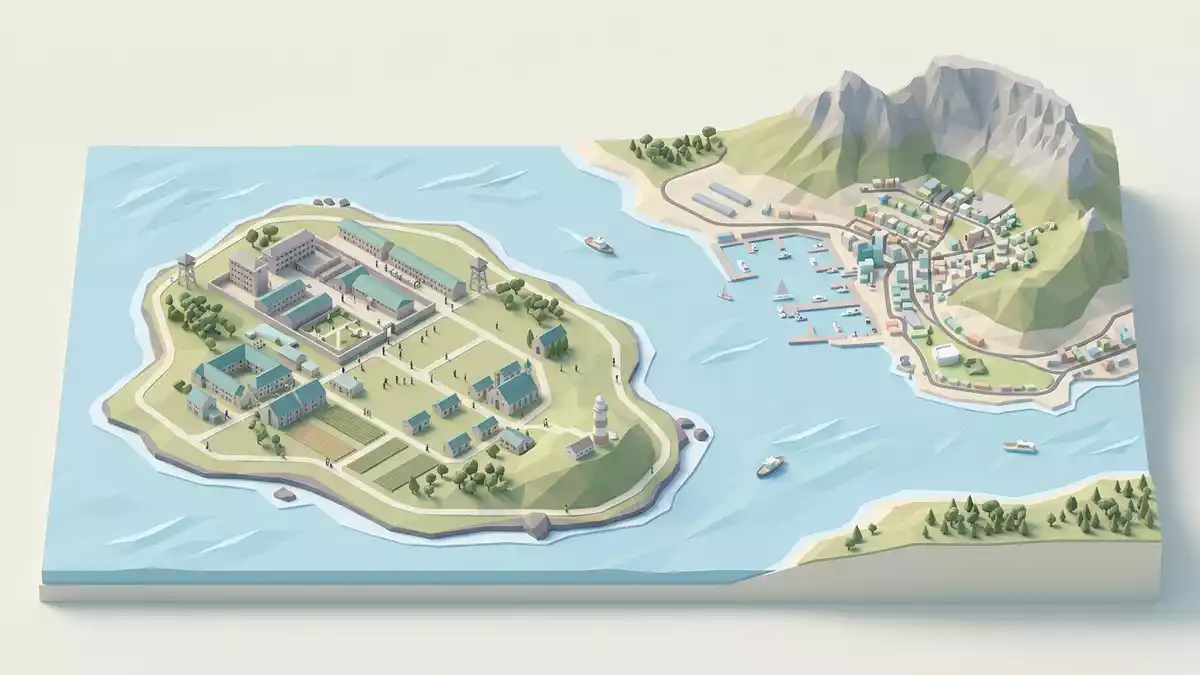
Off the coast of Kapstadt in South Africa, Robben Island rises only a few metres above the Atlantic, yet its low profile carries centuries of confinement, resistance and remembrance. The former maximum?security prison where Nelson Mandela and other anti?apartheid leaders were held now anchors a museum and heritage landscape that preserves the material traces of South Africa’s struggle for democracy.
An island of confinement in Table Bay
Robben Island lies in Table Bay in the Atlantic Ocean, several kilometres offshore from Cape Town’s city centre and the mainland coast of the Western Cape Province.Robben Island is an island in the Atlantic Ocean in Table Bay Its Dutch name refers to the seals that once gathered on its shores, a reminder that this was first a maritime landmark, visited by Portuguese and other European navigators in the fifteenth and sixteenth centuries.Its name is the Dutch word for seals
From the seventeenth century onwards, colonial authorities under the Dutch East India Company and later the British Crown used the island as a place of banishment and imprisonment, isolating people from the Cape mainland behind sea and surf.Robben Island has been used as prison and a place where people were isolated, banished and exiled Over time it also housed a leper colony and a hospital for patients judged difficult to accommodate in the city, as well as fortifications and military installations during the twentieth century.The island housed a leper colony from 1846 to 1931
Maximum?security prison of the apartheid era
Robben Island’s most widely recognised chapter belongs to the apartheid decades, when the South African government operated a maximum?security prison for political opponents on the island.From 1961 Robben Island was used as a prison for political prisoners and convicted criminals Nelson Mandela, later President of South Africa, spent 18 years of his 27?year incarceration here, together with many leaders of the African National Congress and other movements who were convicted under apartheid legislation.Most inmates including Nelson Mandela were black men incarcerated for political offences
The prison complex on Robben Island retains long cell blocks, guard towers, work yards and service buildings that make the regime of control visible in concrete, stone and fencing.Its buildings in particular those of the late twentieth century maximum security prison testify Medium?security facilities for criminal prisoners continued to operate after political detainees were released, with the last inmates leaving in 1996.The island continued to serve as a medium security prison for criminal offenders until 1996 Walking through the compound today, the physical separation of cells, yards and administrative areas shows how the island functioned as a self?contained carceral settlement at the edge of the city.
From prison complex to museum and World Heritage Site
After the closure of the prison in the 1990s, Robben Island was designated a museum, with the Robben Island Museum established in 1997 to conserve the site’s buildings and landscapes.Robben Island Museum was established in 1997 The island’s status as a place of banishment, a hospital for socially marginalised people and a military base across several centuries led to its inscription on the UNESCO World Heritage List in 1999, recognising its historical significance for South Africa and the wider world.Inscribed as a UNESCO World Heritage Site in 1999
Visitors encounter preserved prison buildings, a lighthouse dating from the nineteenth century and remains of medical and military structures set within the island’s low, wind?exposed terrain.A lighthouse was installed in 1864 The setting combines views back to Table Mountain and the skyline of Kapstadt with the confinement architecture that once cut people off from that mainland landscape, creating a stark contrast between the openness of sea and sky and the controlled spaces of the former prison. Together, the surviving structures and the island topography form a cultural landscape that records how democracy in South Africa emerged from within systems of exclusion.
Visiting Robben Island: what travellers from Western Europe should know
- Robben Island lies in Table Bay off Kapstadt in South Africa, across the water from the central city and the northern suburbs of the Western Cape.
- The island’s terrain is low and exposed, with paved areas around the former prison complex and unshaded stretches where wind and Atlantic weather are direct factors.
- Robben Island is reached across the bay by scheduled boat services from the harbour district of Cape Town, linking the mainland with jetties on the island.
- The official language is Afrikaans and the currency is the South African rand.
- Entry requirements depend on your nationality; UK travellers can check the FCDO travel advice at gov.uk/foreign-travel-advice, Irish travellers the Department of Foreign Affairs at ireland.ie.
Searching for Robben Island on social platforms
These links open searches for Robben Island on each platform.Frequently asked questions about Robben Island
Where is Robben Island in relation to Kapstadt?
Robben Island lies in Table Bay off the coast of Kapstadt in South Africa, several kilometres north of the central city and the main harbour.
What should visitors expect when exploring Robben Island?
Visitors encounter preserved prison buildings, open yards, service structures, a lighthouse and low coastal terrain set against Atlantic views towards Table Mountain.
What makes Robben Island distinctive among historical sites?
Robben Island combines a long history of banishment and medical isolation with its role as an apartheid?era maximum?security prison, now conserved as a museum and UNESCO World Heritage Site.


