
Robben Island: an island of stone, sea and memory
Published on 09/18/2026 at 08:19 | Editorial responsibility: Rafael Müller, Editor-in-Chief AD HOC NEWS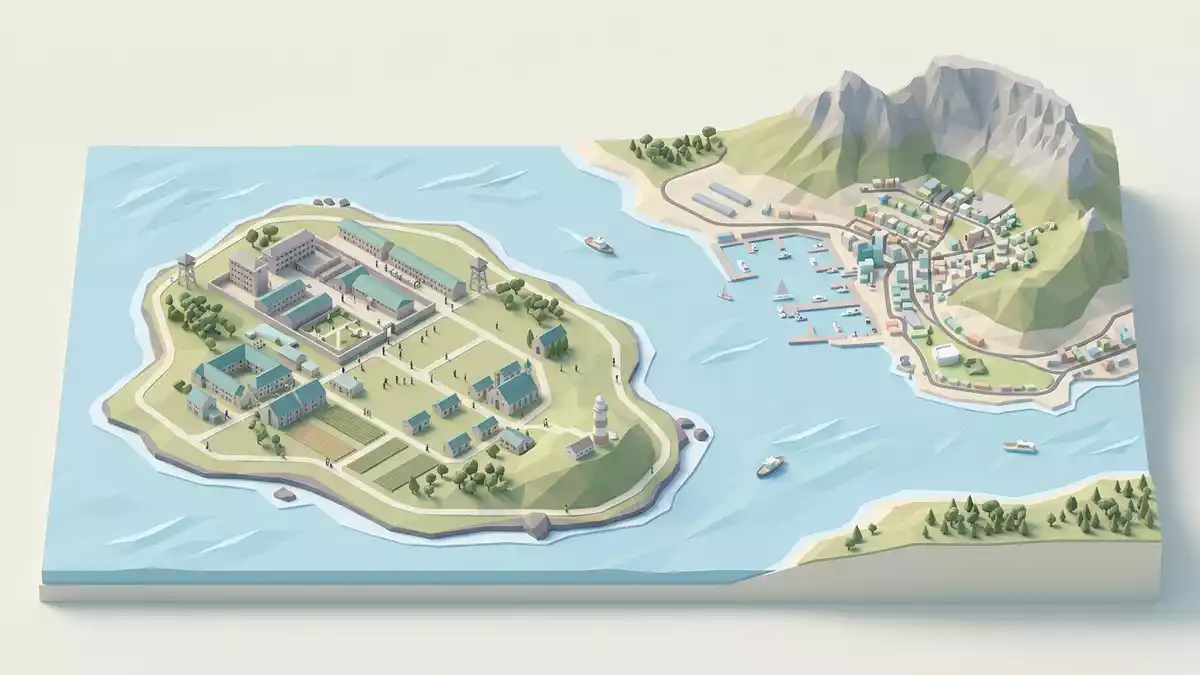
Robben Island off the coast of Kapstadt in South Africa is a low, wind?exposed island where flat rock, thin scrub and prison buildings share the same hard light. It sits in Table Bay, close enough to the mainland for the skyline of Kapstadt and the line of Table Mountain to be visible across the water, yet separated by a stretch of open sea that has long been used as a barrier.
An island shaped by rock and sea
Robben Island lies in the Atlantic Ocean within Table Bay, a short distance north of Kapstadt’s city centre and west of the suburb of Bloubergstrand. The island is roughly oval in plan, with its long axis running north to south and its shorter axis east to west, giving it a compact outline surrounded by shallow reefs and restless surf.Robben Island is described as roughly oval Its surface is largely flat and lies only a few metres above sea level, the result of ancient erosion that levelled the bedrock into a broad, wave?washed platform.The island’s low elevation and flat terrain
The name Robben Island derives from the Dutch and Afrikaans word for seals, a reminder that it is surrounded by cold, nutrient?rich waters where marine life gathers along the rocky shore.The origin of the island’s name in Dutch The coastline is a mix of low cliffs and boulder?strewn beaches, with views back to the high wall of Table Mountain and the broader Cape Peninsula. A lighthouse installed in the nineteenth century rises above this flat landscape, one of the few vertical markers visible from far out in Table Bay.The lighthouse dating from 1864 on the island
Centuries of isolation and confinement
Written records of Robben Island go back to the fifteenth century, when passing ships in the era of early European exploration used it as a stopping place on the approach to the Cape of Good Hope.Early documented history from the fifteenth century In the seventeenth century, under Dutch colonial rule, the island began to be used deliberately as a place of exile and imprisonment, exploiting its isolation within sight of the mainland.Use as a place of exile from the seventeenth century Over time it became a penal colony for those the authorities wished to keep at a distance from Cape society.
During the nineteenth century Robben Island housed a leper colony and institutions for people judged insane, turning its sparse terrain into a landscape of wards and treatment buildings that still leave traces in the ground plan.Use as leper colony and asylum in the nineteenth century Fortifications were later erected during the Second World War, and in the second half of the twentieth century the island became one of South Africa’s maximum?security prisons. From the mid?1960s until 1991 it held many political prisoners, including Nelson Mandela, who spent 18 years of his 27?year imprisonment there, along with other leading figures of movements opposing apartheid.Robben Island’s role as maximum?security prison and Mandela’s imprisonment
From prison complex to World Heritage landscape
After the last political prisoners left Robben Island in 1991, the prison continued for some years as a medium?security facility for criminal offenders until its closure in 1996.Closure of the prison in the 1990s In 1997 the island was turned into a museum and declared a national monument, marking a shift from active incarceration to remembrance and public history.Creation of the museum and national monument status in 1997 Two years later, in 1999, Robben Island was inscribed as a UNESCO World Heritage Site, recognising both the physical remains of the prison complex and the wider story of democracy and freedom emerging from oppression.
The buildings that dominate the island’s central area largely date from the late twentieth century maximum?security prison. They include cell blocks, exercise yards and service structures arranged along internal roads, with watchtowers and security fences marking the boundaries of different zones.UNESCO description of the prison buildings Elsewhere on the island, earlier churches, hospital buildings and wartime military installations stand among open ground and low vegetation, giving visitors an overview of several centuries of institutional use in a single, compact landscape.Structures representing continuous occupation from the seventeenth century
Visiting Robben Island: what travellers from Western Europe should know
- Robben Island lies in Table Bay off Kapstadt and is reached across the water from the city’s waterfront area, with the route giving broad views of the bay and the Cape Peninsula.
- The terrain on the island itself is largely flat but has extensive paved and gravel surfaces, with walking between buildings on level ground and some routes passing exposed coastal areas.
- The official language is Afrikaans and the currency is the South African rand. Entry requirements depend on your nationality; UK travellers can check the FCDO travel advice at gov.uk/foreign-travel-advice, Irish travellers the Department of Foreign Affairs at ireland.ie.
Searching for Robben Island on social platforms
These links open searches for Robben Island on each platform.
Frequently asked questions about Robben Island
Where is Robben Island in relation to Kapstadt?
Robben Island is an island in Table Bay off the Western Cape coast, roughly north of central Kapstadt and west of the suburb of Bloubergstrand.
What can visitors expect to see on Robben Island?
Visitors encounter a largely flat island landscape with prison buildings, earlier hospital and military structures, a nineteenth?century lighthouse and expansive views back to Kapstadt and Table Mountain.
What makes Robben Island distinctive among historic sites?
Robben Island combines stark coastal geology with centuries of institutional use, culminating in its role as a maximum?security prison for political prisoners such as Nelson Mandela and its recognition as a UNESCO World Heritage Site.


