
Robben Island: a flat island with a long shadow over Kapstadt
Published on 09/08/2026 at 13:58 | Editorial responsibility: Rafael Müller, Editor-in-Chief AD HOC NEWS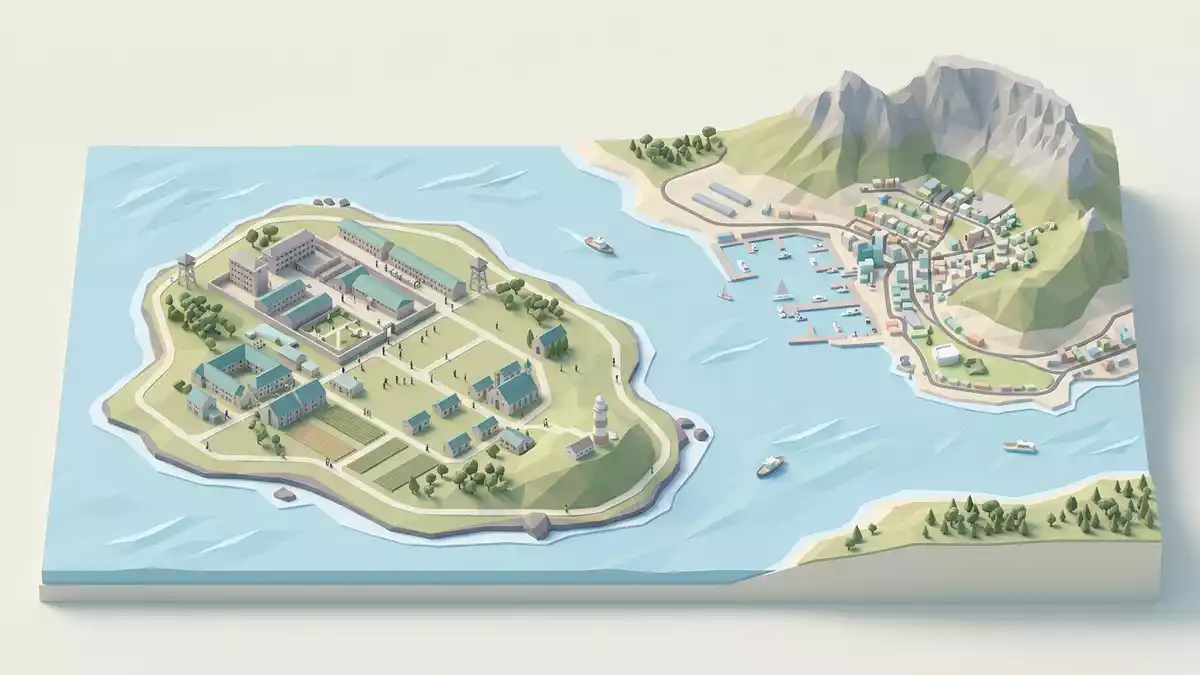
Robben Island is a low, windswept island in Table Bay, lying off Kapstadt, where a seemingly modest landscape carries a dense record of South Africa’s colonial and apartheid history. The island was used for confinement and isolation for centuries, and its former maximum?security prison has become a museum and UNESCO World Heritage Site that keeps the story of political imprisonment and resistance present in the bay.
An island of confinement within sight of Table Mountain
Robben Island sits off the coast of Cape Town in South Africa, in clear view across Table Bay from the city and the slopes of Table Mountain. The island lies roughly several kilometres from the mainland and covers about 13 square kilometres (5 square miles), forming a flattened, largely treeless platform surrounded by cold Atlantic water.about 13 square kilometres The Dutch name “Robben”, referring to seals, recalls the animals that once gathered on its rocky shorelines.the Dutch word for seals
From the sixteenth century, passing ships on the route around the Cape used Robben Island as a stopover, drawing fresh water and meat while remaining offshore from the Cape peninsula. With the establishment of a Dutch settlement under Jan van Riebeeck in the seventeenth century, the island’s isolation led it to be used as a place of banishment, first for criminals and later for political prisoners from across the Dutch East Indies and the Cape.a place of banishment The result is a landscape where natural features and simple buildings are closely tied to enforced separation from the mainland city visible on the horizon.
From leper colony and hospital to military base
Robben Island’s flat ground and separation from the mainland made it a site for isolation far beyond penal use. In the nineteenth century the island became a leper colony, with patients moved there in growing numbers after the Leprosy Repression Act of the 1880s; those judged chronically or mentally ill were also sent across the bay.a leper colony in the nineteenth century Robben Island functioned as a medical settlement until the early 1930s, and the remains of wards and service buildings contribute to the layered character of the site.
With the approach of the Second World War, the island took on a new role as a military base guarding the approaches to Cape Town. Artillery batteries, fortifications and an airstrip were constructed on the island, reflecting its strategic position at the mouth of Table Bay.artillery batteries and fortifications These concrete structures and gun emplacements, still visible alongside institutional buildings, add a further layer to the physical landscape, marking Robben Island as a place where colonial, medical and military histories intersect on a compact piece of land.
Maximum?security prison and post?apartheid museum
In the second half of the twentieth century Robben Island became synonymous with political imprisonment under South Africa’s apartheid regime. From the early 1960s it housed a maximum?security prison where many anti?apartheid activists were held, including Nelson Mandela, who spent 18 of his 27 years of incarceration on the island before becoming South Africa’s first democratically elected president.18 years of imprisonment Other future leaders of the African National Congress, among them Jacob Zuma and Kgalema Motlanthe, were also imprisoned here, and the prison held activists from movements including the Pan Africanist Congress and SWAPO.activists from several movements
The last political prisoners were released in the early 1990s, and the prison complex finally closed in 1996.the prison closed in 1996 Robben Island was subsequently declared a national monument and opened to visitors as a museum, with former inmates among the guides leading tours through cell blocks and around the island. In 1999 UNESCO inscribed Robben Island as a cultural World Heritage Site, recognising the prison buildings and landscape as evidence of a sombre history of oppression and as symbols of the struggle for freedom and democracy.UNESCO inscription in 1999 The preserved prison wing, quarry and harbour together form a setting in which visitors encounter the material traces of apartheid?era incarceration against the backdrop of Cape Town’s skyline.
Visiting Robben Island: what travellers from Western Europe should know
- Robben Island lies in Table Bay off Cape Town, reached by boat from the V&A Waterfront harbour area; organised crossings use vessels suited to ocean conditions.
- The island’s interior is mostly flat, but visits involve walking on paved roads and paths between the harbour, prison buildings and quarry, with some sections exposed to strong wind and weather.
- Robben Island forms part of South Africa, where the official currency is the South African rand and the official languages include Afrikaans, English and several indigenous languages.
- Entry requirements depend on your nationality; UK travellers can check the FCDO travel advice at gov.uk/foreign-travel-advice, Irish travellers the Department of Foreign Affairs at ireland.ie.
Searching for Robben Island on social platforms
These links open searches for Robben Island on each platform.
Frequently asked questions about Robben Island
Where is Robben Island and how does it relate to Kapstadt?
Robben Island lies in Table Bay off Cape Town in South Africa, within sight of the city’s waterfront and Table Mountain, and is reached by boat from the harbour.
What should visitors expect when touring Robben Island?
Visitors travel by sea to a low, open island, then explore former prison buildings, roads and quarries on foot, with guided explanations of political imprisonment and the island’s wider history.
What makes Robben Island distinctive among historical sites?
The close combination of flat island landscape, layered roles as leper colony, military base and maximum?security prison, and its association with Nelson Mandela and other anti?apartheid leaders gives Robben Island a singular place in South African history.


