
Rio Celeste in Upala, Costa Rica and its sky-blue volcanic river
Published on 08/29/2026 at 06:24 | Editorial responsibility: Rafael Müller, Editor-in-Chief AD HOC NEWS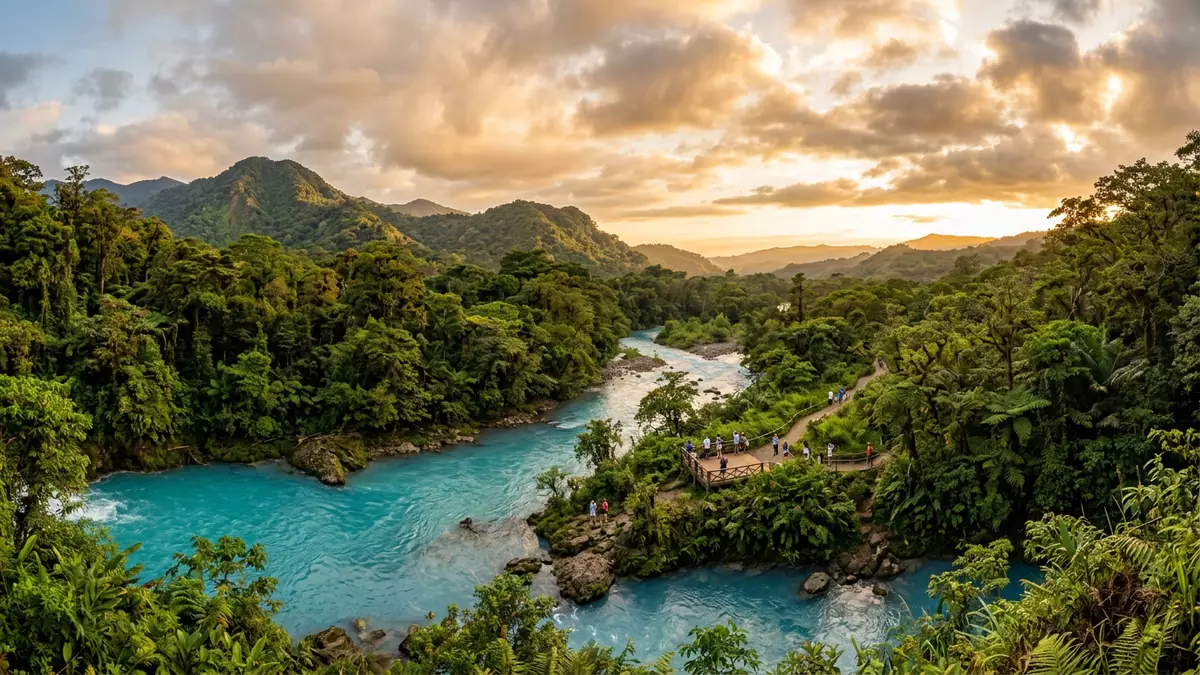
In the northern plains of Costa Rica, Rio Celeste in the Upala region is a river that appears to have been coloured with pigment, its water turning a vivid sky-blue as it winds through the forested slopes of Tenorio Volcano National Park.
The sky-blue river of Tenorio Volcano
Rio Celeste is a natural watercourse inside Tenorio Volcano National Park in northern Costa Rica, within the canton of Upala in the broader Alajuela and Guanacaste area.Celeste River The river runs through dense tropical rainforest on the flanks of the Tenorio volcanic complex, in a landscape of steep hills, humid valleys and thick vegetation. Travellers encounter it as a sequence of river bends, pools and cascades, including a waterfall where the blue water plunges into a basin surrounded by forested slopes.Rio Celeste inside Tenorio Volcano National Park
The name itself translates as “sky-blue river” in Spanish, and that description matches what visitors see when they reach the main viewpoints along the trail inside the park.sky-blue river inside the national park The river flows over a bed of volcanic rocks and sediments, and in many stretches the water appears opaque turquoise rather than clear. The surrounding forest is part of a protected area that covers the Tenorio volcano and neighbouring peaks, giving Rio Celeste a setting of conservation land where primary and secondary rainforest, streams and hot springs share the same protected basin.Tenorio Volcano National Park
Where the colour begins at Los Teñideros
One of the most distinctive features of Rio Celeste is that its blue colour starts at a specific point rather than along its entire length. Upstream, two colourless rivers flow through the forest: Río Buenavista and Quebrada Agria, both draining the volcanic highlands. At a confluence known locally as Los Teñideros, meaning “the dyers” or “dye point”, these two streams meet and their clear waters suddenly form the strikingly turquoise Rio Celeste.Los Teñideros confluence Standing above this junction, visitors see the transition line in the water where the colour appears.
Scientific work involving Costa Rican universities and park authorities has examined why the river changes appearance at this point. Researchers describe how colloidal aluminosilicate particles suspended in the water aggregate when the acidic Quebrada Agria mixes with the more neutral Río Buenavista, and how these particles then scatter sunlight strongly in the blue range, making the flowing water look turquoise to the human eye.optical phenomenon at the riverbed The effect is comparable to the way suspended mineral particles give certain glacial lakes or volcanic pools a milky blue colour, though here it is tied specifically to the chemistry and geology of the Tenorio volcano catchment.explanations of Rio Celeste’s colour
Trails, waterfall views and rainforest terrain
Access to Rio Celeste for visitors is organised through trailheads within Tenorio Volcano National Park, reached by road from nearby communities such as Bijagua in the Upala region.park access from Bijagua Inside the park, paths lead through humid forest towards river viewpoints, including platforms overlooking the main waterfall and sections where the blue water can be seen flowing over rocky steps. The terrain combines maintained trails with stretches of natural ground that can be muddy, and visitors encounter roots, rocks and staircases along the way.forest trails to the waterfall
Along the route, the protected rainforest around Rio Celeste contains a mix of broadleaf trees, undergrowth and epiphytes suited to a warm, wet climate, with the river cutting through ravines and gentler valleys. Views of the river often appear between thick foliage, where the intense blue stands out against shades of green on the banks and surrounding canopy. The area forms part of a volcanic landscape where streams, fumaroles and hot springs occur in different sectors of the park, although the main visitor focus in the Upala area is the river itself and the waterfall that drops into its basin.
Visiting Rio Celeste: what travellers from Western Europe should know
- Rio Celeste flows inside Tenorio Volcano National Park in northern Costa Rica, in the canton of Upala, reached by road from towns such as Bijagua.
- Paths to the river and waterfall viewpoints follow forest trails with exposed roots, rocks and staircases, so walking requires sure footing and suitable footwear.
- The surrounding terrain is humid tropical rainforest on volcanic slopes, and river viewpoints lie in a protected area where trails pass close to steep drops and flowing water.
- For travellers from Western Europe, the nearest major gateways are international airports around San José and Liberia, from which overland routes connect towards Upala and Bijagua.
- The official language is Spanish and the currency is the Costa Rican colón.
Searching for Rio Celeste on social platforms
These links open searches for Rio Celeste on each platform.
Frequently asked questions about Rio Celeste
Where is Rio Celeste located?
Rio Celeste is a river inside Tenorio Volcano National Park in northern Costa Rica, within the canton of Upala and accessible from nearby towns such as Bijagua.
What can visitors expect on a visit to Rio Celeste?
Visitors walk along forest trails inside the national park to viewpoints over a sky-blue river and its waterfall, crossing humid rainforest terrain with roots, rocks and staircases.
What makes Rio Celeste distinctive compared with other rivers?
Rio Celeste stands out for the way two clear streams meet at Los Teñideros and instantly form a vividly turquoise river due to suspended volcanic minerals scattering sunlight.


