
Ribeira, Porto’s layered riverfront quarter
Published on 09/12/2026 at 15:44 | Editorial responsibility: Rafael Müller, Editor-in-Chief AD HOC NEWS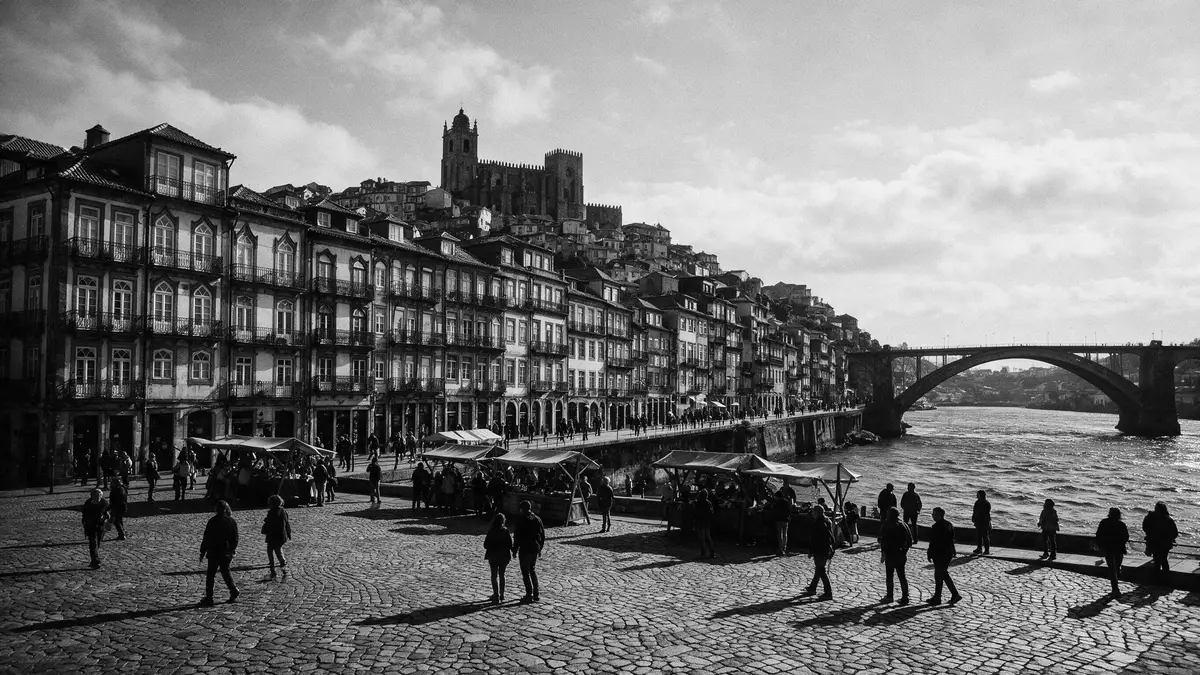
Ribeira is the historic riverside quarter of Porto, a district where tall, narrow houses and cobbled lanes descend in layers towards the Douro River and its quays. Set on the north bank of the river in Portugal’s second-largest city, it forms part of Porto’s historic centre, which was inscribed as a UNESCO World Heritage Site in 1996 for its medieval urban fabric and waterfront setting.Porto's historic centre
Riverside streets leaning down to the Douro
The core of Ribeira lies along the north bank of the Douro River, where the riverfront promenade known as Cais da Ribeira runs in front of a continuous line of historic townhouses.Cais da Ribeira riverside promenade Behind this quay, a tight mesh of streets climbs the hillside, linking the waterfront to the higher ground around Porto Cathedral and São Bento railway station.
Many of the buildings along the riverfront and in the adjoining lanes are tall, narrow houses that stack several floors above small ground-level arcades and doorways. Their façades show a mixture of plaster, exposed stone and ceramic tiles, with balconies facing the river and roofs stepping up the slope. At the centre of the riverfront lies Praça da Ribeira, a historical square that opens directly onto the quays and anchors the district’s relationship with the water.Praça da Ribeira square
Medieval fabric and UNESCO recognition
Ribeira is one of Porto’s oldest neighbourhoods and forms part of the “Historic Centre of Porto, Luiz I Bridge and Monastery of Serra do Pilar”, the ensemble included on the UNESCO World Heritage List.UNESCO World Heritage Site in 1996 This designation reflects a largely intact medieval urban layout in which streets, squares and buildings are organised around the working riverfront. The area around Ribeira retains a pattern of narrow lanes and small plots that date from the period when Porto grew as an Atlantic port and trading centre.
Within this setting, traces of defensive structures still appear above the rooftops. Segments of the fourteenth-century Muralha Fernandina wall, built during the reign of King Fernando I, survive near Ribeira and mark one of the historic limits of the medieval town.Muralha Fernandina defensive wall The juxtaposition of fortified walls, religious buildings such as the cathedral and commercial quays along the river illustrates how closely everyday life and maritime trade were tied to the Douro.
Views across the river and surrounding landmarks
Ribeira occupies the southwestern corner of Porto’s historic centre, running along the river from the area near the Dom Luís I Bridge towards Casa do Infante and the old customs house.Ribeira's riverside slope Standing on the quays, it is possible to see the iron arch of the bridge carrying traffic and pedestrians across the Douro, as well as the hillside of Vila Nova de Gaia on the opposite bank, where traditional wine lodges occupy the slopes.
Behind the riverfront, several streets and small squares link Ribeira to other landmarks of Porto’s centre. The area lies below the hill crowned by Porto Cathedral and within reach of São Bento station, whose hall is lined with large azulejo panels. Nearby stand public buildings such as the Palácio da Bolsa and Casa do Infante, together with the terraces from which wider views over the river and the urban landscape open out.Casa do Infante and river bank
Visiting Ribeira: what travellers from Western Europe should know
- Ribeira occupies the riverside slope on the north bank of the Douro in Porto, west of the Dom Luís I Bridge and opposite Vila Nova de Gaia, within walking distance of São Bento railway station.
- The streets between the upper town and the riverfront are steep and largely paved with cobbles, with staircases and narrow passageways linking different levels.
- The riverfront promenade at Cais da Ribeira runs directly beside the Douro, with open views towards the Dom Luís I Bridge and the hillside of Vila Nova de Gaia.
- The official language is Portuguese and the currency is the euro.
Searching for Ribeira on social platforms
These links open searches for Ribeira on each platform.
Frequently asked questions about Ribeira
Where is Ribeira in Porto?
Ribeira is the riverside quarter on the north bank of the Douro River, forming the southwestern part of Porto’s historic centre and lying below the cathedral hill.
What should visitors expect when walking through Ribeira?
Visitors encounter cobbled streets, tall riverside houses, staircases climbing the slope and the open quays of Cais da Ribeira, with views across to Vila Nova de Gaia.
What makes Ribeira distinctive within Porto?
Ribeira combines a medieval street layout, surviving defensive walls and a working riverfront, all recognised within Porto’s UNESCO-listed historic centre and concentrated along the Douro.


