
Rheinfall and the wide curtain of the High Rhine
Published on 09/10/2026 at 07:57 | Editorial responsibility: Rafael Müller, Editor-in-Chief AD HOC NEWS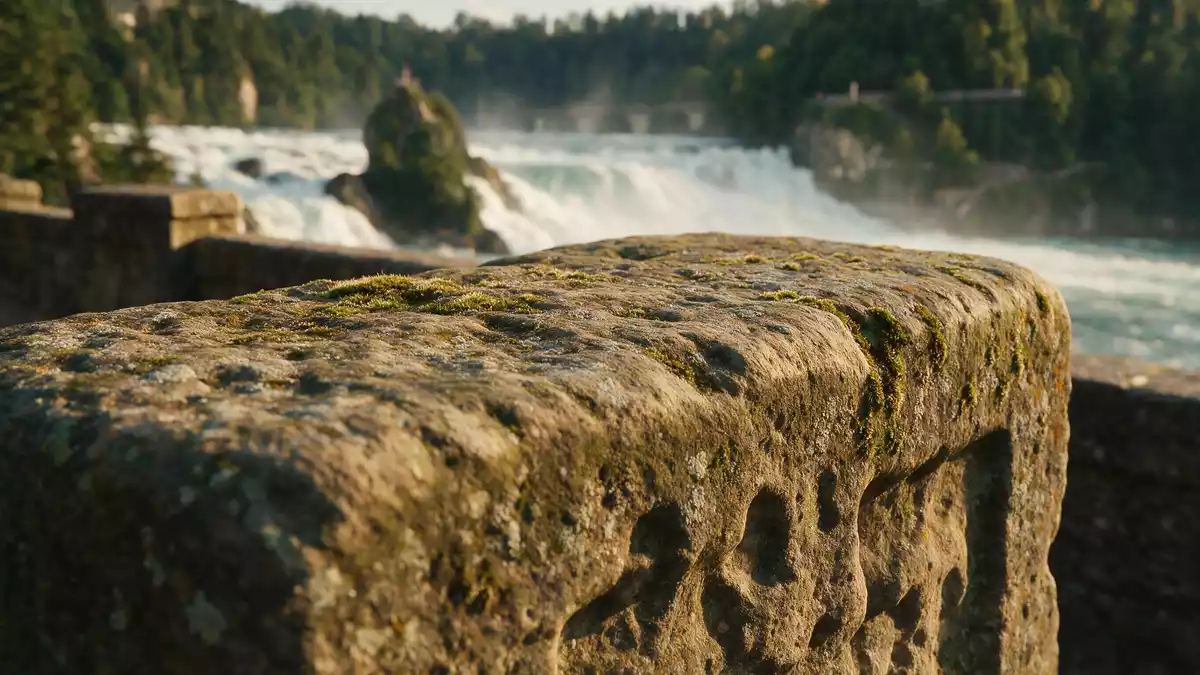
Rheinfall near Neuhausen am Rheinfall in northern Switzerland is where the Rhine River abandons its smooth course and plunges in a broad, compact waterfall across a band of resistant rock. Standing beside the river, the defining impression is scale in width rather than height: the water pours over a relatively low step but stretches right across the channel, turning a short drop into a continuous curtain of water.
The High Rhine forced through a rocky ledge
Rheinfall lies on the High Rhine, the section of the Rhine that runs westward after leaving Lake Constance and before turning north towards Basel. Here the river encounters a harder layer of limestone that forms a ledge, interrupting the flow and creating a single fall where the water tumbles into a lower basin. Over a width of about 150 m (490 ft), the Rhine pours over this rock step in a nearly unbroken front.150 m wide waterfall The drop is about 23 m (75 ft), modest by mountain standards, but the river is broad and deep at this point, so the volume concentrated into that fall makes it one of Europe’s strongest river waterfalls.largest waterfall in Europe
The waterfall sits between two Swiss cantons: Schaffhausen on the right bank and Zurich on the left. The right, northern bank belongs to Neuhausen am Rheinfall in the canton of Schaffhausen, while the left, southern bank lies within Laufen-Uhwiesen in the canton of Zurich.location between Schaffhausen and Zurich Upstream, the town of Schaffhausen lies a short distance along the High Rhine, its riverside quarters facing calmer water that has not yet reached the ledge. Downstream, the river continues in a wider basin, having expended much of its energy in the single dramatic plunge.
Neuhausen am Rheinfall and its riverside viewpoints
Neuhausen am Rheinfall takes its extended name from the waterfall, a reflection of how closely the town’s identity is linked to this short section of river. The municipality, known simply as Neuhausen until 1938, adopted the name Neuhausen am Rheinfall in that year, explicitly tying itself to the falls that form its most prominent natural landmark.renaming in 1938 Streets and vantage points on the northern bank look towards the water as it accelerates towards the ledge, then disappear in spray and foam as the river drops.
The right bank offers promenades and terraces where visitors stand almost level with the upper water surface before it breaks. From these points the width of the falls becomes clear: instead of a single narrow chute, the Rhine spreads in several channels around rock outcrops that rise from the middle of the river. Paths lead along the bank to views of these central rocks, which sit like stranded islands in the falling water; boats cross towards them in the main visiting season, but even from shore their role in splitting the flow is evident.huge volumes of water Looking back towards Neuhausen am Rheinfall, rows of houses and transport lines sit just beyond the immediate river edge, showing how closely the built town approaches the natural spectacle.
Castles, rock and the character of the High Rhine
On the left bank above the waterfall stands Schloss Laufen, a historic castle complex that looks down over the falling Rhine from a rocky spur.views from Laufen Castle Its walls and terraces occupy a vantage point that reveals the full curve of the river as it approaches and then drops over the ledge. From this side, the contrast between the calm upper reach, the turbulent fall and the quieter basin below appears almost as a layered cross-section of the High Rhine’s character.
Geologically, Rheinfall marks a boundary where the river crosses a harder limestone formation that was shaped during the last glacial period.limestone plateau since the last ice age The riverbed upstream lies higher, then steps down as the limestone ledge drops away, forcing the water to descend in a single fall. The rocks that protrude from the centre of the falls, reachable by boat in suitable conditions, are remnants of this formation, resisting erosion more strongly than the surrounding material. Together with the castle and the terraced banks, they give Rheinfall a layered visual composition: human structures perched on the edges, solid rock in the centre, and the river itself thrown into motion between them.
Visiting Rheinfall: what travellers from Western Europe should know
- Rheinfall lies on the High Rhine between Neuhausen am Rheinfall in the canton of Schaffhausen and Laufen-Uhwiesen in the canton of Zurich, south of the town of Schaffhausen.
- The terrain around the waterfall includes riverside promenades, steps down towards viewing platforms and paths that cross bridges or lead through castle grounds above the river.
- Railway stations named Neuhausen Rheinfall and Schloss Laufen am Rheinfall stand close to the banks, providing direct rail access from other parts of northern Switzerland.
- The official language is German and the currency is the Swiss franc.
Searching for Rheinfall on social platforms
These links open searches for Rheinfall on each platform.
Frequently asked questions about Rheinfall
Where is Rheinfall located?
Rheinfall is a waterfall on the High Rhine in northern Switzerland, between Neuhausen am Rheinfall in the canton of Schaffhausen and communities in the canton of Zurich.
What should visitors expect on a visit to Rheinfall?
Visitors encounter a broad river waterfall with promenades, terraces and castle viewpoints on both banks, where the width and force of the falling water dominate the scene.
What makes Rheinfall distinctive among European waterfalls?
Rheinfall combines a relatively low drop with a wide, uninterrupted front across the entire Rhine, producing one of Europe’s most powerful river waterfalls at a single rock ledge.


