
Reserva Nacional de Paracas and its desert coast
Published on 09/10/2026 at 22:49 | Editorial responsibility: Rafael Müller, Editor-in-Chief AD HOC NEWS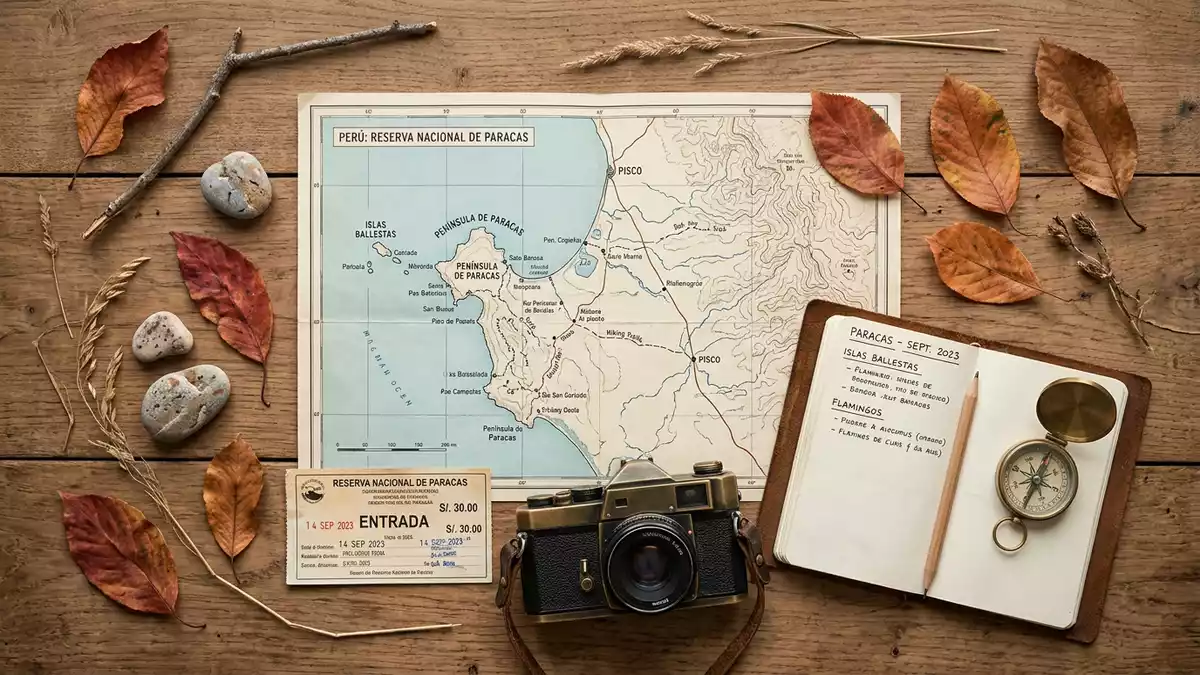
Reserva Nacional de Paracas lies on Peru’s Ica coast near Paracas, where the desert meets bays, rocky shores, sandy beaches and islands. Created on 25 September 1975 by Decreto Supremo N°1281-AG, it covers 335,000 hectares.
Paracas between desert and sea
The reserve’s strongest visual feature is its coast: open desert on one side, marine water on the other, with headlands and low islands between them. That combination gives Reserva Nacional de Paracas its character as a protected coastal landscape rather than a single-viewpoint site. coastal area
Its official purpose includes conserving marine-coastal ecosystems, protecting archaeological and cultural heritage, and supporting responsible use of hydrobiological resources. The reserve also forms part of Ramsar’s list of wetlands of international importance, which places its bays and shallow marine waters in a wider protected framework. created on 25 September 1975
A landscape of bays, beaches and islands
The reserve is not built around a single monument. Its appeal lies in a broad natural composition of bays, sandy stretches, rocky edges and low-lying islands, with open desert pressing close to the shore. The setting is extensive and spare, with the Pacific forming the constant outer edge. bays and islands
Paracas also has a strong cultural layer. The reserve protects archaeological remains associated with the Paracas culture, and the protected area has become tied to that older human presence as well as to the coastal environment itself. Paracas culture
Wildlife and protected ground
Ramsar’s site record describes a habitat that supports birds, fish, reptiles, mammals and marine life across the reserve’s land and water. That biological range is one reason the place reads as a working coastal reserve, not just a scenic shoreline. habitat for birds
The reserve’s dry ground is equally important to its identity. The coastal desert, shallow waters and exposed shoreline sit side by side, and the result is a protected area where land and sea are treated as one connected environment. marine-coastal ecosystems
Visiting Reserva Nacional de Paracas: what travellers from Western Europe should know
- The reserve is in the department of Ica, near the town of Paracas, and access runs through the Santo Domingo checkpoint. From Lima, the Panamericana Sur leads towards the coast. The official language is Spanish and the currency is the Peruvian sol.
- The terrain is open and exposed, with desert ground, coastal tracks and shorelines that cross between land and water. Walking means dealing with sun, wind and uneven surfaces rather than a paved urban route.
- The reserve includes a visitor centre, bird-watching areas, beaches, viewpoints and archaeological sites. Its landscape also includes low islands and broad bays, so a visit can move between desert and sea within one protected area.
- Entry requirements depend on your nationality; UK travellers can check the FCDO travel advice at gov.uk/foreign-travel-advice, Irish travellers the Department of Foreign Affairs at ireland.ie.
Searching for Reserva Nacional de Paracas on social platforms
These links open searches for Reserva Nacional de Paracas on each platform.
Frequently asked questions about Reserva Nacional de Paracas
Where is Reserva Nacional de Paracas?
It is in Peru’s Ica region, near Paracas, and extends across both coastal land and marine waters. The reserve sits in the provinces of Pisco and Ica.
What does a visit involve?
The reserve brings together desert scenery, beaches, bays, viewpoints and archaeological places in one protected coastal setting. Travelling through it means moving across exposed ground between shore and inland desert.
What makes it distinctive?
Reserva Nacional de Paracas combines marine and terrestrial protection in a single reserve. Its mix of desert, shallow water, islands and cultural remains gives it a layered identity.


