Registon: the tiled heart of Samarkand’s Silk Road square
Published on 09/09/2026 at 08:15 | Editorial responsibility: Rafael Müller, Editor-in-Chief AD HOC NEWS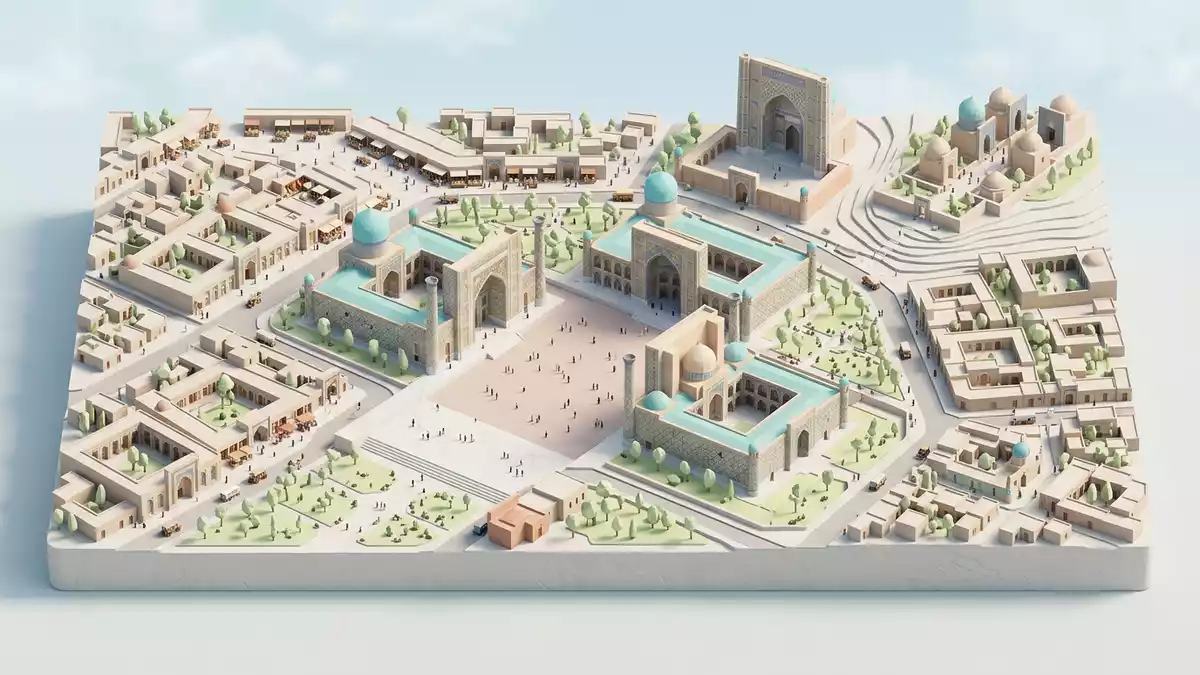
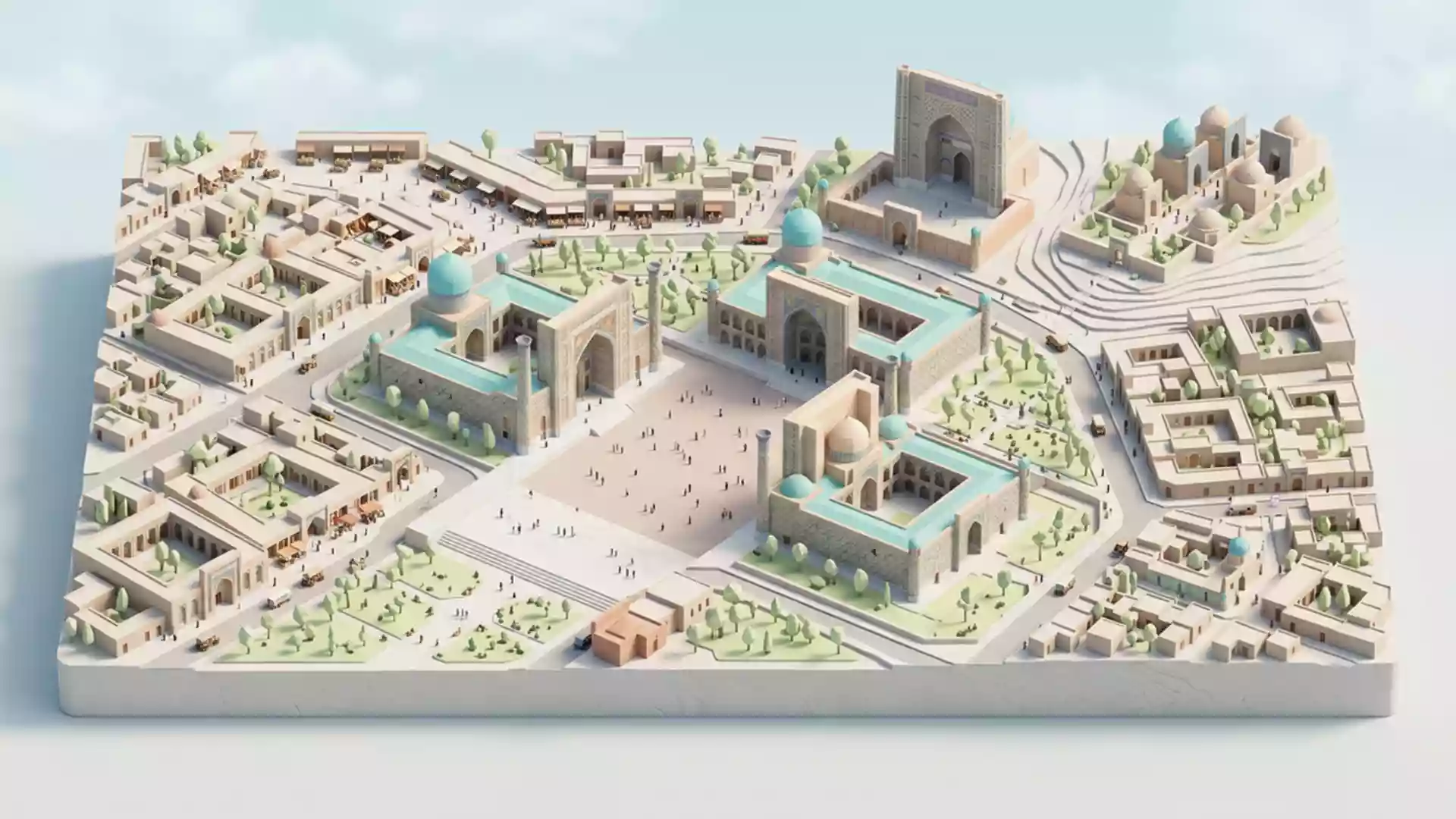
Registon in Samarkand is the historic public square that once formed the ceremonial centre of the Timurid Empire, framed by an ensemble of three monumental madrasas built between the fifteenth and seventeenth centuries. Their vast facades, domes and iwans covered in patterned tiles turn this sandy square into one of Central Asia’s most recognisable architectural settings.
The square where Samarkand gathered
Registon takes its name from Persian, where “registan” means “sandy place”, reflecting the open ground that functioned as Samarkand’s main public square in the Timurid period.registan meaning sandy place In the fifteenth century this was the heart of the city’s political and commercial life, a setting for royal proclamations, assemblies of troops and trade along the Silk Road routes that crossed Central Asia.Registan Square functioned as the center
On three sides of the square rise madrasas, the Islamic colleges whose monumental fronts have turned Registon into a stone and tile theatre of power and scholarship. At ground level the square is a broad paved space, open to the sky and enclosed by the long elevations of these buildings; their main portals face inward, so that the entire composition reads as a single designed ensemble.ensemble of three madrasas
Ulugh Beg Madrasa: Timurid science in tiled brick
The oldest of the three buildings at Registon is the Ulugh Beg Madrasa, completed between 1417 and 1420 under the rule of Mirzo Ulugh Beg, the astronomer-king and grandson of Amir Timur.Ulugh Beg Madrasa commissioned in 1420 Its main portal rises above the square in a tall rectilinear frame filled with dense geometric tilework in turquoise and deep blue, bordered by flanking towers and backed by a courtyard plan that organised teaching and residence around arcaded sides.Ulugh Beg Madrassah 1417-1420
Inside, the madrasa once housed one of the major centres of Islamic learning, where theology, mathematics and astronomy were taught alongside other disciplines.finest Islamic universities anywhere Cells for students line the courtyard, behind pointed arches and ornamental tile panels, and the building’s composition combines Timurid brick construction with glazed ceramic decoration that emphasises symmetry and proportion. The association with Ulugh Beg links Registon not only to political authority but also to the scientific culture that flourished in Samarkand during the fifteenth century.
Sher-Dor and Tilya-Kori: seventeenth-century exuberance
Two centuries after Ulugh Beg, the square’s architectural frame was completed under the rule of Yalangtush Bahadur, when the Sher-Dor Madrasa and Tilya-Kori Madrasa were added during the seventeenth century.Sher-Dor 1619–1636 and Tilya-Kori 1646–1660 Sher-Dor, built between 1619 and 1636, faces Ulugh Beg across the square, repeating the basic portal-and-courtyard scheme but clothing it in more crowded ornament and a celebrated facade programme that includes images of tigers and radiant suns in its tilework.Sherdor Madrassah 1619-1636
Tilya-Kori, whose name means “decorated with gold”, occupies the northern side of Registon and was constructed between 1646 and 1660 as both madrasa and congregational mosque, with a richly gilded interior hall regarded as one of the most opulent spaces in Central Asian architecture.Tilya-Kori contains a gilded interior mosque Together the three madrasas show the progression from Timurid restraint to later seventeenth-century exuberance, their tiled surfaces and domes forming a continuous band of ornament that defines the square and records shifts in style across three centuries.
Registon within Samarkand’s historic centre
Registon stands within the historic core of Samarkand, whose significance as a Silk Road city and Timurid capital is recognised through inscription on the UNESCO World Heritage List as “Samarkand: Crossroad of Cultures”.inscribed within the UNESCO World Heritage property The square lies among older and later quarters that spread across the Zeravshan valley, and forms one of several major monuments that structure the city’s skyline of domes and minarets.
For visitors, Registon offers a concentrated encounter with Central Asian Islamic architecture, where the tiled fronts of three madrasas, their turquoise domes and framed iwans give a sense of both the educational life that once occupied the courtyards and the ceremonial role the space played in the city. It is a place where material, colour and proportion are readable at human scale, whether in the broad sweep of the square or in the smaller details of calligraphic bands and star-shaped patterns in the glazed tiles.
Visiting Registon: what travellers from Western Europe should know
- Registon is situated in central Samarkand in eastern Uzbekistan, and can be reached from other parts of the city by road and by local transport serving the historic centre.
- The square itself is level and open, but exploring the madrasas involves walking through large courtyards and up flights of steps in some interior sections.
- The official language is Uzbek and the currency is the Uzbekistani som.
- Entry requirements depend on your nationality; UK travellers can check the FCDO travel advice at gov.uk/foreign-travel-advice, Irish travellers the Department of Foreign Affairs at ireland.ie.
Searching for Registon on social platforms
These links open searches for Registon on each platform.
Frequently asked questions about Registon
Where is Registon and what kind of place is it?
Registon is the historic central square of Samarkand in eastern Uzbekistan, an open urban space framed by three monumental Islamic madrasas.
What should visitors expect when they come to Registon?
Visitors encounter a broad paved square enclosed by tiled facades, domes and iwans, with access to large courtyards and interior halls within the madrasas.
What makes Registon distinctive among Central Asian sites?
Its ensemble of three madrasas from the fifteenth to seventeenth centuries, with continuous glazed tile decoration and a gilded mosque interior, creates a concentrated display of Central Asian Islamic architecture.