
Registon square in Samarkand and its tiled madrasah ensemble
Published on 09/08/2026 at 11:12 | Editorial responsibility: Rafael Müller, Editor-in-Chief AD HOC NEWS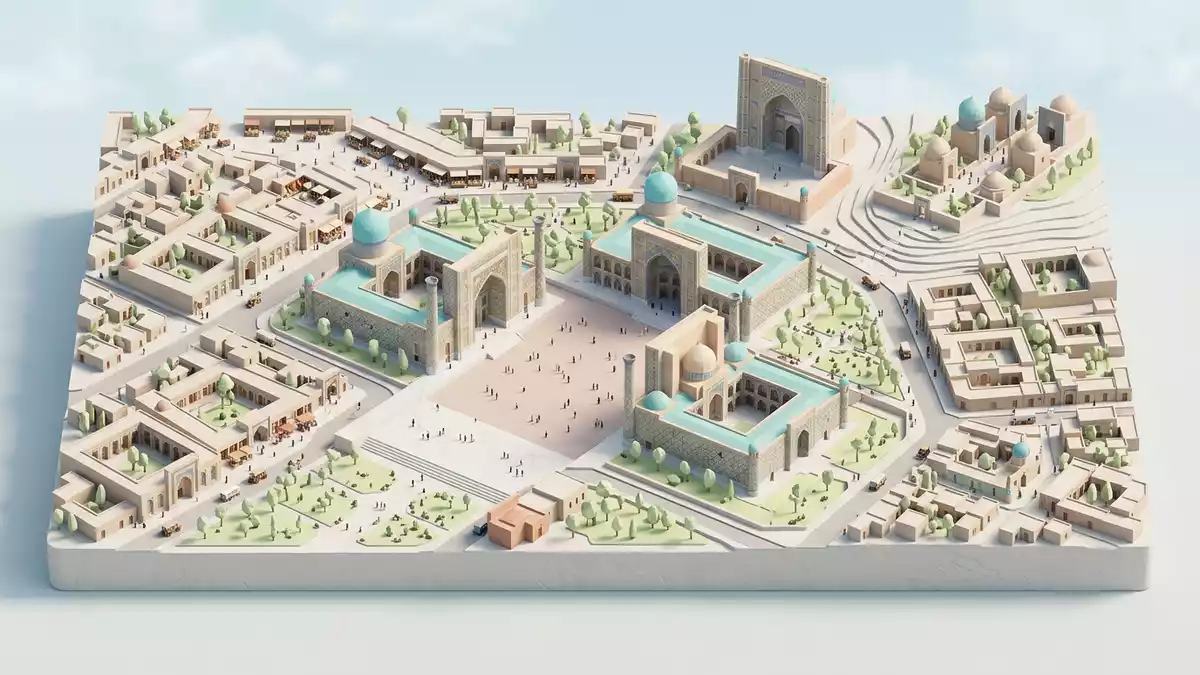
Registon in Samarkand is a historic public square framed by grand madrasahs whose tiled facades have become one of the most recognisable images of Central Asian architecture. Set within the old urban core of Samarkand in Uzbekistan, it forms an ensemble of Islamic colleges from the fifteenth to the seventeenth century that turns an open paved space into an architectural theatre.
A Timurid square defined by three madrasahs
Registon began as the civic centre of Samarkand during the Timurid era, a place where royal proclamations were heard and justice administered against a backdrop of monumental buildings.the civic centre of Samarkand The name “Registon” derives from a Persian term for a sandy place, recalling its origin as a gathering ground rather than a palace courtyard.a Persian term for a sandy place Over time the square was formalised as a brick-paved plaza enclosed on three sides by religious schools, turning the void itself into the focus of the composition.
The oldest of the madrasahs on Registon is the Ulugh Beg Madrasa, commissioned in the early fifteenth century by the Timurid ruler and astronomer Ulugh Beg.Ulugh Beg Madrasa in the fifteenth century Later dynasties added Sher-Dor Madrasa and Tilla-Kari Madrasa in the seventeenth century, so that three separate colleges now face each other across the square.Sher-Dor and Tilla-Kari in the seventeenth century Together they span roughly two centuries of construction and show successive phases of Central Asian Islamic architecture within a single confined space.three distinct madrasas spanning two centuries
Ulugh Beg, Sher-Dor and Tilla-Kari: tiled facades facing a shared space
The Ulugh Beg Madrasa stands on one side of Registon, identifiable by its high entrance portal framed by intricate geometric tilework and flanked by tall minarets.the ensemble of buildings on Registan Square Inside, its plan follows a standard madrasah layout, with teaching rooms and student cells arranged around a courtyard. The building reflects the fifteenth-century Timurid interest in education, astronomy and theology, expressed through a rigorous decorative programme of glazed tiles, inscriptions and patterned brick.
On another side of the square, Sher-Dor Madrasa mirrors the general massing of Ulugh Beg but introduces seventeenth-century tastes in colour and imagery. Its facade combines blue and ochre tiles with stylised animal and sun motifs worked into the ornamental scheme.Sher-Dor Madrassah on Registon Between them, on the third side of Registon, Tilla-Kari Madrasa completes the ensemble with a mosque whose interior surfaces are richly gilded, hence its name meaning “gold-covered”.Tilla-Kari Madrasa with gilded interiors In plan and elevation, these three structures create a kind of architectural horseshoe around the open square, with their portals facing towards the centre.
Registon within Samarkand’s World Heritage landscape
Registon sits within the historic centre of Samarkand, a city long associated with caravan routes across the Silk Road and with the Timurid dynasty of the fourteenth and fifteenth centuries.Registan square as the heart of old Samarkand The square and its madrasahs form part of the ensemble of monuments in Samarkand that were inscribed as a UNESCO World Heritage site in 2001, recognising both the architectural quality of the buildings and their role in the urban history of Central Asia.inscribed on the UNESCO World Heritage List in 2001
Walking across the paved surface of Registon, the geometry of the space becomes clear: three monumental facades frame a central void, with streets opening out from the side without a madrasah. Each building combines structural brick with glazed ceramic tiles in shades of blue, turquoise and white, arranged in calligraphic bands, star patterns and interlaced designs that catch the strong sunlight of Samarkand. The tall portals and slender minarets mark the square as a ceremonial setting, yet the madrasahs themselves historically housed students, teachers and worshippers, tying everyday educational life to the pageantry of urban ritual.
Visiting Registon: what travellers from Western Europe should know
- Registon lies within central Samarkand in eastern Uzbekistan, with the square reached along city streets near Islam Karimov Street and other historic thoroughfares.
- The square surface is paved and largely level, but access into the madrasahs involves steps through their entrance portals and movement across stone and brick floors.
- Samarkand’s climate brings hot summers and cold winters, so conditions on the open square change markedly with the season, while interiors of the madrasahs are enclosed spaces.
- The official language is Uzbek and the currency is the Uzbekistani som.
- Entry requirements depend on your nationality; UK travellers can check the FCDO travel advice at gov.uk/foreign-travel-advice, Irish travellers the Department of Foreign Affairs at ireland.ie.
Searching for Registon on social platforms
These links open searches for Registon on each platform.
Frequently asked questions about Registon
Where is Registon and what kind of place is it?
Registon is a historic public square in the city of Samarkand in Uzbekistan, enclosed on three sides by monumental Islamic madrasahs.
What should visitors expect when they arrive at Registon?
Visitors encounter an open paved plaza surrounded by richly tiled facades, with access into the courtyards and halls of Ulugh Beg, Sher-Dor and Tilla-Kari Madrasas.
What makes Registon distinctive among Central Asian landmarks?
Its combination of three madrasahs from the fifteenth to seventeenth centuries framing a single square creates a rare architectural ensemble within the historic Silk Road cityscape.


